
NUC Approves 13 New Degree Programmes for Nigerian Universities The National Universities Commission (NUC) has announced the approval of 13 new degree programmes across various Nigerian universities, marking another step in its ongoing efforts to expand academic offerings and strengthen the quality of higher education in the country. The approval, which follows a rigorous accreditation
NUC Approves 13 New Degree Programmes for Nigerian Universities
 The National Universities Commission (NUC) has announced the approval of 13 new degree programmes across various Nigerian universities, marking another step in its ongoing efforts to expand academic offerings and strengthen the quality of higher education in the country. The approval, which follows a rigorous accreditation process, is expected to enhance access to quality education and align university curricula with global standards and the evolving needs of the Nigerian economy.
Ooni Of Ife’s 7 Queens In 2025
In a statement released by the commission on Thursday in Abuja, the Acting Executive Secretary of the NUC, Chris Maiyaki, said the newly approved programmes were carefully evaluated and found to meet the minimum academic standards required for operation. He emphasized that the commission remains committed to ensuring that Nigerian universities produce graduates who can compete favorably at home and abroad.
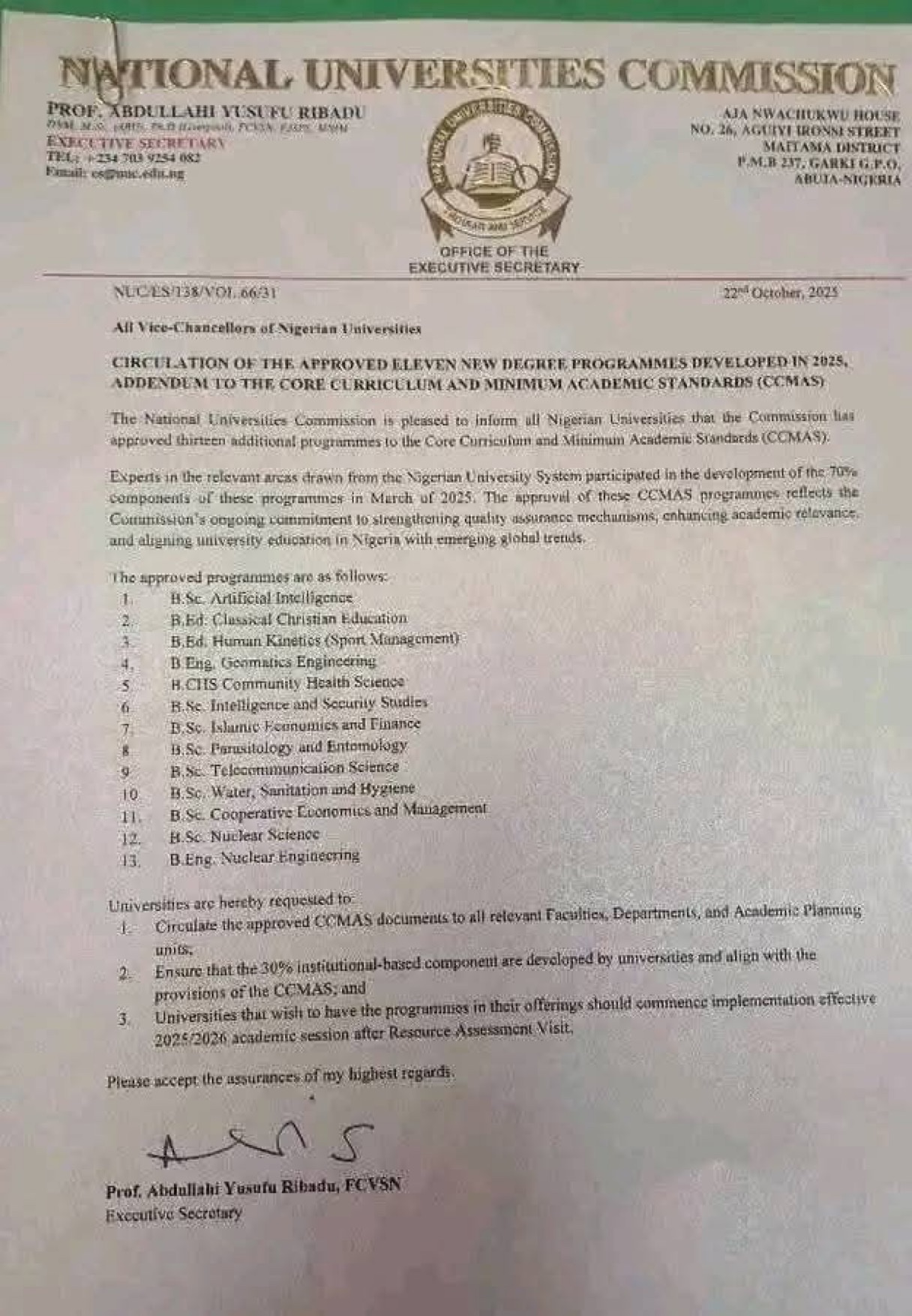 According to the statement, the 13 new programmes cut across both undergraduate and postgraduate levels, covering disciplines in science, technology, health, environmental studies, and management. The new programmes include Artificial Intelligence, Cybersecurity, Data Science, Renewable Energy Engineering, Forensic Science, Public Health, Tourism and Hospitality Management, Film and Multimedia Studies, and Environmental Sustainability, among others.
Maiyaki explained that the approval was granted after a series of resource verification visits by NUC teams to the proposing institutions. During these visits, the commission assessed the adequacy of academic resources such as qualified lecturers, laboratories, libraries, lecture halls, and ICT infrastructure to support effective teaching and learning.
“The National Universities Commission has concluded a comprehensive review of requests from universities seeking to introduce new academic programmes. After due diligence, resource verification, and accreditation, we are pleased to announce that 13 new programmes have been approved for commencement in the 2025/2026 academic session,” the statement read.
He added that universities seeking to establish new programmes must demonstrate their capacity to deliver high-quality training and research, particularly in specialized and emerging fields. “The commission’s mandate is not just to expand access to education but to ensure that the quality of instruction meets the expectations of both national development goals and international benchmarks,” Maiyaki stated.
Expanding Academic Frontiers
The new approvals come at a time when Nigeria’s tertiary education system is under pressure to accommodate the growing population of students seeking university admission. According to recent statistics, over 1.9 million candidates applied for admission into universities in the 2024 Unified Tertiary Matriculation Examination (UTME), yet fewer than 30 percent secured placements due to limited spaces and programme options.
By approving new degree programmes, the NUC aims to diversify academic offerings and create more opportunities for students to study contemporary fields that reflect the realities of the modern world. Courses such as Artificial Intelligence and Data Science, for instance, are designed to prepare Nigerian graduates for roles in the fast-growing digital economy, while Renewable Energy Engineering and Environmental Sustainability focus on addressing global challenges such as climate change and energy transition.
Stakeholders React
The approval has been welcomed by stakeholders in the education sector. The Committee of Vice-Chancellors of Nigerian Universities (CVCNU) described the development as timely and forward-looking. Professor Yakubu Ochefu, the Secretary-General of the CVCNU, commended the NUC for its strategic direction, saying the addition of these programmes will help Nigerian universities stay competitive and relevant.
“We must acknowledge the NUC’s foresight in expanding the academic landscape to include disciplines that are shaping the global economy. Nigerian universities must not lag behind in producing experts in Artificial Intelligence, Robotics, Renewable Energy, and Cybersecurity,” Ochefu said.
Similarly, the Academic Staff Union of Universities (ASUU) also expressed cautious optimism, urging the commission to ensure that the approved programmes are adequately funded and staffed. ASUU President, Prof. Emmanuel Osodeke, noted that while expanding academic offerings is commendable, “quality must not be sacrificed for quantity.” He added that government and university administrators must invest in infrastructure, research facilities, and staff development to sustain the new programmes.
Strengthening Quality Assurance
The NUC has also reiterated that quality assurance remains at the heart of its mandate. It stated that universities offering any of the newly approved programmes will be closely monitored and subject to periodic accreditation exercises. Any institution found to be running substandard programmes or operating without approval would face sanctions, including withdrawal of accreditation and closure of the affected department.
Maiyaki emphasized that the commission would continue to encourage innovation in curriculum design and promote research partnerships with industry players. He noted that the goal is to produce graduates who are not only employable but also capable of creating jobs and driving technological advancement.
“The NUC is determined to reposition the Nigerian university system to serve as a catalyst for national development,” he said. “The approval of these 13 new programmes is part of our broader vision to align academic training with the Fourth Industrial Revolution and the Sustainable Development Goals.”
Conclusion
The approval of 13 new degree programmes by the National Universities Commission marks a positive stride in Nigeria’s higher education reform agenda. As universities prepare to launch these programmes in the 2025/2026 academic session, the focus now shifts to implementation — ensuring that the right infrastructure, faculty, and resources are in place to deliver quality education.
If properly executed, these programmes could open new pathways for innovation, research, and national development, positioning Nigerian universities as competitive players in the global knowledge economy.
















Leave a Comment
Your email address will not be published. Required fields are marked with *