
NUPENG Warned Against Fuel Strike Threats Amid Clash with Dangote Refinery Nigeria faces renewed fears of fuel scarcity as tensions escalate between the Nigeria Union of Petroleum and Natural Gas Workers (NUPENG) and the Dangote Refinery. The labour union has ordered its Petroleum Tanker Drivers (PTD) branch to stop lifting petroleum products from Dangote depots
NUPENG Warned Against Fuel Strike Threats Amid Clash with Dangote Refinery
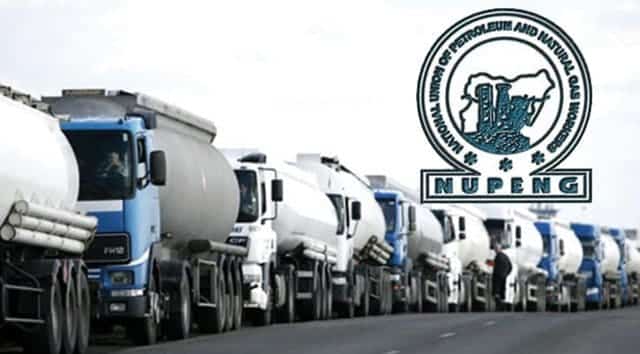
Nigeria faces renewed fears of fuel scarcity as tensions escalate between the Nigeria Union of Petroleum and Natural Gas Workers (NUPENG) and the Dangote Refinery. The labour union has ordered its Petroleum Tanker Drivers (PTD) branch to stop lifting petroleum products from Dangote depots beginning Monday, September 8, in protest against alleged anti-labour practices.
At the heart of the confrontation is the refinery’s reported stance that drivers recruited for its fleet of 10,000 compressed natural gas (CNG) trucks will not be permitted to join any trade union. NUPENG has described this as “an affront on the right of association guaranteed under the 1999 Constitution and a breach of international labour laws.”
The development has sparked heated reactions, with critics warning the union not to plunge the country into fresh chaos by weaponizing strikes.
Pressure Mounts On Zamfara Governor Over Banditry Remarks
NUPENG Accuses Dangote of Anti-Union Practices
In a statement jointly signed by NUPENG President Williams Akporeha and General Secretary Afolabi Olawale, the union alleged that Dangote Refinery was engaging in anti-labour practices that threatened the survival and livelihoods of its members.
The statement accused the refinery of deliberately undermining the rights of workers to freely associate, adding that such policies were incompatible with Nigeria’s democratic and international labour commitments.
“The denial of trade union participation is not only unconstitutional but also exposes thousands of workers to exploitation,” NUPENG stated. “This refinery, built with Nigerian sweat and resources, cannot be allowed to become a centre for the suppression of workers’ rights.”
Civil Society Group Pushes Back
However, in a strong rebuttal issued on Saturday, George Priye West, president of the citizens-led group Mass Action Against Economic Saboteurs (MAAES), warned that NUPENG’s threats risk destabilising the country.
According to West, union membership is a matter of personal choice, not compulsion, and any attempt to shut down petroleum distribution on such grounds amounts to sabotage.
“The Supreme Court has already affirmed that the question of union membership is a fundamental right of the individuals. No worker can be forced to join a union against their will. Any industrial action called on such flimsy grounds is not about labour rights but a reckless attempt to destabilise Nigeria and inflict suffering on millions of ordinary citizens,” West declared.
The group dismissed NUPENG’s accusations against the Dangote Refinery as baseless, portraying them as part of a larger campaign to frustrate Nigeria’s most ambitious private-sector project.
Dangote Refinery Seen as National Asset
West defended the Dangote Refinery as a transformational $20 billion investment that has created jobs, strengthened local capacity, and positioned Nigeria to reduce dependence on imported petroleum products.
“Dangote Refinery is not enslaving anyone; it is creating thousands of decent jobs, strengthening local capacity, and providing Nigerians with a long-awaited solution to fuel import dependence. For anyone to describe it as a threat is nothing short of mischief,” he said.
The group described the refinery as a beacon of hope, stressing that attempts to undermine it through strikes or industrial actions should be viewed as sabotage.
“It is shameful that the same unions that watched over the collapse of Nigeria’s government-owned refineries are now plotting against the private refinery that has given the nation renewed hope. Nigerians will not allow this sabotage. We will rise to defend Dangote Refinery at all times, because it represents progress, jobs, and self-sufficiency,” West maintained.
Warning Against Fuel Scarcity and Instability
With the possibility of disruptions looming, the MAAES called on the federal government and security agencies to adopt firm measures to prevent any strike that could destabilise petroleum product distribution nationwide.
“Any attempt by NUPENG or any group to declare a strike on this hollow basis must be treated as economic sabotage and even as an act of terrorism against the people,” West insisted.
He added that Nigerians, already burdened by economic pressures, could not afford another round of artificial fuel scarcity triggered by power struggles between labour unions and private enterprises.
“The government must not fold its arms while a few vested interests attempt to blackmail the nation into chaos. Nigerians deserve stability, not manufactured scarcity,” he said.
Public Urged to Remain Calm
The group further urged Nigerians to ignore threats of scarcity and continue their daily activities without fear of disruption.
“We call on the public to remain calm and resolute. This is not a struggle for ordinary workers but a fight by entrenched interests who cannot stomach competition. Nigerians should go about their businesses and not allow themselves to be misled by this campaign of destabilisation,” the statement read.
West emphasised that MAAES is not opposed to unionism but stressed that workers must retain the freedom to choose whether or not to belong to a union.
“The right to join a union is sacred, but so too is the right not to join one. The constitution protects both rights equally. What NUPENG seeks to do is force people into its fold to preserve its relevance. That is not democracy. That is tyranny, and it will not stand,” West declared.
Rising Tensions Ahead of Deadline
As the September 8 deadline for the suspension of fuel lifting from Dangote depots approaches, Nigerians brace for potential disruptions. While NUPENG frames its position as a defence of labour rights, critics see it as an overreach that risks inflicting unnecessary hardship on citizens.
Observers warn that unless the government steps in decisively, the standoff could escalate into a nationwide crisis, threatening economic stability and public order.
For now, Nigerians remain caught between a powerful labour union and a private conglomerate whose refinery has become both a symbol of hope and a target of controversy. The coming days will determine whether dialogue or confrontation defines the nation’s path forward.












Leave a Comment
Your email address will not be published. Required fields are marked with *