
DSS Arraigns Two Senior Ansaru Commanders on 32-Count Terrorism Charge The Department of State Services (DSS) has arraigned two senior commanders of Ansaru, an Al-Qaeda-linked terrorist organization, on a 32-count charge bordering on terrorism. The high-profile suspects—Mahmud Usman, also known by multiple aliases including Abu Bara’a, Abbas, and Mukhtar, who styled himself as the “Emir of
DSS Arraigns Two Senior Ansaru Commanders on 32-Count Terrorism Charge
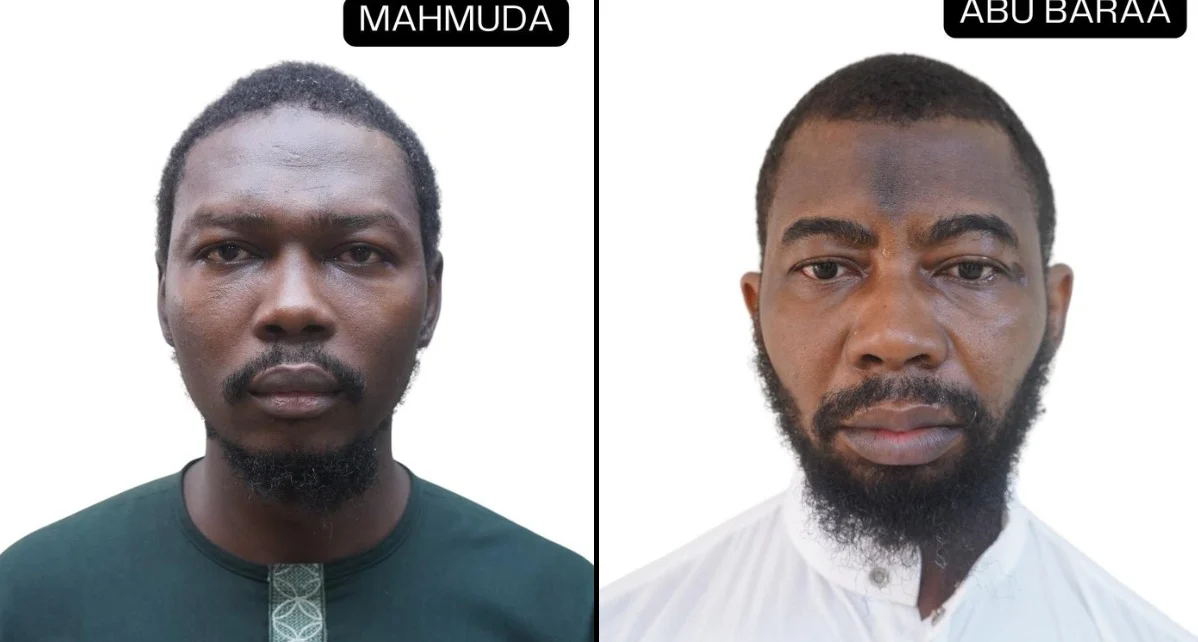
The Department of State Services (DSS) has arraigned two senior commanders of Ansaru, an Al-Qaeda-linked terrorist organization, on a 32-count charge bordering on terrorism. The high-profile suspects—Mahmud Usman, also known by multiple aliases including Abu Bara’a, Abbas, and Mukhtar, who styled himself as the “Emir of Ansaru,” and Mahmud al-Nigeri, popularly called Malam Mamuda, his deputy and chief of staff—appeared before Justice Emeka Nwite on Thursday in Abuja.
The two men were recently captured in coordinated security operations and are now facing trial for allegedly leading and financing a terrorist organisation, recruiting fighters, coordinating attacks, and overseeing violent crimes across Nigeria.
Federal Government Reports 80% Implementation Of 2024 Budget, Focus On Grassroots Projects
Terror Network Leaders in the Dock
According to the DSS charge sheet, the defendants played central roles in Ansaru’s terror campaign in Nigeria, serving as operational leaders and recruiters. Abu Bara, identified as the group’s emir, was accused of establishing sleeper cells in different regions of the country, orchestrating high-profile kidnappings, and using ransom payments and armed robberies to bankroll the sect’s activities.
His deputy, Malam Mamuda, allegedly provided specialised training for fighters. Intelligence reports indicate that between 2013 and 2015, Mamuda trained in Libya under foreign jihadist instructors from Egypt, Tunisia, and Algeria. His expertise included advanced weapons handling and the fabrication of improvised explosive devices (IEDs), which were later deployed in attacks against military and civilian targets.
Links to High-Profile Attacks
Ansaru, a breakaway faction of Boko Haram with allegiance to Al-Qaeda in the Islamic Maghreb (AQIM), has been implicated in several high-profile attacks in Nigeria. The DSS told the court that the two defendants were central to many of these incidents.
In July 2022, Ansaru militants coordinated the deadly attack on the Kuje prison in Abuja, leading to the escape of over 600 inmates, including 64 Boko Haram suspects. The jailbreak sent shockwaves across the country and further exposed the scale of Nigeria’s security challenges.
The militants were also linked to an assault on the Nigerian Army’s Wawa Cantonment in Kainji, Niger State, in 2022. The raid reportedly caused multiple casualties and demonstrated the group’s ability to stage complex operations against fortified military installations.
Beyond these attacks, the group has been tied to multiple kidnappings. National Security Adviser (NSA) Nuhu Ribadu disclosed that the suspects were named in the 2013 abduction of French engineer Francis Collomp in Katsina State, an operation that drew international condemnation. They were also fingered in the 2019 kidnapping of Musa Uba (Magajin Garin Daura), a senior traditional ruler and in-law to President Muhammadu Buhari, as well as the abduction of the Emir of Wawa.
NSA Describes Arrest as “Turning Point”
NSA Ribadu hailed the arrest of Abu Bara and Mamuda as a breakthrough in Nigeria’s counterterrorism campaign. He described Abu Bara as the “coordinator of terrorist sleeper cells across Nigeria and the mastermind of several high-profile kidnappings and armed robberies used to fund terrorism.”
On Mamuda, Ribadu highlighted his training abroad and his role as a tactical instructor for Ansaru, noting that his skills in IED construction and guerrilla warfare posed a grave threat to Nigeria’s security.
“Their arrest marks a turning point in our fight against terrorism. They were not only leaders of Ansaru in Nigeria but also maintained cross-border networks with jihadist groups in Mali, Niger, and Burkina Faso,” Ribadu said.
He added that the arrests have disrupted terror financing pipelines and recruitment channels that had strengthened Ansaru’s resilience over the years.
Trial and Implications
The arraignment before Justice Nwite signals the beginning of a trial that could expose more details about the structure and financing of Ansaru’s terror activities. The 32-count charge reportedly covers a wide range of offences, from conspiracy to commit terrorism, to the procurement of arms, training of militants, and direct involvement in attacks on state institutions.
Legal experts say the case will be closely watched both locally and internationally, given the global interest in combating Al-Qaeda-linked networks in West Africa. If convicted, the defendants could face life imprisonment or even the death penalty, depending on the weight of evidence and the provisions of Nigeria’s anti-terrorism laws.
Broader Security Context
The prosecution of Abu Bara and Mamuda comes at a time when Nigeria is intensifying efforts to degrade terror groups operating within and around its borders. The country faces multiple security threats — from Boko Haram and Islamic State West Africa Province (ISWAP) in the northeast, to Ansaru in the northwest, and various bandit gangs that often collaborate with extremist groups.
Analysts believe the dismantling of Ansaru’s leadership structure could weaken the group’s operational capacity. However, they caution that sleeper cells and foreign-backed jihadist networks in the Sahel still pose a serious risk.
For Nigerians, the arrest and arraignment of these high-ranking terrorists may provide a measure of relief, particularly for communities ravaged by kidnappings, ambushes, and attacks linked to Ansaru. The government, however, faces the dual challenge of ensuring justice is served while preventing retaliatory strikes from remnants of the group.
As the trial proceeds, the case is expected to shed light on the complex web of terror financing, cross-border alliances, and the resilience of extremist ideologies in West Africa. What is clear is that the capture of Abu Bara and Mamuda represents a significant blow to Ansaru — one that could tilt the balance in Nigeria’s long and difficult war against terrorism.















Leave a Comment
Your email address will not be published. Required fields are marked with *