
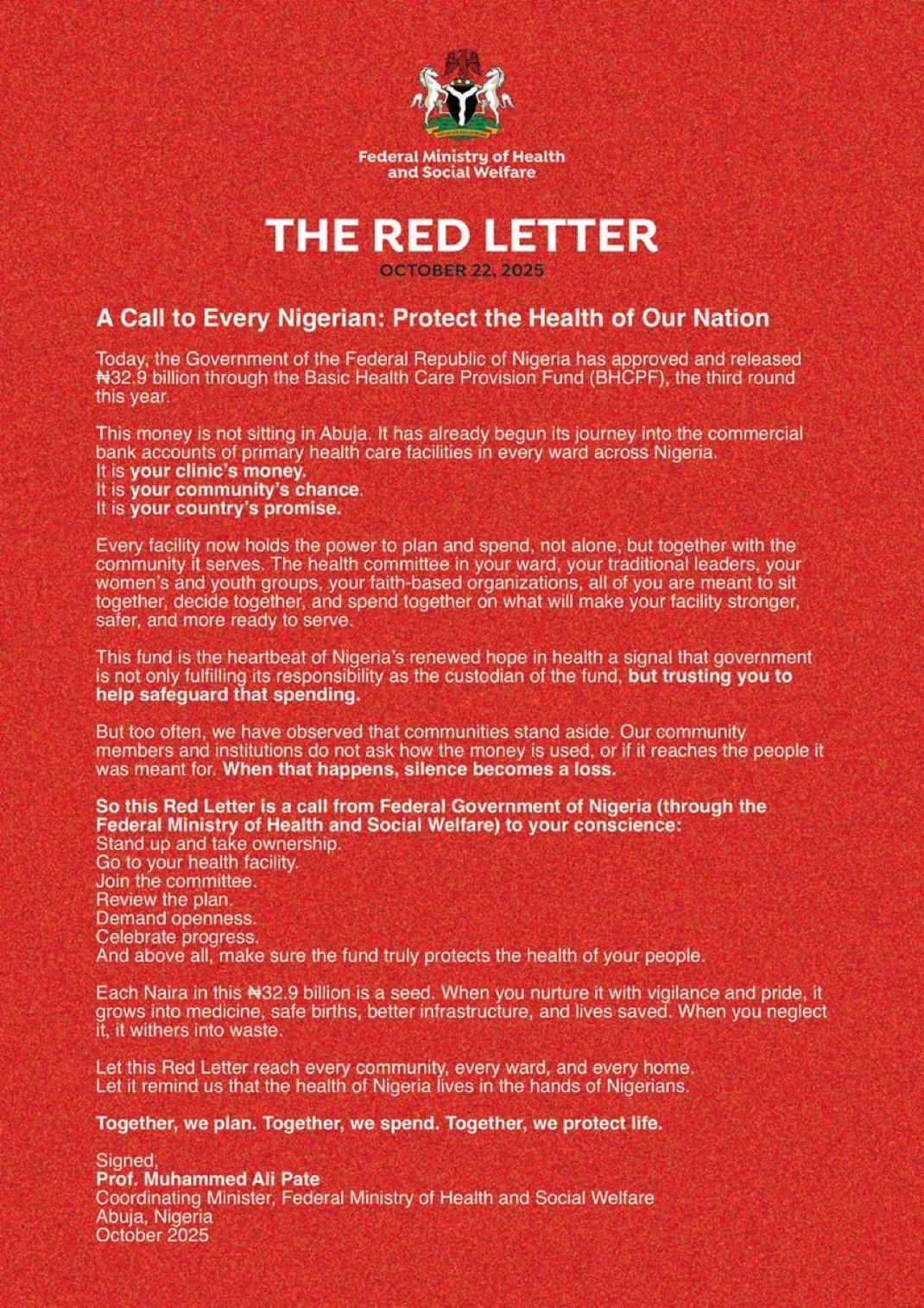
Federal Government Issues “Red Letter” to Nigerians on Funds Released to Primary Health Centres The Federal Government, through the Federal Ministry of Health and Social Welfare, has issued an open “Red Letter” to all Nigerians, raising alarm over the misuse, mismanagement, and diversion of funds released for the revitalization and maintenance of Primary Health Centres
Federal Government Issues “Red Letter” to Nigerians on Funds Released to Primary Health Centres
The Federal Government, through the Federal Ministry of Health and Social Welfare, has issued an open “Red Letter” to all Nigerians, raising alarm over the misuse, mismanagement, and diversion of funds released for the revitalization and maintenance of Primary Health Centres (PHCs) across the country.
In the strongly worded statement signed by the Coordinating Minister of Health and Social Welfare, Professor Muhammad Ali Pate, and made public on Wednesday, the ministry expressed deep concern that despite the federal government’s consistent release of funds to states and local government authorities for the strengthening of PHCs, the expected improvements in healthcare delivery at the grassroots level have not been fully realized.
The “Red Letter,” described as an urgent call to action, emphasized transparency, accountability, and citizen participation in monitoring health projects. The government said it was compelled to issue the public notice after discovering glaring discrepancies between funds disbursed to states and the quality of health services available in rural and semi-urban communities.
According to the letter, “The Federal Government has, over the past three years, released substantial funds through various channels — including the Basic Health Care Provision Fund (BHCPF), donor-supported initiatives, and intervention grants — intended to improve the functionality of over 10,000 Primary Health Centres nationwide. Unfortunately, evidence gathered through monitoring reports, audits, and citizen feedback indicates that a significant number of these centres remain in deplorable condition, under-staffed, or non-functional despite the release of funds.”
The ministry noted that some local authorities have failed to utilize the allocated funds for their intended purposes, with reports of abandoned facilities, poor record-keeping, and procurement irregularities. “This situation is unacceptable and represents a betrayal of the government’s commitment to achieving universal health coverage for all Nigerians,” the letter stated.
To address the problem, the Ministry of Health announced a comprehensive audit of all Primary Health Centres that received funding between 2021 and 2025. The audit, to be jointly conducted by the National Primary Health Care Development Agency (NPHCDA), the Office of the Accountant General of the Federation, and independent civil society monitors, aims to identify leakages, recover diverted funds, and ensure that future disbursements are strictly tied to performance-based outcomes.
The government also directed state ministries of health to publish quarterly financial statements showing how PHC funds are spent at the state and local government levels. “From this point forward, transparency will be the rule, not the exception. Every kobo released for health must be traced to the last mile — to the clinic, to the medicine shelf, and to the health worker providing care,” the letter added.
In addition, Professor Pate urged Nigerians to play an active role in safeguarding the nation’s health investments. “We are calling on community leaders, traditional rulers, and ordinary citizens to help us protect what belongs to them. Report any irregularities, ghost projects, or cases of corruption in the management of Primary Health Centres to the appropriate authorities. Health is a collective responsibility, and silence in the face of misuse only deepens our national health crisis,” the letter emphasized.
The “Red Letter” also outlined key reforms being implemented by the federal government to strengthen the PHC system. These include the recruitment and retraining of 120,000 frontline health workers over the next two years, provision of solar power and clean water to rural health facilities, digital tracking of health expenditures, and the establishment of a National PHC Dashboard to monitor real-time performance indicators.
According to the ministry, the government’s goal is to ensure that every ward in Nigeria has at least one fully functional and adequately staffed PHC by 2027. “No Nigerian should have to travel more than five kilometers to access essential healthcare. That is the standard we are working toward, and we expect full cooperation from all tiers of government,” the statement said.
The letter also expressed gratitude to development partners such as the World Bank, UNICEF, and the Bill & Melinda Gates Foundation for their continued technical and financial support toward strengthening Nigeria’s health system. However, it stressed that the ultimate responsibility for the success or failure of PHC reforms rests on Nigerians themselves.
“This letter is not merely a warning but a moral appeal to our collective conscience. Health funds are not political rewards. They are sacred trusts meant to save lives — mothers during childbirth, children from preventable diseases, and communities from avoidable suffering,” the government reiterated.
The Federal Ministry of Health further disclosed that it will soon launch a toll-free hotline and an online reporting platform to enable Nigerians to submit complaints or evidence of misuse of PHC funds anonymously. Whistleblowers, the ministry added, will be protected under the existing whistleblower protection policy.
Meanwhile, reactions have begun to trail the open letter across social and traditional media. Civil society organizations such as BudgIT and the Health Reform Foundation of Nigeria (HERFON) commended the federal government for its boldness in confronting the systemic issues affecting PHC financing. They, however, urged the government to ensure that investigations lead to concrete sanctions, not mere rhetoric.
As the government prepares to roll out the next phase of PHC revitalization under the Renewed Hope Health Agenda, the “Red Letter” stands as both a warning and a wake-up call — that Nigeria’s journey toward universal health care cannot succeed without transparency, accountability, and collective vigilance.
In the words of the Minister, “The era of business as usual is over. Every naira released for healthcare must translate into healthier lives for Nigerians. Anything less is a disservice to our nation.”

















Leave a Comment
Your email address will not be published. Required fields are marked with *