
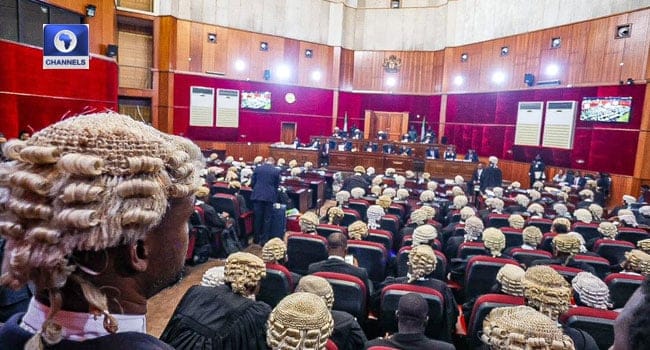
FCT High Court Orders Benue Election Tribunal to Sit in Abuja Due to Security Concerns Tribunal to Hear Election Petitions Away from Benue Amidst Rising Insecurity The High Court of the Federal Capital Territory (FCT) has ordered the Benue State Local Government Election Petitions Tribunal to conduct its proceedings in Abuja, citing security concerns in
FCT High Court Orders Benue Election Tribunal to Sit in Abuja Due to Security Concerns
Tribunal to Hear Election Petitions Away from Benue Amidst Rising Insecurity
The High Court of the Federal Capital Territory (FCT) has ordered the Benue State Local Government Election Petitions Tribunal to conduct its proceedings in Abuja, citing security concerns in Benue State. The tribunal will now hear all petitions arising from the October 5, 2024 local government elections at the Nigerian Bar Association (NBA) House in Abuja.
The decision was made by Justice M. M. Adamu, who granted an ex-parte application filed by a faction of the All Progressives Congress (APC) in Benue State. The application was presented by Attorney Anderson Asemota on behalf of APC Chairman Augustine Agada, Publicity Secretary Daniel Ihonmu, and the APC itself.
House Of Representatives Passes Landmark Tax Reform Bills With Major Exemptions
Court Bars Tribunal from Relocating to Benue
Justice Adamu’s ruling specifically prohibits the Local Government Petition Tribunal Chairmen in Benue’s three zones from relocating to Makurdi, the state capital, to conduct hearings. Similarly, the Local Government Appeal Tribunal has been barred from transferring its sittings from Abuja to Benue State.
To ensure the smooth conduct of proceedings, the court has directed the Inspector-General of Police (IGP) and the Nigeria Police Force (NPF) to provide adequate security for the tribunal’s sessions in Abuja.
An enrolled court order obtained by Daily Post outlined the key directives:
- The tribunal and appeal tribunal must continue hearings at the NBA House in Abuja until further notice.
- A restraining order prevents any attempt to relocate the tribunal to Benue State before petitions are fully resolved.
- The Nigeria Police Force is mandated to provide security cover for tribunal members and petitioners throughout the proceedings in Abuja.
Legal Arguments Supporting the Abuja Relocation
Attorney Anderson Asemota, representing the applicants, emphasized the urgency of the court’s intervention due to time constraints and security threats in Benue.
He argued that:
- The tribunal has a strict 180-day timeframe to complete its work, as stipulated by the Nigerian Constitution.
- Any delay caused by a relocation to Benue could lead to an infringement on the petitioners’ constitutional rights.
- Security threats in Benue would make it impossible for tribunal members to safely conduct proceedings.
‘They Cannot Return to Egypt’ – Asemota Reacts
Reacting to the ruling, Asemota defended the necessity of keeping the tribunal in Abuja. Using a biblical metaphor, he likened a return to Benue to going back to ‘Egypt’, a place of hardship and uncertainty.
“The order we got, basically, is to say that the tribunal has the power to continue holding its proceedings here in Abuja. The court directed that they should go ahead and conduct their proceedings without relocating,” Asemota stated.
“They cannot go back to ‘Egypt’ (Benue) because if they return, the proceedings cannot be concluded. The petitioners’ constitutional rights would be completely infringed upon.”
Asemota further explained that Section 36 of the Nigerian Constitution guarantees every petitioner the right to seek legal redress, and any attempt to delay the tribunal’s work could deny them justice.
Tribunal’s Time Limit Nearing Expiration
One of the primary concerns raised during the court session was the approaching 180-day deadline for the tribunal to resolve election disputes.
“By the 14th of next month, the 180 days would have expired completely. That is why the court made this order—to salvage the situation and ensure that none of the petitioners is denied his or her constitutional rights,” Asemota explained.
He stressed that election tribunals do not have unlimited time to complete their proceedings, unlike other civil or criminal cases. The court’s ruling ensures that the tribunal can conclude its work within the legally required timeframe.
Implications of the Court’s Decision
The FCT High Court’s ruling sets a legal precedent regarding the handling of election petitions in states facing security challenges. The relocation of the tribunal to Abuja highlights the increasing concerns over insecurity in parts of Nigeria, where violence has disrupted governance and judicial processes.
This ruling:
- Ensures the safety of tribunal members and petitioners by keeping proceedings in a secure location.
- Prevents delays that could affect the legal outcome of election petitions.
- Upholds the constitutional rights of petitioners, ensuring they receive a fair hearing within the required timeframe.
Next Steps
With this ruling in place, the Benue State Local Government Election Petitions Tribunal and Appeal Tribunal will continue their sessions at the NBA House in Abuja. Meanwhile, security arrangements are expected to be tightened to ensure that the tribunal operates without external interference.
The case remains a significant test of how Nigeria’s legal system navigates election disputes in the face of security threats. The final resolution of the petitions will likely influence future judicial decisions regarding tribunal relocations.















Leave a Comment
Your email address will not be published. Required fields are marked with *