
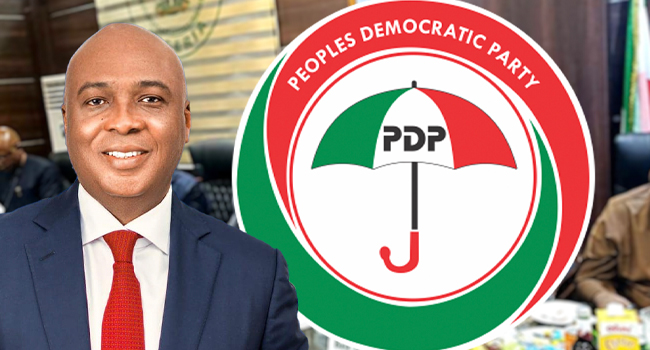
Saraki Responds to PDP Crisis, Pledges to Persuade Wike Back into Reconciliation Talks As tensions continue to mount within the Peoples Democratic Party (PDP), former Senate President Bukola Saraki has stepped forward in a bid to salvage the fragile reconciliation efforts disrupted by the withdrawal of Nyesom Wike, the Minister of the Federal Capital Territory
Saraki Responds to PDP Crisis, Pledges to Persuade Wike Back into Reconciliation Talks
As tensions continue to mount within the Peoples Democratic Party (PDP), former Senate President Bukola Saraki has stepped forward in a bid to salvage the fragile reconciliation efforts disrupted by the withdrawal of Nyesom Wike, the Minister of the Federal Capital Territory (FCT). In a statement delivered through his media aide, Yusuph Olaniyonu, Saraki reassured party members and the public that Wike’s departure from the peace process does not mark a collapse of the initiative but rather a signal that more diplomatic work lies ahead.
Wike, a prominent figure in the PDP and member of the G5 governors’ group, recently announced his withdrawal from reconciliation negotiations. In his public declaration, he blamed Oyo State Governor Seyi Makinde and Enugu State Governor Peter Mbah for fuelling the internal crisis. Wike’s explosive statement has since sparked renewed uncertainty about the stability of the party and cast doubt over the upcoming 99th National Executive Committee (NEC) meeting, scheduled for May 27.
ADC Confirms Coalition Talks Nearing Completion Ahead Of 2027 Elections
Reacting to these developments, Saraki played down the severity of Wike’s exit. “Wike’s pulling out of the arrangement is not really a setback as you inferred. It’s just an indication that we still need to do more work and intensify more efforts,” he said.
Saraki Vows to Rescue PDP from Collapse Amid NEC Meeting Uncertainty
The former Senate President, who chairs the PDP Reconciliation Committee, emphasized the delicate nature of conflict mediation, warning against hasty public statements that could inflame tensions further. “A mediator cannot be seen reacting to every issue arising from conflicts otherwise in the process of speaking, he may say something that the various parties may misinterpret,” Olaniyonu stated on behalf of Saraki.
He pointed to Wike’s own remarks acknowledging his prior involvement in the reconciliation process as a positive sign, suggesting the door remains open for future dialogue. “Even in the first statement issued by Wike, you can see where he referred to his position in the reconciliation committee,” Saraki noted, indicating that the bridge to peace had not been completely burned.
More urgently, Saraki sounded the alarm on the implications of a crumbling PDP for Nigeria’s political future. With the Alliance for Democracy (AD) and the All Peoples Party (APP)—two other founding parties of Nigeria’s current democratic era—already defunct, Saraki stressed the PDP’s importance as the last-standing legacy party. “The alternative to PDP is one-party state. The PDP goes beyond party. That is the only legacy party that is remaining,” he warned. “Allowing it to die will be a major setback for democracy.”
Amid escalating concerns, the PDP’s Board of Trustees reportedly summoned an emergency meeting in Abuja on Monday to assess the threat posed by the growing crisis. Party insiders told Punch that the uncertainty surrounding the NEC meeting was too dangerous to ignore, especially with influential members like Wike publicly disassociating themselves from party-led initiatives.
Recognizing the gravity of the situation, Saraki and his reconciliation panel convened an urgent session with major stakeholders on Sunday night. The meeting, sources revealed, aimed to develop a new approach to healing the rift before the scheduled NEC gathering. While details of the discussions remain private, it is believed that Saraki is personally reaching out to Wike in a final effort to persuade him to reconsider his stance.
The party’s leadership is fully aware that any postponement of the NEC meeting could have disastrous consequences for its national outlook. With party members already at odds over legal issues, leadership designations, and zoning disagreements, the failure to hold a unified NEC meeting could signal a complete breakdown of internal structure.
Observers argue that Saraki’s leadership in the reconciliation committee remains one of the few stabilizing elements amid the current chaos. His political experience, coupled with his historical role within the PDP, positions him as a key figure capable of navigating the complexities of party unity.
With time ticking down to the NEC meeting, the stakes have never been higher for Nigeria’s opposition politics. The question now is whether diplomacy, dialogue, and political maturity can prevail over ambition, mistrust, and factionalism.
As the PDP stands at this critical juncture, all eyes remain on Saraki, Wike, and the party’s leadership to steer the party away from the brink and back toward cohesion.









Leave a Comment
Your email address will not be published. Required fields are marked with *