
The Battle of Osogbo: Yoruba Triumph Forged in Courage and Strategy Battle of Osogbo—In the swirling mists of 19th-century Yoruba history, one clash stands out not just for its military implications but for the mythic weight it carries in the hearts of a people: the Battle of Osogbo, fought around 1840. It was a
The Battle of Osogbo: Yoruba Triumph Forged in Courage and Strategy
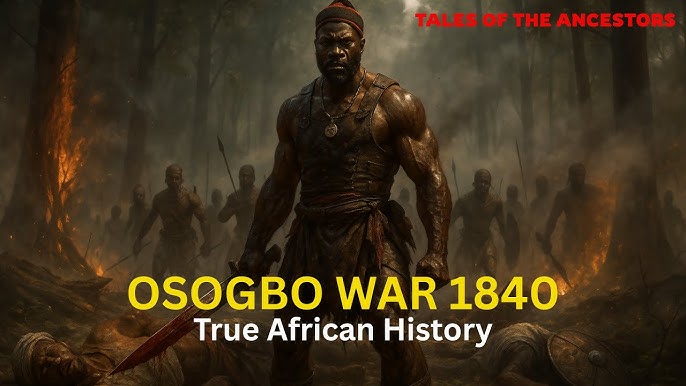
Battle of Osogbo—In the swirling mists of 19th-century Yoruba history, one clash stands out not just for its military implications but for the mythic weight it carries in the hearts of a people: the Battle of Osogbo, fought around 1840. It was a moment where swords clashed not only for land but for identity, where strategy met spirituality, and where a sacred river, a warrior’s courage, and a people’s determination converged to stem the tide of conquest.
It was a defining stand during the Yoruba Revolutionary Wars, marking the moment when the Ilorin Emirate’s jihadist advance was finally halted. What makes this battle particularly unforgettable isn’t just the blood spilled, but the legends born—of gods intervening, muskets roaring, and a river refusing to yield.
Setting the Stage: The Rise of Tension
By the early 19th century, the powerful Oyo Empire had collapsed, sending shockwaves through Yorubaland. Opportunistic forces emerged from the ruins—most notably, the Ilorin Emirate, a Fulani-led Islamic state under the banner of the Sokoto Caliphate. Its cavalry-driven military campaigns had swept through swathes of former Oyo territories, converting or crushing towns in its wake.
Their goal? Nothing less than to dip the Quran into the Atlantic, as oral history proclaims—a symbolic conquest of all southern lands.
Osogbo, situated along the Osun River, was a beacon of Yoruba spirituality and culture. It wasn’t merely a town; it was a shrine, a sanctuary, and a final stand. The town’s double-layered earth walls stood like clenched fists, and its people—descendants of Oyo exiles—refused to be erased.
The Remarkable Story of Luwo Gbagida: The16th, And First Only Female Ooni Of Ile Ife
The Combatants: Friends, Foes, and the Faithful
- Ilorin Emirate: Led by the seasoned Hausa warlord Balogun Ali, the Ilorin forces were a thunderous force of nearly 5,000, composed mostly of cavalry. Fast-moving, spear-wielding, and wrapped in the zeal of jihad, they believed Osogbo would be the next domino to fall. Two Yoruba defectors—Ajikobi and Lateju—served as guides and commanders for Ilorin, their betrayal etched into Yoruba memory.
- Ibadan-Osogbo Alliance: Osogbo’s defenders, though besieged, were far from helpless. Their desperate emissaries reached out to Ibadan, the new military power of the south. Answering the call was Balogun Oderinlo, a legendary general and master of guerrilla tactics. His infantry-heavy army, with fewer horses but superior discipline, included warriors like Ogunmola, who would become folklore heroes. Armed with long swords and European muskets obtained from coastal traders, they turned technological inferiority into tactical brilliance.
Prelude to Bloodshed: Siege and Strategy
In 1840 (or perhaps late 1838, depending on the oral accounts), Ilorin launched its third siege of Osogbo, tightening a stranglehold that pushed the town to the brink. Food ran low. Disease festered. Spirits frayed.
But hope rode in from the south.
Balogun Oderinlo, understanding that surprise and mobility were their only advantages, led his warriors across the Osun River under the cover of night. At a ford now known as Elegba, ferrymen were paid 2,000 cowries, an enormous sum that has since become legendary. Some say the river shimmered unnaturally that night, a sign of Osun’s protection.
Oderinlo’s army arrived just in time, taking position in the thick brushlands of Idi Aka, a strategic quarter near Osogbo’s northwestern wall.
The Battle Unfolds: The Rain, The Fire, The Roar
At first light, the Ilorin army charged. Cavalry surged forward like a tidal wave, hooves pounding the dry earth, dust clouds rising. But hidden in the foliage were Ibadan musketeers. At close range, the muskets barked, felling horses and riders. The cavalry faltered, then chaos erupted.
Oderinlo’s infantry surged forward. What followed was brutal: steel against spear, mud against muscle, scream against silence. The battle seesawed—until legend says the sky darkened suddenly, and rain fell in sheets.
This was no ordinary rain, locals insist. It was the spirit of Osun, the goddess of the river, fighting for her people. The muddy terrain trapped the Ilorin horses, and the cavalry’s mobility—its greatest strength—was gone. Warriors who once trampled enemies now fell, disoriented and mired.
In that moment, Ibadan’s counterattack broke Ilorin’s lines. Balogun Ali fled, his army decimated. Horse skeletons lay scattered for years after, so numerous and sun-bleached that farmers dubbed the fields “the ghost plain.”
Aftermath: Spoils, Shame, and Songs
The victory was total. The siege lifted. Osogbo lived.
The spoils were immense: thousands of horses, captured and devalued so drastically that a single horse sold for one cowrie in Osogbo’s markets. Ibadan warriors scoffed at riding, instead taking horse tails as trophies—symbolic proof that infantry had bested cavalry.
The traitors, Ajikobi and Lateju, were captured. Lateju’s head was paraded in Ibadan as a warning; Ajikobi was handed over to the Alaafin of Oyo, a rare gesture that showed respect for ancestral authority even in a fragmented land.
Legacy: From Battlefield to Festival Ground
The victory at Osogbo didn’t just halt Ilorin—it shifted the entire political axis of Yorubaland.
- Ibadan rose as Yorubaland’s military hegemon, commanding respect and fear.
- Osogbo became a symbol of spiritual victory, its people forever bonded to the goddess Osun.
- The battle ensured the survival of traditional Yoruba religion and identity at a time when both were threatened with erasure.
To this day, Osogbo commemorates the battle at the Osun-Osogbo Festival, held annually in the sacred Osun Grove, now a UNESCO World Heritage Site. Devotees walk barefoot into the forest, reenacting the desperation and deliverance of 1840, while griots sing of Ogunmola’s fearlessness, the rainstorm, and the cowries paid for freedom.
A sacred spring, said to have emerged after the battle to heal wounded warriors, is still visited for its miraculous properties.
Echoes in Modern Nigeria
The tale of Osogbo isn’t confined to the past. It lives on in modern media, memes, music, and movements.
- On X (formerly Twitter), users like @YorubaHistory post, “The day Yorubaland stood firm against empire,” keeping the memory alive.
- In 2023, a Nollywood epic titled “Rain of Osun: The Last Stand” dramatized the battle, with Balogun Oderinlo portrayed by a popular actor, drawing a new generation into the legacy.
- In Osogbo’s schools, students visit battle sites and shrine trails, learning not just who won, but why it mattered.
Why It Still Matters
The Battle of Osogbo was more than a military engagement—it was a spiritual reckoning, a moment where unity overcame betrayal, and where land, identity, and belief converged.
It proved that adaptation—not just brute strength—could turn the tide. European firearms, night maneuvers, divine intervention, and moral clarity formed the ingredients of victory.
As the Yoruba proverb goes, “Odo kii fo fun ode, sugbon o fo fun akinkanju”—“The river does not part for the hunter, but it parts for the brave.”
Osogbo did not part for Ilorin.
But it opened for the brave.















Leave a Comment
Your email address will not be published. Required fields are marked with *