
APC Battles Internal Crisis Across States as Factionalism, Legal Disputes, and Power Struggles Threaten 2027 Strategy Despite holding power at the federal level and controlling 23 states, the All Progressives Congress (APC) is grappling with internal fissures that threaten its stability and cohesion ahead of the 2027 general elections. From Lagos to Rivers, Benue to
APC Battles Internal Crisis Across States as Factionalism, Legal Disputes, and Power Struggles Threaten 2027 Strategy

Despite holding power at the federal level and controlling 23 states, the All Progressives Congress (APC) is grappling with internal fissures that threaten its stability and cohesion ahead of the 2027 general elections. From Lagos to Rivers, Benue to Bayelsa, and Akwa Ibom to Delta, factional battles, leadership tussles, and legal disputes are posing a serious challenge to the ruling party’s grip on political dominance.
While the party’s Director of Publicity, Bala Ibrahim, has downplayed the issues as “resolvable,” branding them as normal political dynamics, party insiders, state stakeholders, and analysts see a much more complex picture that could undermine the APC’s broader electoral agenda if not addressed decisively.
Lagos: Factions Clash as Power Struggle Rages
In Lagos, the party’s historical stronghold and President Bola Tinubu’s political base, the APC is mired in internal warfare. Factions such as the Justice Forum and the Mandate Group have clashed openly, with disputes intensifying over local government primaries and party leadership.
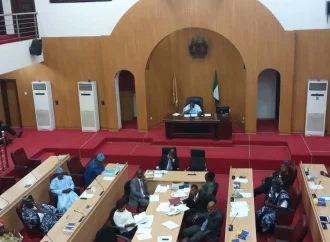
Speaker Mudashiru Obasa narrowly escaped removal earlier in the year during a heated internal crisis in the State Assembly. The situation revealed the deep factional divisions that the Governance Advisory Council (GAC) could not fully resolve. The crisis flared again after the July 12 LG elections, where accusations of candidate imposition led to street protests.
Party chairman Cornelius Ojelabi came under fire from members who accused him of bias and loyalty to the Justice Forum, sidelining Mandate loyalists. Chief Muraina Taiwo, a GAC member, accused him of manipulating council slots in favour of his faction, warning that continued factionalism could cost the party dearly in 2027.
Rivers: Legal Battles and Wike’s Influence Fuel Tensions
In Rivers State, the situation is even more precarious. The long-standing rivalry between former Minister Rotimi Amaechi and Tony Okocha, backed by Minister Nyesom Wike, has splintered the party. Although a state High Court reinstated Emeke Beke as chairman, the national party continues to recognise Tony Okocha, igniting a standoff that has divided the base.
Beke accuses Wike of manipulating both the APC and PDP structures to install loyalists for the August 30 LG polls, undermining democracy and creating a “one-candidate” system across both major parties.
Beke’s visit to newly appointed APC National Chairman, Prof. Nentawe Yilwatda, yielded little, with the national secretariat reaffirming Okocha’s chairmanship. The situation has escalated into a full-blown legal and political crisis.
Benue: Governor vs SGF in a Test of Power
In Benue, the rift between Governor Hyacinth Alia and Secretary to the Government of the Federation, George Akume, has birthed two parallel leaderships within the party. While Benjamin Omale leads a caretaker committee loyal to Alia, Austin Agada, backed by Akume, heads a rival state executive committee.
President Tinubu’s recent appeal for reconciliation after visiting the state has yet to yield results. The Agada-led group, citing a state High Court ruling, insists it remains the legitimate leadership. Efforts to reconcile the factions appear cosmetic, with no concrete unity talks held.
Akwa Ibom: Old vs. New Members Tussle for Control
In Akwa Ibom, the APC is divided between long-time members and new defectors who came into the party with a recent gubernatorial defection. Concerns have grown over alleged plans to offer automatic tickets to the newcomers, sidelining core party loyalists.
One party leader warned that such actions could provoke mass defections. “This merger feels more like an acquisition,” he said, accusing new entrants of dominating congress preparations and positioning themselves for total control.
Bayelsa: Suspensions, Court Cases, and Leadership Rift
The Bayelsa APC is also embroiled in tension stemming from a feud between Senator Heineken Lokpobiri and former Governor Timipre Sylva. Lokpobiri’s suspension by several LG chapters, citing anti-party activities, sparked controversy. Despite attempts to freeze the action, local executives have taken the matter to court.
Some members want Lokpobiri to lead the party due to his federal appointment, while others insist Sylva retains more local influence. The infighting has made it difficult for the party to present a unified front.
Delta: Omo-Agege vs. Oborevwori – Power Shift Sparks Tensions
The defection of Governor Sheriff Oborevwori from the PDP to the APC in April 2025 has dramatically altered Delta’s political landscape. Though welcomed by the national leadership, the move has unsettled Senator Ovie Omo-Agege, a key APC leader in the state.
A pressure group loyal to Omo-Agege has accused the national leadership of sidelining long-term party members in favour of the new entrants. In an open letter to President Tinubu, the group described the defection as a “hostile takeover,” warning of potential backlash and a threat to party cohesion.
CPC Bloc Discontent and Northern Concerns
Following former President Muhammadu Buhari’s death, the influence of the defunct Congress for Progressive Change (CPC) bloc has diminished. Some of Buhari’s former loyalists have threatened to exit the party, alleging marginalisation. However, prominent figures like Prof. Adebayo Shittu have dismissed such threats, claiming CPC loyalists remain committed to Tinubu’s 2027 re-election.
Bright Spots: Edo and Gombe Defy the Trend
While most APC chapters are plagued by infighting, Edo and Gombe States are outliers. In Edo, recent defections from the PDP have boosted APC numbers in the state assembly, with Speaker Blessing Agbebaku joining the party and retaining his position.
In Gombe, party leaders insist the chapter remains unified. APC chieftain Sabo Zanna described claims of a rift as “mischievous,” affirming support for both President Tinubu and Vice President Shettima.
A Party Under Pressure
The APC, while confident in its ability to manage internal issues, faces mounting challenges across critical states. Factionalism, leadership tussles, legal battles, and power realignments have exposed fault lines that could weaken the party’s grip if not strategically addressed.
With the 2027 elections fast approaching and a revitalised opposition coalition emerging, the ruling party must prioritise unity, fairness, and transparency—or risk repeating the PDP’s 2015 collapse.













Leave a Comment
Your email address will not be published. Required fields are marked with *