
Falana Warns Wike Against Sealing Foreign Embassies Over Ground Rent Debts Abuja, Nigeria – Prominent human rights lawyer, Femi Falana (SAN), has issued a stern warning to the Minister of the Federal Capital Territory (FCT), Nyesom Wike, cautioning him against any attempt to seal embassies and foreign missions in Abuja over unpaid ground rents. Falana
Falana Warns Wike Against Sealing Foreign Embassies Over Ground Rent Debts
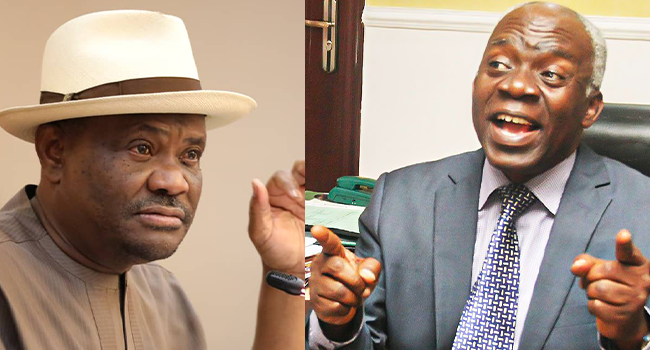
Abuja, Nigeria – Prominent human rights lawyer, Femi Falana (SAN), has issued a stern warning to the Minister of the Federal Capital Territory (FCT), Nyesom Wike, cautioning him against any attempt to seal embassies and foreign missions in Abuja over unpaid ground rents. Falana emphasized that such a move would violate both local and international laws and could trigger serious diplomatic backlash for Nigeria.
Falana’s comments came during an appearance on Politics Today, a program aired by Channels Television, where he tackled the recent threat by the FCT Administration to reclaim thousands of properties from owners who have defaulted on ground rent payments.
PDP Crisis Deepens In Lagos As Top Leaders, Spokesman Defect To APC
Embassy Properties Are Inviolable Under International Law – Falana
At the heart of Falana’s warning lies the Vienna Convention on Diplomatic Relations, a key international treaty that governs diplomatic interactions and guarantees the inviolability of foreign missions. Citing Article 22 of the convention, Falana stressed that under no circumstance can the FCT Administration forcefully take over or seal embassies due to outstanding debts.
“As far as the Vienna Convention on diplomatic relations is concerned, the premises of any embassy in Abuja are inviolable,” Falana stated. “If we embark on invading the embassy of any country, it’s going to lead to serious diplomatic problems for Nigeria. So, it is not allowed.”
The human rights lawyer maintained that the enforcement of such drastic measures without due legal process contravenes not only international law but also Nigeria’s constitutional provisions, specifically the right to fair hearing under Section 36 of the 1999 Constitution.
Court Precedents Forbid Unilateral Seizure of Properties
Falana revealed that Nigerian courts—across all judicial levels including the Supreme Court—have consistently ruled that the FCT Administration does not possess the authority to unilaterally seal any property. He pointed out that at least 20 court judgments have affirmed this position, reinforcing the requirement for proper legal proceedings before punitive actions are taken.
“The minister cannot order that a house be sealed up because the right to a fair hearing is guaranteed,” he stated. “Before you can take action against me, you must give me the right to make a representation.”
He further explained that disputes involving land use and development in the FCT must be resolved through the Urban and Regional Planning Tribunal, which is the legal authority empowered to handle such cases.
Falana Urges Intervention from Foreign Affairs and AGF
In light of the escalating controversy, Falana called on the Minister of Foreign Affairs, Yusuf Tuggar, and the Attorney General of the Federation, Lateef Fagbemi (SAN), to intervene and guide the FCT Minister on the proper legal and diplomatic steps to follow.
“I expect the Minister of Foreign Affairs to have intervened. I also expect the Attorney General of the Federation to intervene,” Falana stated. “The rule of law must be allowed to operate.”
Falana acknowledged the issue of unpaid rents but stressed that the solution must be pursued within the legal framework. “Yes, people are owing. Too bad! But if you want to collect your money, you must go to court,” he insisted.
Wike’s Ultimatum and the Presidential Grace Period
The controversy began when the FCT Administration, under Wike’s directive, published the names of approximately 9,000 debtors in national newspapers, threatening to reclaim over 5,000 properties whose owners had defaulted on ground rent payments for up to four decades. Among the properties already targeted was the PDP national secretariat in Abuja.
On May 23, 2025, the administration began enforcement procedures, including sealing defaulting properties. However, President Bola Tinubu intervened, granting defaulters a 14-day grace period to pay up. That period ended on Friday, June 6, 2025, a national holiday for Eid, leading many to speculate about the next phase of action following the Sallah break.
Observers are now closely watching to see whether Wike will heed Falana’s legal counsel or proceed with his planned enforcement—a move that could have wide-ranging domestic and international consequences.
For now, Falana’s intervention serves as a significant legal and ethical checkpoint in a politically charged issue, reminding the government of the delicate balance between enforcement and the rule of law in a democratic society.















Leave a Comment
Your email address will not be published. Required fields are marked with *