
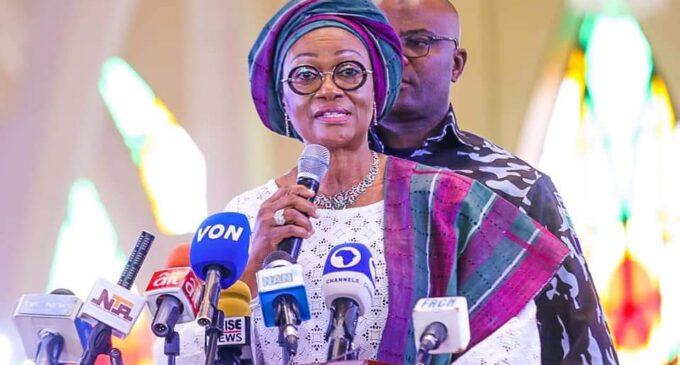
‘Muslim-Muslim Ticket Was A Bitter Pill’ – First Lady, Remi Tinubu The First Lady of Nigeria, Senator Oluremi Tinubu, has revealed that she faced a wave of backlash from within her own church community following her husband, President Bola Ahmed Tinubu’s decision to run on a Muslim-Muslim ticket in the build-up to the 2023 general
‘Muslim-Muslim Ticket Was A Bitter Pill’ – First Lady, Remi Tinubu
The First Lady of Nigeria, Senator Oluremi Tinubu, has revealed that she faced a wave of backlash from within her own church community following her husband, President Bola Ahmed Tinubu’s decision to run on a Muslim-Muslim ticket in the build-up to the 2023 general elections. A committed Christian who rose to the position of Assistant Pastor in the Redeemed Christian Church of God (RCCG) in 2018, Mrs Tinubu admitted the experience was difficult but said it ultimately strengthened her spiritual resolve. She described the opposition she encountered as “a bitter pill,” but one that reinforced her reliance on faith and her determination to embrace peace over resentment.
Court Restrains UBA From Paying Out Osun LG Allocations
Speaking in her newly released 52-page memoir titled The Journey of Grace: Giving Thanks in All Things, published to mark her 65th birthday, the First Lady reflected on the intense political battles and personal challenges that accompanied her husband’s long-awaited bid for the presidency. In the book, structured across five chapters covering the years 2021 to 2025, she described how she drew comfort from the Word of God during that turbulent period. “When the Word of God says we should bless our enemies, not curse them, and do good to those who persecute us… I am at peace, doing all I can to make Nigeria better and greater,” she wrote.
According to Mrs Tinubu, what might have broken her instead became an opportunity to reaffirm her Christian values. She emphasized that forgiveness became a cornerstone of her response, not only toward critics from her church but also toward individuals she described as betraying her husband during the heat of the 2023 campaign. “I do not have anything against anyone…the question is how I did not feel the betrayal anymore? I knew the Grace factor was evident, and the Holy Spirit continually comforted me. Never to avenge myself, assuring me that it is God’s prerogative. Mine is to thank Him for fighting for us,” she wrote.
The First Lady also provided a candid account of how some of President Tinubu’s long-standing political allies withdrew from him when he finally made the decision to contest the presidency after more than 14 years of weighing the option. She expressed surprise and disappointment that people she expected to stand firmly by him chose instead to step aside or hedge their support until they saw which way the political winds would blow. “Most people I thought would support the idea, because past relationships, were not forthcoming,” she noted. “Some said no indirectly, while others would rather want to see the outcome before taking a position. I realised that whatever good you do in life, it is only God who rewards you and not man.”
For the First Lady, such moments were an important spiritual lesson about the dangers of placing hope in people rather than in God. She explained that her decision to forgive those who turned away from her family was inspired by the example of Jesus Christ, who demonstrated unconditional love and forgiveness. “Letting go is what I did; doing good is what matters most. Like my Saviour Jesus Christ in Acts 10:38, who went about doing good, and healing all that were oppressed of the devil, for God was with Him. We should never put our trust in any man; when they help, it is God using them to be a blessing. When they stop, it means their assignment for you from God has ended,” she reflected.
One of the central themes of Mrs Tinubu’s memoir is the importance of gratitude in all circumstances. She recounted how a scripture from 1 Thessalonians 5:18—“In everything give thanks, for this is the will of God in Christ Jesus concerning you”—inspired both her outlook and the subtitle of the book. According to her, the verse came to her during a quiet moment of reflection and instantly redefined her perspective on the trials she faced. “One morning, while I was in the bathroom, the Holy Spirit dropped this Word…that it is not in some things to give thanks, but in everything, both good and bad. Then I realised that this publication’s subtitle will be just that,” she revealed.
By adopting a posture of gratitude, Mrs Tinubu said she was able to navigate the bitterness of criticism, the sting of betrayal, and the uncertainties of political life without losing her inner peace. She stressed that her faith had given her the resilience to endure not only personal attacks but also the scrutiny that comes with being Nigeria’s First Lady.
The memoir sheds light on the personal struggles behind the scenes of Nigeria’s fiercely contested 2023 elections, revealing a First Lady who balanced her pastoral responsibilities with the demands of politics, while navigating criticism from her religious community. Her testimony reflects the often-overlooked toll political battles take on family members, particularly those in the public eye.
For Mrs Tinubu, the lessons of those years are clear: true strength lies in forgiveness, resilience, and the ability to focus on God’s purpose rather than human failings. Her account also offers insight into how she views her role today, not just as the wife of the President, but as a servant leader committed to promoting peace, unity, and spiritual renewal within Nigeria.
While her husband’s Muslim-Muslim ticket remains one of the most controversial political decisions of recent years, Mrs Tinubu’s reflections suggest that she views the outcome not simply in terms of political strategy, but as part of a divine plan. Through her book, she has positioned her story as one of grace, gratitude, and perseverance in the face of both public and private storms.
Ultimately, The Journey of Grace serves not just as a memoir but also as a spiritual testimony. It portrays Nigeria’s First Lady as a woman who endured criticism, betrayal, and uncertainty yet chose to emerge with a message of thanksgiving and forgiveness. Her narrative emphasizes the enduring belief that leadership, at its core, is not about power or position but about faith, service, and the ability to let go of pain in order to embrace peace.













Leave a Comment
Your email address will not be published. Required fields are marked with *