
Nigeria Government Reviews Political Office Holders’ Pay As Citizens Face Tough Economy The Federal Government, through the Revenue Mobilisation Allocation and Fiscal Commission (RMAFC), has disclosed plans to revisit the salaries of political office holders in Nigeria. The commission, led by its chairman, Mohammed Shehu, explained that the current earnings of top public officials are
Nigeria Government Reviews Political Office Holders’ Pay As Citizens Face Tough Economy
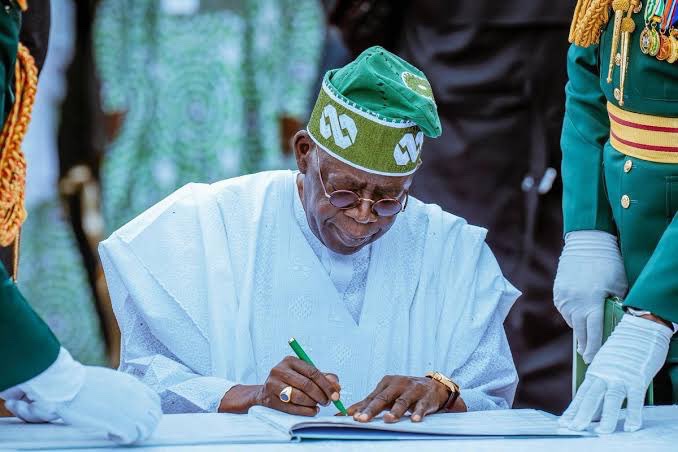
The Federal Government, through the Revenue Mobilisation Allocation and Fiscal Commission (RMAFC), has disclosed plans to revisit the salaries of political office holders in Nigeria. The commission, led by its chairman, Mohammed Shehu, explained that the current earnings of top public officials are both outdated and inadequate given the scope of their responsibilities and the economic realities of today’s Nigeria.
Speaking at a press briefing in Abuja on Monday, August 18, Shehu noted that President Bola Tinubu currently earns about ₦1.5 million monthly, while ministers receive less than ₦1 million. These figures, he stressed, have remained unchanged since 2008.
“You are paying the President of the Federal Republic of Nigeria ₦1.5m a month, with a population of over 200 million people. Everybody believes that it is a joke,” Shehu said, emphasising that the disparity in public sector salaries is both demoralizing and unsustainable.
LEGAL NOTICE – 2025 CYBERCRIMES ACT NOW IN FORCE
Salary Gaps and Perceived Inequities
Shehu highlighted a glaring imbalance in Nigeria’s remuneration structure. According to him, certain heads of federal agencies currently earn between ten to twenty times more than ministers or even the president. He described this as fundamentally unfair, noting that the situation undermines morale among political office holders and could encourage corrupt practices.
“You cannot pay a minister less than ₦1m per month since 2008 and expect him to put in his best without necessarily being involved in some other things,” Shehu stated. “You pay either a CBN governor or the DG ten times more than you pay the President. That is just not right. Or you pay him twenty times higher than the Attorney-General of the Federation. That is absolutely not right.”
The RMAFC chairman explained that the commission’s constitutional mandate only covers the salaries of political, judicial, and legislative office holders—not civil servants or the minimum wage. This clarification came in response to criticism from the Nigeria Labour Congress (NLC), which accused the government of ignoring the nation’s worsening inequality while focusing on political leaders’ welfare.
Public Reaction and the Labour Union’s Stance
The NLC and other critics argue that political office holders already enjoy hidden allowances, perks, and access to state resources that inflate their real earnings far beyond official figures. To them, a pay increase for politicians at a time when ordinary Nigerians are grappling with rising inflation, fuel subsidy removal, and stagnant wages appears both insensitive and misplaced.
However, official records confirm that the basic salaries of Nigeria’s political office holders have not been formally adjusted in over 15 years. A recent fact-check by The Fact-CheckHub revealed that Vice President Kashim Shettima earns approximately ₦12.1 million annually—roughly ₦1 million monthly—based on RMAFC documents obtained through a Freedom of Information (FoI) request.
The same report highlighted that, while adjustments have been proposed over the years, no significant legal changes have been made since the Certain Political, Public and Judicial Office Holders (Salaries and Allowances) Amendment Act of 2008.
A History of Stalled Reviews
The history of salary reviews for political office holders in Nigeria has been marked by stalled reforms and incomplete implementations.
- 2000: RMAFC proposed a new remuneration package, later formalised through the Salaries and Allowances Act of 2002.
- 2007–2008: A comprehensive review led to the 2008 Amendment Act, which remains the operative framework today.
- 2009: A downward review was suggested due to reduced national earnings, but it was never legislated.
- 2015: Another review was initiated but failed to secure approval from the Presidency or National Assembly.
- 2023: RMAFC recommended a 114% salary increase for the president, vice president, governors, lawmakers, and judicial officers, effective from January 1, 2023. However, the proposal was not signed into law.
The recurring failure to implement updated frameworks reflects political sensitivities and public backlash whenever the issue of politicians’ pay arises.
Revenue Allocation Formula Also Under Review
In a related announcement, Shehu confirmed that RMAFC has also begun reviewing Nigeria’s revenue-sharing formula. The revenue allocation formula determines how funds from the Federation Account are distributed among federal, state, and local governments—a subject of longstanding contention.
Currently, the federal government takes 52.68%, states receive 26.72%, and local governments get 20.60%, while an additional percentage is allocated to oil-producing states through the 13% derivation principle. Many state governors have repeatedly called for a review, arguing that the formula leaves them underfunded while overstretching state responsibilities in critical sectors like education, healthcare, and infrastructure.
Shehu said the review would aim to create a fairer system that reflects current economic realities and the constitutional responsibilities of each tier of government.
Balancing Governance, Fairness, and Public Perception
The twin issues of political office holders’ salaries and the revenue allocation formula go to the heart of Nigeria’s governance challenges. On one hand, there is an argument for fair compensation of leaders tasked with managing a nation of over 200 million people. On the other, public distrust of politicians—fueled by perceptions of waste, corruption, and privilege—makes any attempt to raise salaries highly controversial.
For many Nigerians, the demand for better wages for politicians seems out of touch with the harsh economic realities faced by ordinary citizens. Inflation remains high, unemployment persists, and the cost of living has surged following fuel subsidy removal. Against this backdrop, the NLC and other labour groups continue to push for a new minimum wage that reflects the rising cost of survival.
Still, governance experts argue that failing to pay political office holders fairly can have long-term consequences, including low performance, corruption, and the inability to attract competent professionals into public service.
As RMAFC pushes forward with its review of political office holders’ salaries and the revenue allocation formula, the debate reflects broader issues of governance, equity, and trust in Nigeria. While leaders may indeed deserve fair pay relative to their responsibilities, the government faces the delicate task of balancing this with public expectations, economic hardship, and the demand for transparency in public finance.
For now, the conversation is likely to intensify as Nigerians await whether the proposed adjustments will be formally approved—or once again shelved in the face of political pressure and public outrage.










Leave a Comment
Your email address will not be published. Required fields are marked with *