
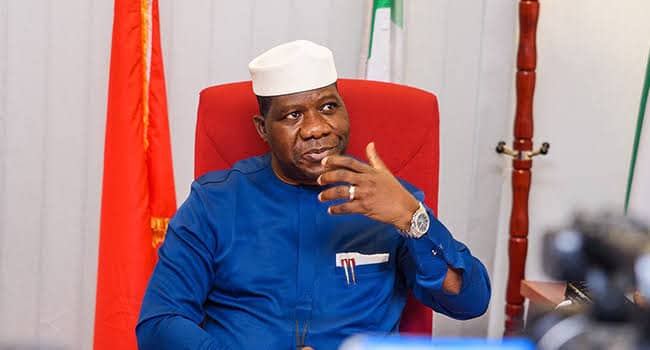
Senate Leader Bamidele Defends Tinubu’s Fuel Subsidy Removal Calls for Focus on Long-Term Economic Stability Senate Leader, Senator Opeyemi Bamidele, has defended President Bola Tinubu’s decision to remove the fuel subsidy, emphasizing that the move was necessary to dismantle a powerful cabal that had been profiting at the expense of the Nigerian people. In a
Senate Leader Bamidele Defends Tinubu’s Fuel Subsidy Removal
Calls for Focus on Long-Term Economic Stability
Senate Leader, Senator Opeyemi Bamidele, has defended President Bola Tinubu’s decision to remove the fuel subsidy, emphasizing that the move was necessary to dismantle a powerful cabal that had been profiting at the expense of the Nigerian people.
In a statement issued on Monday by his Directorate of Media and Public Affairs, Bamidele responded to criticisms surrounding the subsidy removal, clarifying that the real beneficiaries were not ordinary Nigerians but a select group of individuals with access to subsidy funds.
“I am convinced that the president did the right thing by removing the fuel subsidy, for which the 9th National Assembly made provision till May 2023. However, the people who made governance difficult for President Tinubu were those benefiting from fuel subsidies,” Bamidele stated.
NLC Slams Obasanjo’s Accusations Over ₦70,000 Minimum Wage Agreement
Fuel Subsidy Benefited a Privileged Few, Not the Masses
Bamidele explained that although fuel subsidies were originally intended to make petroleum products affordable for Nigerians, they had been manipulated by powerful interests. He pointed out that despite the subsidies, fuel prices remained high, and citizens did not experience significant relief.
“It was not common men and women of this country who were benefiting from the fuel subsidy. It was members of the cabal who had access to the fuel subsidy. They are the ones taking away this privilege all in the name and on behalf of the masses. And the masses did not benefit from it,” he said.
According to Bamidele, the National Assembly had only allocated funds for the subsidy until May 2023, making its removal inevitable, regardless of Tinubu’s decision.
“In the 2023 budget, the National Assembly only made provision for fuel subsidy till May 2023. Whether President Tinubu was removed at his inauguration or not, there was no longer funding for subsidy because we did not make provision for it beyond May 2023,” he clarified.
Government Shifts Budget Focus to Capital Expenditure
Discussing the government’s fiscal priorities, Bamidele highlighted that the 2025 Appropriation Act reflects a shift from recurrent to capital expenditure. He explained that more funds are being directed towards long-term investments in infrastructure, education, health, and agriculture, rather than consumables and administrative costs.
“Compared to the previous fiscal years, the federal government is devoting less to recurrent expenditure while more is being devoted to capital expenditure. That is a major shift from what had been in practice since the return to democracy. It means we are spending less on consumables,” he stated.
He stressed the importance of investing in sectors that would drive economic growth and improve the living conditions of Nigerians.
No Retrenchment Despite Economic Challenges
Bamidele praised President Tinubu for refusing to lay off public workers despite economic hardships. He warned that job cuts could worsen security challenges, particularly in the agricultural sector, which has already been affected by instability.
“Retrenching workers is not an option before this administration because it will cause more problems. Look at our situation. We are confronted with grave security challenges that nearly erode the gains of the administration, especially in the area of agriculture. This is mainly because people could no longer go to farms,” Bamidele said.
He acknowledged that while security remains a challenge, improvements have been recorded, with displaced persons returning to their communities and farmers resuming work.
Optimism for Economic and Security Improvements
Despite the ongoing difficulties, Bamidele expressed optimism that the country was on a path to recovery. He urged Nigerians to be patient, assuring them that the government’s policies would yield positive results over time.
“While it is not yet Uhuru, the security situation is fast improving across the federation today. Some of the IDPs are gradually relocating to their base. Farmers are steadily returning to their farms. Altogether, things are improving. I am sure that things will be different very soon,” he concluded.
As Nigeria navigates economic reforms, the removal of fuel subsidies remains a controversial yet strategic policy aimed at ensuring long-term financial stability. The government’s focus on capital projects and job security indicates a commitment to economic recovery, but the effectiveness of these measures will be determined in the coming months.










Leave a Comment
Your email address will not be published. Required fields are marked with *