
Shettima Criticizes Presidential Overreach Amid Controversy Over Fubara’s Removal In what is being widely interpreted as a veiled rebuke of President Bola Tinubu’s contentious removal of Governor Simi Fubara of Rivers State, Vice-President Kashim Shettima has spoken out against presidential overreach, reigniting debate over executive interference in Nigeria’s federal structure. While not directly referencing the
Shettima Criticizes Presidential Overreach Amid Controversy Over Fubara’s Removal
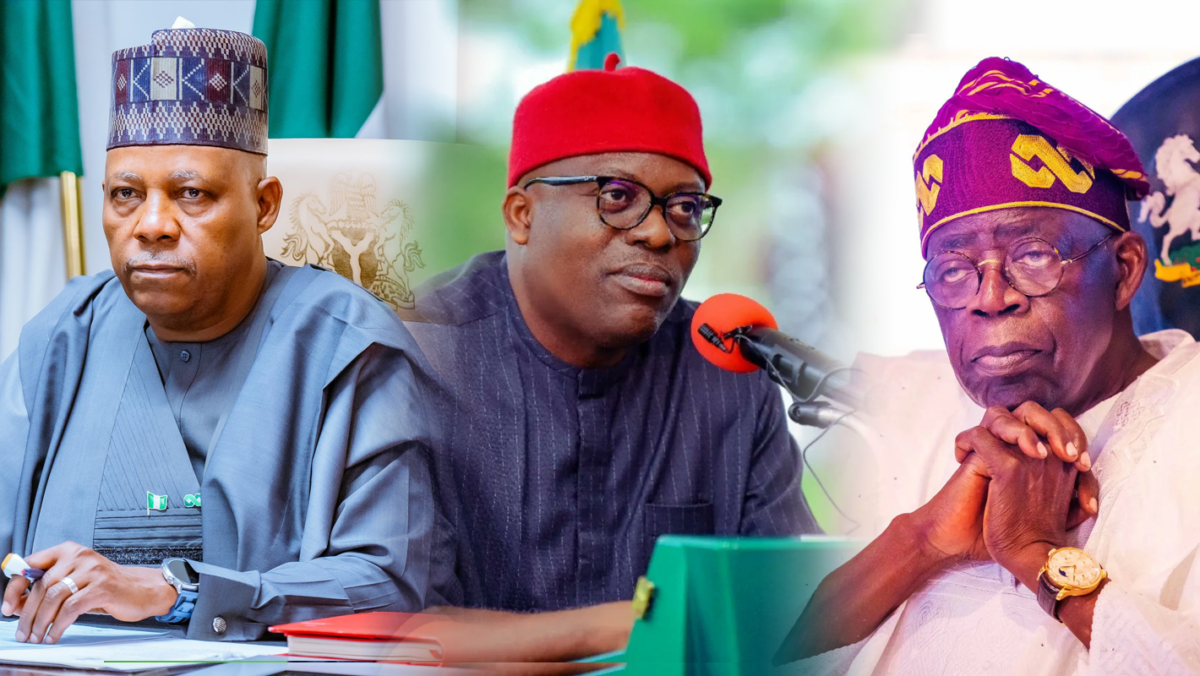
In what is being widely interpreted as a veiled rebuke of President Bola Tinubu’s contentious removal of Governor Simi Fubara of Rivers State, Vice-President Kashim Shettima has spoken out against presidential overreach, reigniting debate over executive interference in Nigeria’s federal structure. While not directly referencing the March 18, 2025, removal of Fubara, Shettima’s pointed remarks at a book launch in Abuja on Thursday suggested deep discomfort with the legality and constitutionality of the president’s actions.
Governor Fubara, elected under the banner of the opposition Peoples Democratic Party (PDP), was removed from office in what many critics described as an unprecedented executive fiat. His ousting was initially reported by Peoples Gazette, sparking outrage across the country. The National Assembly subsequently ratified the decision, with allegations surfacing that lawmakers were bribed to support the move. Since then, a retired military general has been serving in an interim capacity as governor of Rivers State.
One Year After Supreme Court Ruling, LG Autonomy Stalls As FG, Governors Trade Blame
Shettima’s Subtle Yet Striking Reproach
While speaking at the launch of a memoir by former Attorney-General of the Federation, Mohammed Bello Adoke (SAN), Vice-President Shettima drew parallels between current political developments and his own experience as a governor during the Goodluck Jonathan administration. In what was clearly a reference to the ongoing Fubara saga, Shettima recounted how he narrowly escaped a similar fate over a decade ago.
“Former President Goodluck Ebele Jonathan was floating the idea of removing this Borno governor (pointing at himself), and Aminu Waziri Tambuwal, the former Speaker of the House of Representatives, had the courage to tell the president: ‘You don’t have the power to remove an elected councillor,’” Shettima told the audience.
He went on to praise Adoke for standing his ground against pressure from the Jonathan administration to remove governors of northeastern states amid a growing insurgency in 2013. “The president was still unconvinced, he mooted the idea at the Federal Executive Council, Mr Mohammed Adoke told the president: ‘You do not have the power to remove a sitting governor.’”
Another senior lawyer in the cabinet at the time, Kabiru Turaki, also agreed with Adoke’s legal opinion, according to Shettima, effectively ending the attempt. “That was how the matter was laid to rest,” the vice-president said.
Shettima’s statements, though indirect, send a strong signal of dissent regarding President Tinubu’s recent handling of the Rivers crisis. By invoking a historical parallel in which democratic norms were ultimately preserved, Shettima appeared to question the legality and moral justification for removing an elected official outside the constitutionally prescribed process.
Political Tension Within the Presidency
The vice-president’s comments come amid simmering tensions between himself and President Tinubu. Since the controversial removal of Fubara, Shettima had remained conspicuously silent, prompting speculation about his stance. His decision to address the broader implications of such actions now—through a calculated speech—could deepen the rift between Nigeria’s top two executives.
Political analysts believe Shettima’s move is both strategic and symbolic. “He’s asserting his own political ideology, distancing himself from a decision that has drawn sharp criticism from both domestic observers and international stakeholders,” said Dr. Usman Olatunji, a political science lecturer at the University of Abuja.
The timing of the speech is also significant. Just weeks ago, a high-level meeting at the Presidential Villa reportedly turned chaotic when Tinubu loyalists endorsed the president for a second term in 2027—without extending the same courtesy to Shettima as his running mate. The breach of tradition, analysts argue, reflects underlying tensions and may signal an impending reshuffle or political realignment.
Legal and Political Fallout of Fubara’s Removal
The removal of Governor Fubara has raised profound constitutional questions. Legal experts and civil society organizations have called it a dangerous precedent that undermines Nigeria’s federal system. “There is no provision in the 1999 Constitution that grants the president the power to sack an elected state governor,” noted Femi Falana (SAN) in an earlier statement.
The fact that the National Assembly later ratified the president’s decision—amid allegations of bribery—has only intensified scrutiny. Critics argue that the rubber-stamp nature of the endorsement points to the erosion of democratic checks and balances under the current administration.
Rivers State, once seen as a strategic bastion of opposition strength, has since been plunged into administrative uncertainty. The appointed military figure currently overseeing the state has no electoral mandate, a situation many argue is unconstitutional and undemocratic.
A Calculated Risk or a Moral Stand?
For Shettima, Thursday’s remarks could prove a defining moment. In a political environment where dissent is often muted, his decision to speak out—albeit obliquely—may bolster his image as a principled leader committed to democratic values. It may also alienate him from the inner circle of the presidency and set the stage for future political realignment.
With murmurs already circulating about 2027 and the internal politics of the ruling All Progressives Congress (APC) becoming increasingly volatile, Shettima’s stance could resonate with a public disillusioned by rising authoritarianism.
While the presidency has yet to officially respond to Shettima’s comments, the silence may speak volumes. For now, Nigerians are left watching a subtle but potentially explosive power shift unfold at the highest levels of government.
Created with AIMONEYGEN.COM – “Visit GPTS Collection”











Leave a Comment
Your email address will not be published. Required fields are marked with *