
Conflicting Police Reports Cast Doubt on Alleged Eid Violence in Kano A recent police reports on a wireless signal dated March 30, 2025, has cast serious doubt on subsequent claims of violence during the Eid-el-Fitr celebrations in Kano. The document contradicts allegations that led to the controversial police invitation of the Emir of Kano, Muhammadu
Conflicting Police Reports Cast Doubt on Alleged Eid Violence in Kano
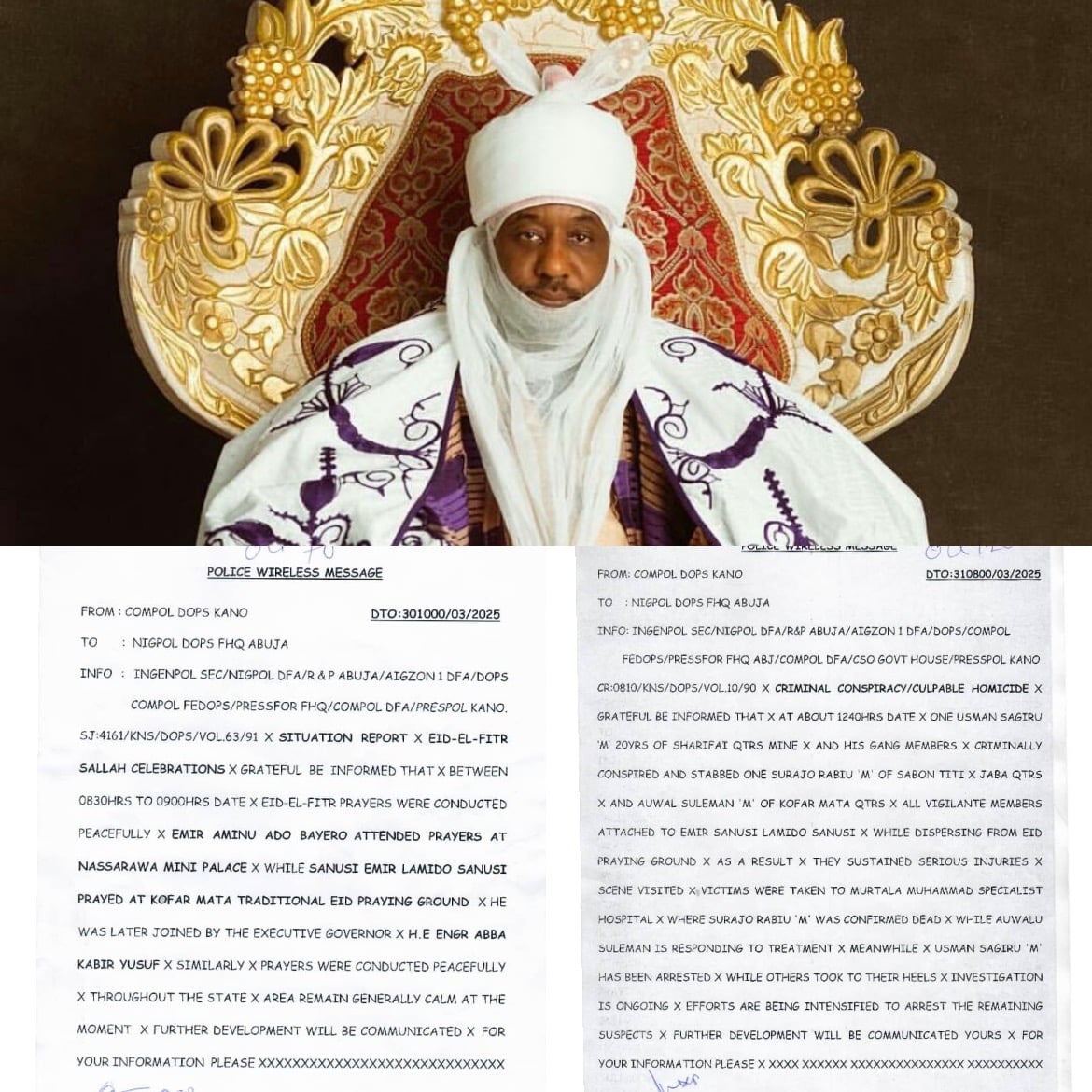 A recent police reports on a wireless signal dated March 30, 2025, has cast serious doubt on subsequent claims of violence during the Eid-el-Fitr celebrations in Kano. The document contradicts allegations that led to the controversial police invitation of the Emir of Kano, Muhammadu Sanusi II, for questioning.
While the initial report confirmed peaceful prayers across Kano State, a second signal issued a day later cited an incident of criminal conspiracy and culpable homicide, raising concerns about possible political motives behind the rapidly changing narrative.
IGP Extends Withdrawal Of Police Security From Lagos Monarchs Amid Political Fallout
Peaceful Eid Prayers Contradict Later Violence Allegations
The original police communication, marked SJ:4161/KNS/DOPS/VOL.63/91 X, provided a situation report on the Eid-el-Fitr celebrations and confirmed that all events, including the prayers attended by the two rival emirs—Muhammadu Sanusi II and Aminu Ado Bayero—were held peacefully.
The signal explicitly stated, “Grateful. Be informed that between 08:30 a.m. to 09:00 a.m., Eid prayers were conducted peacefully. Emir Aminu Ado Bayero attended prayers at Nasarawa mini palace, while Emir Sanusi Lamido Sanusi prayed at Kofar Mata traditional Eid praying ground. He was later joined by the executive governor, H.E. Engr. Abba Kabir Yusuf. Similarly, prayers were conducted peacefully throughout the state. The area remains generally calm at the moment.”
This contradicts the later police report dated March 31, which claimed a violent altercation occurred during Sanusi’s return from the Eid ground. The later communication reported that a 20-year-old man, Usman Sagiru, along with others, stabbed two vigilante members reportedly attached to Emir Sanusi. One of the victims, Surajo Rabiu, died from his injuries, while the other, Auwal Suleman, is recovering.
Palace Denies Incident, Questions Motive
Sources close to Emir Sanusi’s palace flatly denied any knowledge of the alleged violent event during or immediately after the prayers. “The emir and his entourage were unaware of any disturbance. The information only reached us hours after the emir had already returned safely to the palace,” one palace source said to Daily Nigerian.
In response to accusations that the emir violated a durbar ban by returning to the palace on horseback, palace insiders emphasized that such a tradition is rooted in Islamic history and religious customs. “Returning on horseback after Eid prayers is a Sunnah—an established tradition of Prophet Muhammad (SAW),” said one official. “There is no legal basis for banning a religious practice protected by the constitution.”
They also stated that the emir had obtained prior government approval to ride his horse, just as he had done in the previous year when a similar ban was imposed.
Doubts Over the Identity of Victims and Vigilantes
An important revelation from the palace disputes the connection between the stabbing victims and the Emir’s official security team. “The palace did not hire any vigilante members to protect the emir,” a senior official clarified. “We do not recognize the names of those reported as victims.”
This statement undermines the core claim of the second police signal, which positioned the victims as vigilantes associated with the emir. Critics argue that this may have been a deliberate attempt to implicate the traditional ruler in a politically charged situation.
Palace sources have pointed fingers at unnamed “enemies of the emir” for orchestrating a smear campaign. “This is a politically motivated effort to discredit the emir and destabilize the emirate,” one source said.
Political Undertones and Misrepresented Meetings
Reports indicate that the police may have acted under political pressure to question Emir Sanusi in connection with the supposed incident. Although Inspector-General of Police Kayode Egbetokun eventually withdrew the invitation, many believe it was a move aimed at embarrassing the emir, possibly on behalf of political factions opposing his growing influence.
The tension between the emir and political interests was highlighted during a pre-Sallah meeting involving Deputy Inspector-General of Police, Abubakar Sadiq, and Emir Sanusi. Palace sources allege that police misrepresented the content of that conversation. “The emir made it clear that the governor, as the Chief Security Officer of the state, was the appropriate authority to decide on the durbar. He advised against the politicization of peace and security,” one aide explained.
A Crisis of Credibility?
The inconsistencies between the two police signals have sparked a broader debate over institutional credibility and political interference in the duties of law enforcement. Civil rights advocates and observers have expressed concern that Nigeria’s security agencies may be increasingly used as tools in political power struggles, especially in sensitive regions like Kano, where traditional institutions wield significant influence.
“What we are witnessing is not just a conflict over events during Eid, but a larger struggle over the authority of traditional leadership versus political power,” said a northern political analyst. “This could have dangerous implications for the stability of Kano State.”
Moving Forward
With an ongoing investigation and heightened tensions, the spotlight remains on the IGP’s next moves and whether the police will offer a clarified, consistent account of the incident. Meanwhile, Emir Sanusi continues to receive public support, particularly from religious leaders and community groups who see the developments as an attack on constitutional religious freedoms and cultural traditions.
As the dust settles, what remains clear is that the controversy has rekindled debates about the balance between politics, security, and traditional authority in Nigeria.












Leave a Comment
Your email address will not be published. Required fields are marked with *