
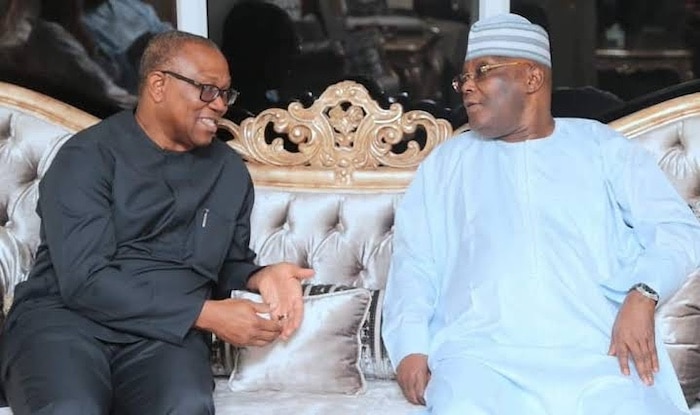
ADC Faces Internal Storm Over Coalition Bid as Atiku, Obi Eye 2027 Presidency The African Democratic Congress (ADC), a party once overlooked in Nigeria’s political arena, is now at the center of fierce internal tensions following reports that former Vice President Atiku Abubakar and Labour Party’s 2023 presidential candidate, Peter Obi, may adopt the party
ADC Faces Internal Storm Over Coalition Bid as Atiku, Obi Eye 2027 Presidency
The African Democratic Congress (ADC), a party once overlooked in Nigeria’s political arena, is now at the center of fierce internal tensions following reports that former Vice President Atiku Abubakar and Labour Party’s 2023 presidential candidate, Peter Obi, may adopt the party as a coalition platform to challenge President Bola Ahmed Tinubu in 2027.
Established in 2005, the ADC has remained a minor player in national politics. However, as cracks continue to deepen in the Peoples Democratic Party (PDP) and Labour Party (LP), it is increasingly being viewed as a viable alternative for a broad-based coalition. This sudden elevation in political relevance has exposed the party’s internal divisions, with some leaders embracing restructuring and others resisting efforts to relinquish control to new power blocs.
Internal Rift Deepens as ADC Considers Hosting Opposition Coalition
The possibility of a merger involving high-profile political figures like Atiku and Obi has prompted excitement and anxiety within ADC’s ranks. Supporters of the coalition argue it represents a historic opportunity to unseat the All Progressives Congress (APC) and challenge Tinubu’s hold on power. Others, however, fear that such a move could result in long-serving members being sidelined.
According to reports, initial coalition discussions were centered on the Social Democratic Party (SDP). However, that prospect quickly fizzled out after SDP’s National Secretary, Olu Agunloye, flatly rejected any idea of mergers or party takeovers. As a result, ADC emerged as the new focus for opposition unity.
ADC National Chairman Ralph Nwosu confirmed the party’s openness to playing a central role in the anti-Tinubu movement, declaring it ready to be the “face” of opposition unity. In some states, preparations for this shift have already begun. Dr. Femi Soluade, ADC Chairman in Ogun State, disclosed that internal restructuring was in progress.
“There has been realignment, re-engineering, and repositioning of the party… we are doing some fixtures at the regional and state levels to accommodate the interests of more than six blocs forming the coalition,” Soluade said.
Leaders in Rivers, Kano, Kebbi, and Niger States echoed similar sentiments, signaling their readiness to make room for newcomers. Gombe State’s party leadership reportedly agreed to collectively step aside for the sake of unity and progress.
Hauwa’u Muhammed of Kebbi said, “The national leadership holds the four aces. If they ask us to relinquish our positions to the new entrants, we will, if it will take our party to greater heights.”
Such perspectives paint a picture of a party willing to make sacrifices for a larger political cause. Yet, not all voices within the ADC are singing from the same hymn sheet.
Southeast PDP Caucus Presses For Retention Of Sunday Ude-Okoye As Party Secretary
Resistance Mounts Against Wholesale Leadership Changes
From Osun to Delta, Plateau to Benue, opposition to a complete leadership overhaul is growing. Osun State Chairman Charles Omidiji flatly rejected any plan to displace existing executives.
“Why would anyone come into the party and displace us? We’ll negotiate, but we won’t accept a takeover. It must be shared equally,” he stated.
Similar views were shared by Plateau State’s Sabiu Musa, who warned against rushing into congresses to accommodate new entrants, and Delta’s Austin Okolie, who stressed the importance of rewarding loyalty and long-term commitment to the party.
South-East National Vice Chairman, Chilos Godsent, took a more measured stance, warning that imposing leadership changes without democratic negotiation would be unacceptable. “It is very undemocratic if the newcomers request or impose conditions without a mutual restructuring of the party offices on a win-win basis,” he said.
Benue State Chairman, Celestine Orbunde, emphasized mutual respect, adding, “New members cannot just come and say they want to take over everything completely, as if the old members don’t know how to build a party.”
Gombe’s Auwal Barde voiced one of the most emphatic rejections. “We welcome positive coalitions, but we won’t hand over leadership to newcomers who barely understand our history and struggle,” he declared.
These divisions highlight a broader challenge in Nigeria’s opposition politics — the struggle to balance legacy, loyalty, and pragmatism. While the idea of a mega-coalition may appeal to those seeking change in 2027, the ADC’s internal fault lines must be carefully managed if the coalition is to materialize.
As discussions continue, the success or failure of this political realignment may ultimately hinge not just on national figures like Atiku and Obi, but on the ADC’s ability to reconcile its internal contradictions and build a united front for the battles ahead.







Leave a Comment
Your email address will not be published. Required fields are marked with *