
Ajibola Basiru Rejects NES Leadership Award, Alleges Political Manipulation by Osun State Government In a dramatic turn of events, the National Secretary of the All Progressives Congress (APC), Senator Ajibola Basiru, has formally rejected an Award of Excellence in Leadership scheduled to be conferred on him by the Osun State chapter of the Nigerian Economic
Ajibola Basiru Rejects NES Leadership Award, Alleges Political Manipulation by Osun State Government
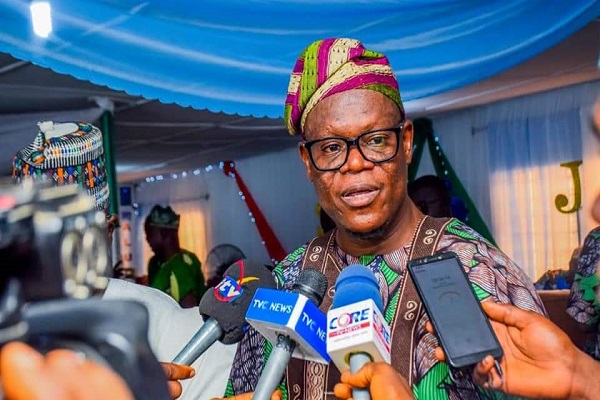
In a dramatic turn of events, the National Secretary of the All Progressives Congress (APC), Senator Ajibola Basiru, has formally rejected an Award of Excellence in Leadership scheduled to be conferred on him by the Osun State chapter of the Nigerian Economic Society (NES). His decision followed the abrupt postponement of the award ceremony, which he vehemently condemned as the result of political interference allegedly orchestrated by the Osun State Government.
In a letter made available to The Nation and signed by his Special Adviser on Legal and Political Strategy, Othuke Amata Aso, Basiru strongly criticized the postponement, accusing the NES of compromising its professional integrity under the influence of partisan politics.
APC Gains From PDP’s Struggles, Says Party Secretary Ajibola Basiru
Award Rejection Sparks Controversy Over Political Influence
According to Senator Basiru, the supposed postponement of the award, originally scheduled for April 11, 2025, was nothing more than a politically motivated cancellation. Citing insider sources within the NES, he claimed that Governor Ademola Adeleke of Osun State applied pressure on the society to rescind the award, allegedly because of Basiru’s political affiliation and rising national prominence within the APC.
“The real reason for this shameful retreat is the undue pressure and shenanigans exerted by the Governor of Osun State, Mr. Adeleke, on the leadership of your society,” the statement read. The APC stalwart described the NES’s actions as a betrayal of professional ethics, lamenting what he termed “mediocrity” and “cheap politicking” on the part of the Osun State administration.
Basiru initially hesitated to accept the award, citing a general skepticism toward honorary recognitions. However, after encouragement from trusted colleagues and associates, he consented—only to be met with what he described as an “embarrassing and unprofessional turnaround.”
Focus Keyword: “Integrity” at the Core of Basiru’s Allegations
At the center of the controversy lies a deeper question of integrity, both for the NES and for the Osun State Government. Senator Basiru’s letter lambasted the communication from NES as poorly structured and vague, stating that the April 7 notice lacked clarity and appeared “hastily prepared.”
In their letter, the NES Osun chapter, represented by its Chairman, Professor Adeleke Aremo, and Secretary, Adewale Sam-Aliyu, cited “logistic and security complexities” as reasons for postponing the event. However, no future date was proposed, further fueling speculation and reinforcing Basiru’s accusations of political interference.
Basiru, who served as a senator and now holds a top position within the ruling party, expressed disappointment in the NES for yielding to what he called “external pressures,” arguing that it tarnishes the ideals of the institution. “This represents a stain on your society’s reputation and a disservice to the very ideals it purports to champion,” he wrote.
He urged the NES to rise above political manipulations and reaffirm its commitment to excellence based on merit, not partisanship. According to him, the ability of academic and professional bodies to maintain neutrality is critical to the integrity of democratic institutions and governance structures in the country.
Reactions and Broader Implications
While the NES has not responded publicly to the allegations, the episode has stirred debate across political and academic circles in Osun State and beyond. Critics argue that the incident reflects a worrying trend in which non-political institutions fall prey to the influences of partisan politics, thereby losing credibility.
Others have defended the Osun State Government, noting that the NES remains an independent body and its decision to postpone the award might indeed have been based on genuine concerns. However, the absence of a new date and the sudden nature of the announcement have cast doubt on such defenses.
The incident has also drawn attention to the broader relationship between politics and civil society in Nigeria. When institutions like the NES are perceived as being politically compromised, it raises concerns about their ability to function as impartial observers and contributors to national development.
Senator Basiru concluded his response by calling on the NES Osun State chapter to redeem itself by returning to the path of professional independence. “Let merit prevail over manipulation, and let the values of academic and economic excellence be upheld without fear or favor,” he stated.
His rejection of the award, though controversial, has been praised in some quarters as a principled stand against what he perceives as creeping politicization in civic institutions. Others view it as a reflection of ongoing tensions between the APC and the PDP-led Osun State Government.
 The unfolding drama surrounding the NES award to Senator Ajibola Basiru reveals much about the fragile line between professional recognition and political power in Nigeria. At its heart is a call for integrity—for professional bodies to uphold their values and for political actors to respect the boundaries of nonpartisan institutions.
As the public awaits any official response from the NES and the Osun State Government, the spotlight remains fixed on how such issues are managed moving forward. The credibility of civil society institutions may well depend on their ability to remain neutral arbiters of excellence, immune to the ebb and flow of political tides.












Leave a Comment
Your email address will not be published. Required fields are marked with *