

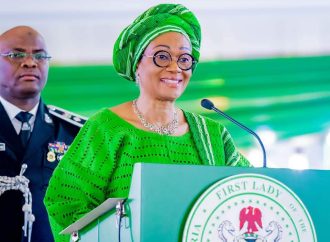
Nigeria’s First Lady, Senator Oluremi Omowunmi Tinubu, stands today as one of the country’s most influential female political figures, combining her long legislative career with a strong commitment to social welfare, education, and women’s empowerment. Born on September 21, 1960, in Ogun State, she grew up in Lagos and received her early education at Our
Nigeria’s First Lady, Senator Oluremi Omowunmi Tinubu, stands today as one of the country’s most influential female political figures, combining her long legislative career with a strong commitment to social welfare, education, and women’s empowerment. Born on September 21, 1960, in Ogun State, she grew up in Lagos and received her early education at Our Lady of Apostles Secondary School, Ijebu-Ode, before proceeding to the University of Ife (now Obafemi Awolowo University).
Her rise to national prominence began during her husband Bola Ahmed Tinubu’s tenure as Governor of Lagos State from 1999 to 2007, a period during which she played a central role in community-focused social initiatives. Her visibility increased further when she entered formal politics, contesting and winning the Lagos Central senatorial seat in 2011. She went on to serve three uninterrupted terms in the Senate, distinguishing herself through policy advocacy around education, women’s rights, and social protection.
Throughout her 12-year legislative career, Senator Tinubu sponsored and supported bills related to gender equity, youth development, and protection against sexual harassment in tertiary institutions. She developed a reputation for discipline, moral clarity, and principled conduct, traits that continue to define her public image.
With the inauguration of President Bola Ahmed Tinubu in May 2023, she assumed the role of Nigeria’s First Lady. Her tenure has been defined by the Renewed Hope Initiative (RHI)—a national humanitarian and empowerment project focused on supporting women, youths, elderly citizens, and persons with disabilities. Under the RHI, the First Lady has implemented scholarship schemes, agricultural grants for women farmers, small-business support for low-income households, and medical outreach programmes across the country.
Senator Tinubu’s public engagements often emphasize national unity, value-driven leadership, and moral responsibility, reflecting her strong Christian background as an ordained pastor in the Redeemed Christian Church of God. Though sometimes attracting public debate for her forthright remarks, she remains firmly positioned as an advocate of civic discipline and family values.
She continues to play a central role not only in humanitarian efforts but also in shaping the public image of the Tinubu presidency, blending political experience with community-based activism.
DETAILED TIMELINE OF OLUREMI TINUBU
1960
- Born on September 21, 1960, in Ogun State, Nigeria.
1970s
- Attends Our Lady of Apostles Secondary School, Ijebu-Ode.
- Moves to Lagos for further studies and family life.
1980s
- Studies at the University of Ife (Obafemi Awolowo University).
- Marries Bola Ahmed Tinubu during this period.
1990s
- Becomes increasingly active in community service and women-centered social programmes.
- Supports her husband’s political journey, especially during the NADECO-democracy era.
- 1999: Bola Tinubu sworn in as Governor of Lagos State.
1999–2007
- Serves as Lagos First Lady.
- Establishes several charitable and empowerment projects, including support for widows, youth training, and elderly welfare.
2011
- Wins election as Senator for Lagos Central.
- Begins first term at the National Assembly.
2015
- Re-elected to the Senate for a second term.
- Sponsors bills on gender equity, social protection, and education.
2019
- Secures a third term as Senator, strengthening her influence in national politics.
- Continues oversight duties and community outreach.
2023
- Husband, Bola Ahmed Tinubu, inaugurated as President of Nigeria on May 29, 2023.
- Becomes the First Lady of the Federal Republic of Nigeria.
- Launches the Renewed Hope Initiative (RHI) to coordinate nationwide humanitarian programmes.
2023–2025
- Implements large-scale empowerment programmes for youths, women, and persons with disabilities.
- Continues to deliver speeches emphasizing discipline, national unity, civic responsibility, and moral values.
- Maintains high visibility in public policy discussions affecting social welfare.
 CHILDREN OF OLUREMI TINUBU AND PRESIDENT BOLA TINUBU
The First Lady has three children with President Bola Ahmed Tinubu. These include:
1. Zainab Abisola Tinubu
2. Habibat Tinubu
3. Olayinka Tinubu
These three are her biological children.
President Tinubu, however, has other children from earlier relationships, making the family larger — but Oluremi Tinubu herself is mother to three.








Leave a Comment
Your email address will not be published. Required fields are marked with *