
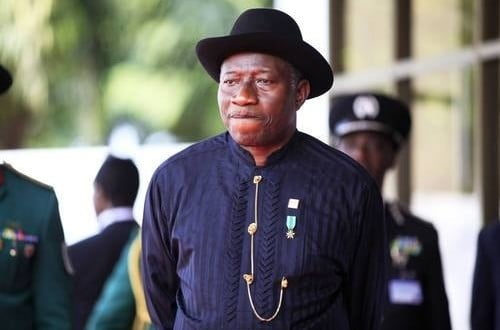
Ex-President Jonathan Dragged To Court Over 2027 Ambition A lawyer, Johnmary Chukwukasi Jideobi, has filed a suit at the Federal High Court in Abuja, seeking a judicial order permanently barring former President Goodluck Jonathan from contesting in the 2027 presidential election or in any future elections in Nigeria. The case, which has reignited constitutional debates
Ex-President Jonathan Dragged To Court Over 2027 Ambition
A lawyer, Johnmary Chukwukasi Jideobi, has filed a suit at the Federal High Court in Abuja, seeking a judicial order permanently barring former President Goodluck Jonathan from contesting in the 2027 presidential election or in any future elections in Nigeria. The case, which has reignited constitutional debates about presidential tenure limits, also seeks to restrain the Independent National Electoral Commission (INEC) from accepting or publishing Jonathan’s name as a candidate under any political party.
I’m A Beneficiary Of Election Shenanigans, INEC Must Stop BIVAS Abracadabra – Aregbesola
According to court documents, the Attorney-General of the Federation (AGF) has been joined as the third defendant in the suit, which is marked FHC/ABJ/CS/2102/2025. The plaintiff, Jideobi, is asking the court to interpret key provisions of the 1999 Constitution (as amended) and issue a perpetual injunction preventing Jonathan from presenting himself for nomination in any future presidential election.
The suit specifically requests that the court declare that INEC has no constitutional authority to accept or publish Jonathan’s name as a presidential candidate and that the Attorney-General should ensure full compliance with any orders that the court may issue in this regard.
At the centre of the legal dispute is the interpretation of Sections 1(1), (2), (3) and 137(3) of the 1999 Constitution. Jideobi has asked the court to determine one key question:
“Whether, in view of the combined provisions of Sections 1(1), (2), (3), and 137(3) of the Constitution, the first defendant, Goodluck Ebele Jonathan, is eligible under any circumstances to contest for the office of the President of the Federal Republic of Nigeria.”
According to the plaintiff, a “careful and holistic interpretation” of these constitutional sections disqualifies Jonathan from running again because he has already been sworn in twice as President — first in 2010 following the death of President Umaru Musa Yar’Adua, and again after winning the 2011 presidential election.
The Plaintiff’s Arguments
In an affidavit deposed to by Emmanuel Agida, Jideobi’s associate, the plaintiff described himself as an “advocate of constitutionalism and the rule of law.” He stated that he was compelled to institute the action after reading reports suggesting that Jonathan might seek another term in 2027. Agida argued that allowing Jonathan to contest again would “violate the express provisions of the Constitution limiting the number of times a person can occupy the office of President.”
According to the affidavit, Jonathan first assumed office as President on May 6, 2010, following the death of Yar’Adua on May 5, 2010. He was then elected in 2011 for a full four-year term, which he completed in 2015. The plaintiff contended that this meant Jonathan had already been sworn in twice and had therefore reached the constitutional limit of two tenures for any president.
“The 1st defendant, having completed the unexpired term of late President Yar’Adua and subsequently served a full term after the 2011 election, has exhausted the constitutional limit of two tenures as President,” the affidavit stated.
The plaintiff further argued that if the court does not act, there is a likelihood that a political party could present Jonathan as its presidential candidate in the 2027 general election, an act he described as “a clear violation of the Constitution.”
On Locus Standi
Addressing his legal standing to file the suit, Jideobi said that as a Nigerian citizen and a constitutional lawyer, he has the duty to uphold and protect the rule of law. He maintained that his interest in the case is not personal but in the public interest, as it concerns the integrity of Nigeria’s constitutional democracy.
He stated: “As a Nigerian lawyer trained in constitutional law, I have come across a provision in the Constitution stating that a person who was sworn in as President to complete the term of another elected President shall not be elected to such office more than once. It is my duty to forestall any violation of this constitutional provision.”
Jideobi further explained that if Jonathan were allowed to contest and eventually win the 2027 election, it would mean he had been sworn in as President three times, exceeding the maximum of two terms permitted by the Constitution. He described such a scenario as a threat to constitutional order and democratic stability.
He added: “If the 1st defendant is allowed to contest and possibly win the forthcoming 2027 presidential election, he will have exceeded the cumulative maximum of eight years that any Nigerian President is constitutionally permitted to serve. This would undermine the supremacy of the Constitution.”
Background of the Controversy
Goodluck Jonathan’s eligibility for future elections has been a matter of public and legal debate since the passage of the Fourth Alteration Act to the 1999 Constitution. Section 137(3) of that amendment stipulates that “a person who was sworn in as President to complete the term for which another person was elected shall not be elected to such office more than once.”
Jonathan first assumed office in 2010 after Yar’Adua’s death and later contested and won in 2011, before losing his re-election bid in 2015 to President Muhammadu Buhari.
In 2022, similar lawsuits were filed at various courts when reports emerged that Jonathan might be considering a presidential run under the All Progressives Congress (APC). Though he never formally declared his candidacy, those cases reignited debates about whether Section 137(3) barred him from running again.
While some legal scholars have argued that the amendment cannot be applied retroactively since it came into force after Jonathan’s first term, others contend that its intent clearly disqualifies anyone who has been sworn in twice from seeking re-election, regardless of when the amendment took effect.
Implications and Reactions
Neither Jonathan nor his legal team has yet responded to the latest suit. Similarly, INEC and the Office of the Attorney-General of the Federation have not issued official statements. However, political analysts believe the case could once again test the judiciary’s interpretation of Nigeria’s presidential term limits, especially as the 2027 elections approach.
Constitutional lawyer Kayode Ajulo commented that the case “raises important questions about the intersection between law and politics in Nigeria.” He said that while the courts had previously sidestepped a conclusive ruling on Jonathan’s eligibility, this new suit could force a definitive judicial interpretation before the next election cycle.
Others have warned that the case could deepen political divisions if not resolved early. “This is not just about one man,” said analyst Chidi Odinkalu. “It’s about setting a precedent for how strictly Nigeria enforces constitutional provisions on term limits.”
Conclusion
In his final prayer before the court, Jideobi urged the judge to declare that Jonathan is constitutionally ineligible to contest in the 2027 election or any future election for the office of President. He also asked for a perpetual injunction restraining INEC from accepting or publishing Jonathan’s name as a candidate and compelling the Attorney-General to ensure compliance with the court’s eventual ruling.
He emphasized that the suit was filed “in the interest of justice, the rule of law, and the preservation of Nigeria’s constitutional order.”
The court has not yet fixed a date for the hearing of the case, but it is expected to generate significant attention as the 2027 general election draws closer.














Leave a Comment
Your email address will not be published. Required fields are marked with *