

No Sane Human Being Will Join PDP, Cites Electoral Experience and Party Division – Godswill Akpabio Senate President Godswill Akpabio has issued a stern warning to Nigerian politicians, advising them against joining the opposition Peoples Democratic Party (PDP). His remarks came during the Senate’s screening of Professor Joash Amupitan as the prospective Chairman of the
No Sane Human Being Will Join PDP, Cites Electoral Experience and Party Division – Godswill Akpabio

Senate President Godswill Akpabio has issued a stern warning to Nigerian politicians, advising them against joining the opposition Peoples Democratic Party (PDP). His remarks came during the Senate’s screening of Professor Joash Amupitan as the prospective Chairman of the Independent National Electoral Commission (INEC). Akpabio’s comments, though partly humorous, carried deep political undertones that reflected his discontent with the current state of the PDP and his past experiences during elections.
During the plenary session, an exchange between Akpabio and Senator Seriake Dickson of Bayelsa West sparked the conversation. Dickson had noted that no candidate contested the results of the recent presidential election conducted in Ghana, a comment that prompted Akpabio to reflect on Nigeria’s electoral landscape. In response, Akpabio reminded his colleagues that former President Goodluck Jonathan, who contested under the PDP in 2015, did not challenge the outcome of that year’s presidential election, demonstrating political maturity and respect for the democratic process.
However, Senator Dickson was quick to point out that the 2015 election took place under a PDP-led administration. This observation appeared to provoke Akpabio, who replied sharply, stating that while the PDP was once a formidable political force, it has since become deeply fractured. He said, “At that time, PDP was not torn to shreds, but there is no human being that is sane today that can even join such a platform.” His statement immediately drew reactions from senators across party lines, as Akpabio made it clear that the PDP, in his view, has lost its unity and direction.
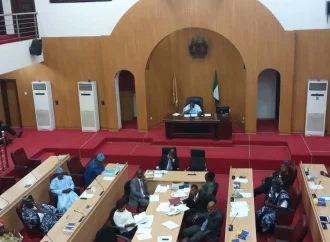
Cross River Assembly Moves to Ban Housing Agents Over Arbitrary Rent Hikes
PDP and Political Sanity: Akpabio’s Bold Declaration
The Senate President’s bold assertion that “no sane individual” would join the PDP reflects a growing sense of rivalry between Nigeria’s ruling and opposition parties. His remarks also come at a time when political realignments are intensifying ahead of future elections. Akpabio, a former governor of Akwa Ibom State and one-time PDP stalwart before defecting to the All Progressives Congress (APC), appears to be leveraging his experience to question the credibility and internal cohesion of his former party.
Akpabio did not stop at political commentary; he revisited his personal ordeal during the 2019 general elections. Recounting his experience, he revealed that his votes were allegedly burnt in his local government area, a development that led him to seek legal redress. “I was cheated in the 2019 elections, and we went to court,” he said. “The court annulled the election and ordered the prosecution of the electoral officer, but instead of prosecuting the INEC commissioner, they prosecuted the returning officer, a professor from the University of Calabar who has done 34 years in service.”
According to Akpabio, the situation was mishandled, as the real culprits escaped justice while the wrong individuals were penalized. He expressed frustration that the same INEC Resident Electoral Commissioner who allegedly tampered with the results remained untouched while a returning officer, who merely performed his duty, was imprisoned. Akpabio added that the commissioner, “working with some cohorts, changed the story that the man was trying to assist Akpabio,” a narrative he described as false and misleading.
The Senate President questioned the logic behind such a claim, asking, “If the man was trying to assist Akpabio, how come they burnt my votes in my local government? How come I was not announced as the winner? I kept quiet.” His emotional recounting of events highlighted not only his personal grievances but also systemic issues in Nigeria’s electoral process.
Akpabio went further to advocate for accountability and reform in the country’s electoral system. He emphasized the need to ensure that amendments to the Electoral Act hold the right individuals accountable for election irregularities. “If we are amending the Electoral Act, the real offenders must be held responsible because at the level of the returning officer, the man can only announce what is collated from the collation centres,” he stated. He cautioned against allowing Resident Electoral Commissioners to manipulate results by hijacking announcements, a practice he described as a direct violation of the law.
The Senate President also expressed concern that INEC, as an institution, has often failed to take full responsibility for certain infractions in the electoral process. “INEC should be held responsible for certain infractions in the Electoral Act,” he asserted, insisting that transparency and justice must guide future electoral reforms.
Akpabio’s comments have since sparked political debate across Nigeria’s political spectrum. While his statement against the PDP drew laughter and reactions from some lawmakers, others viewed it as a reflection of the deep-rooted distrust between Nigeria’s leading political parties. Observers have noted that Akpabio’s experience underscores the urgent need for credible electoral management, impartiality, and the fair treatment of candidates by electoral bodies.
As Nigeria looks toward future elections, the Senate President’s remarks serve as both a warning and a call to action. His words echo the sentiment that the credibility of the electoral process remains a cornerstone of democracy. Whether his criticism of the PDP was political banter or a genuine reflection of disillusionment, one message was clear: Nigeria’s political class must uphold integrity, unity, and accountability if the nation’s democracy is to thrive.













Leave a Comment
Your email address will not be published. Required fields are marked with *