
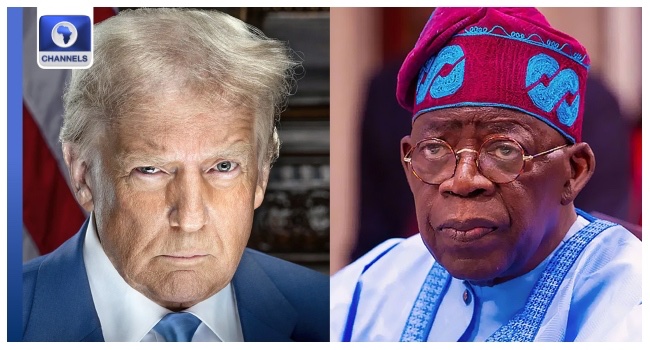
US TO PROVIDE INTELLIGENCE SUPPORT, DEFENCE EQUIPMENT TO NIGERIA — PRESIDENCY In a significant boost to Nigeria’s counterterrorism and internal security efforts, the Presidency has confirmed that the United States government has agreed to provide expanded intelligence support, advanced defence equipment, and operational partnership to Nigeria. The decision reportedly followed a series of high-level engagements
US TO PROVIDE INTELLIGENCE SUPPORT, DEFENCE EQUIPMENT TO NIGERIA — PRESIDENCY
 In a significant boost to Nigeria’s counterterrorism and internal security efforts, the Presidency has confirmed that the United States government has agreed to provide expanded intelligence support, advanced defence equipment, and operational partnership to Nigeria. The decision reportedly followed a series of high-level engagements between officials from both countries, aimed at upgrading collaboration against terrorism, banditry, and transnational organised crime across West Africa.
AMOTEKUN: CRITICAL DECISION DAY IN OSUN WEST .
According to senior Presidency sources, the renewed cooperation is part of Washington’s broader strategy to stabilise the Sahel and the Gulf of Guinea—two regions that have seen rising extremist activity, military coups, and geopolitical competition. For Nigeria, Africa’s largest democracy and economic powerhouse, the partnership represents a timely intervention as the nation continues to battle insurgency in the North-East, banditry in the North-West, separatist violence in the South-East, and various forms of organised criminal activity nationwide.
The Presidency said the United States offered enhanced intelligence-sharing capabilities that will allow Nigerian security agencies to access satellite surveillance, real-time movement tracking, threat analysis, and advanced monitoring technologies. The collaboration will also involve training Nigerian operatives in modern intelligence gathering, counter-espionage, and digital forensics.
Officials in Abuja say this step will dramatically improve Nigeria’s ability to pre-empt terrorist attacks, identify the operational bases of armed groups, and cut off weapons and funding routes that sustain criminal networks.
A second major component of the new agreement is the provision of advanced defence equipment. While details are still being finalised, sources indicate that the package will include unmanned aerial systems, encrypted communication devices, armoured mobility platforms, and upgraded battlefield technology designed to improve the precision and safety of military operations.
A senior administration official noted that President Donald Trump, in his renewed global security framework, emphasised strengthening alliances with nations that are “critical to regional stability.” Nigeria, the official added, remains a central pillar in US-Africa policy, especially in efforts to curb extremist organisations with global linkages.
The Presidency also confirmed that Washington has requested stronger accountability mechanisms from Nigeria to ensure that all supplied equipment and intelligence tools are used strictly in accordance with international standards, human rights guidelines, and bilateral defence protocols. Nigerian authorities have reportedly agreed, assuring that the partnership will be governed by transparent oversight and operational responsibility.
In addition to hardware and intelligence, the United States will expand its training programmes for Nigerian military and police personnel. The focus will include counterterrorism strategy, hostage-rescue operations, cyber defence, border security, and the protection of critical national infrastructure.
Security analysts say this development marks one of the most consequential shifts in Nigeria-US relations in recent years. After a period of friction, particularly over equipment procurement restrictions and concerns about human rights practices, both sides appear to have realigned their priorities. With extremist groups adapting their tactics—using drones, encrypted communication, and exploiting ungoverned spaces—international collaboration has become essential.
For Nigeria, the timing is particularly crucial. The military has recently intensified operations across several hotspots, but officials admit that intelligence gaps and outdated equipment remain obstacles. The expanded US support is expected to reduce those limitations.
Beyond security, experts note that stronger ties between Washington and Abuja could influence economic, diplomatic, and trade relations. American officials have repeatedly stated that a stable Nigeria is essential to the overall prosperity of West Africa, which continues to face threats from armed groups pushing southward from the Sahel.
Domestically, the announcement has generated reactions from across the political spectrum. Supporters argue it demonstrates the government’s commitment to modernising Nigeria’s security architecture. Critics, however, caution that external assistance must be balanced with the strengthening of Nigeria’s own defence industry and intelligence institutions, warning against overdependence on foreign powers.
Human rights organisations have also called for the partnership to prioritise civilian protection. They urged that improved capability should be matched with improved discipline, accountability, and respect for international law to prevent abuses during military operations.
Nevertheless, officials in the Presidency insist the partnership will be a turning point. “This is a strategic collaboration built on mutual respect and shared interests,” one senior aide said. “Nigeria is committed to restoring peace across the federation, and the support from the United States will help us achieve results more effectively and responsibly.”
As the technical details of the agreement are finalised, further announcements are expected in the coming weeks. Both governments are preparing for additional meetings to outline timelines, equipment delivery schedules, and the deployment framework for intelligence specialists.
For now, officials in Abuja say the expanded cooperation signals a renewed confidence in Nigeria’s role as a regional leader—and a heightened resolve to win the long-running fight against insecurity.










Leave a Comment
Your email address will not be published. Required fields are marked with *