
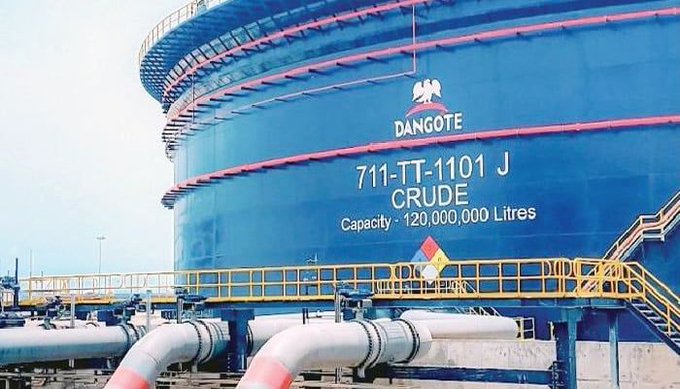
Nigeria’s fuel supply landscape has shifted significantly as the Dangote Refinery now provides about 92 percent of the nation’s petrol, following the Federal Government’s decision to pause petrol imports. The development marks a major milestone in the country’s efforts to reduce reliance on imported refined petroleum products and strengthen domestic refining capacity. Industry sources
Nigeria’s fuel supply landscape has shifted significantly as the Dangote Refinery now provides about 92 percent of the nation’s petrol, following the Federal Government’s decision to pause petrol imports.
The development marks a major milestone in the country’s efforts to reduce reliance on imported refined petroleum products and strengthen domestic refining capacity.
Industry sources indicate that the massive output from the Dangote Petroleum Refinery, located in Lagos, has dramatically increased the availability of locally refined petrol, allowing the government to slow down or temporarily halt fuel importation.
The move is expected to reduce pressure on Nigeria’s foreign exchange reserves while supporting the government’s broader strategy to achieve energy self-sufficiency.
Reps Panel Orders FAAN To Recover N18.98bn Debt From Foreign Airlines
The refinery, owned by Africa’s richest businessman Aliko Dangote, has steadily ramped up production since operations began. With its large refining capacity, the facility has become a key supplier of petrol to the Nigerian market.
Reports suggest that the refinery’s output now accounts for roughly 92 percent of the country’s petrol supply, making it the dominant player in the domestic fuel distribution chain.
This shift has allowed the Federal Government to scale back imports that previously filled the gap between domestic production and national consumption.
For decades, Nigeria relied heavily on imported petrol despite being one of Africa’s largest crude oil producers. Limited capacity at local refineries forced the country to spend billions of dollars annually on fuel imports.
However, the rise of the Dangote Refinery is gradually changing that narrative.
Officials believe that relying more on locally refined products could stabilize supply, improve fuel security, and reduce the economic strain associated with large-scale imports.
Industry analysts also say the move could help stabilize fuel prices in the long run by reducing exposure to global market fluctuations and foreign exchange volatility.
The government’s decision to pause imports is therefore seen as a strategic step to encourage domestic production and strengthen Nigeria’s refining industry.
At the same time, stakeholders in the energy sector are closely watching how the shift will impact fuel distribution, market competition, and pricing across the country.
Experts note that while the Dangote Refinery’s dominance could improve supply stability, maintaining transparency and fair competition within the downstream petroleum sector will remain important.
As the refinery continues to increase its operational capacity, analysts predict that Nigeria could soon become a net exporter of refined petroleum products to other African countries.
For many observers, the current development signals a major turning point in Nigeria’s decades-long struggle with fuel import dependence.












Leave a Comment
Your email address will not be published. Required fields are marked with *