
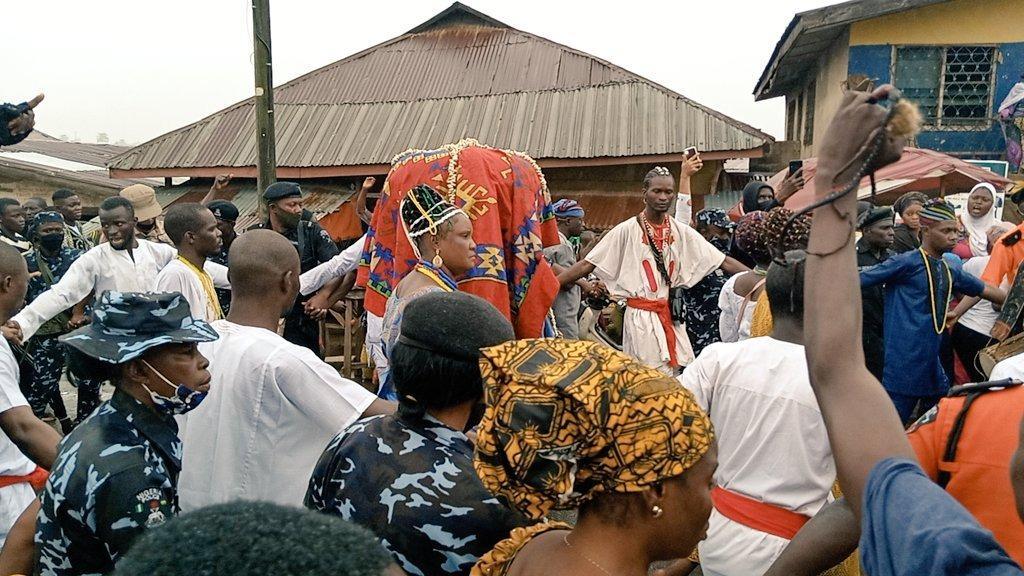
The most significant yearly event in Òṣogbo, southwest Nigeria, is the Ọṣun Òṣogbo festival. It attracts thousands of tourists and believers from all across Nigeria and the world. The festival honors Ọṣun, a prominent female deity in the Yorùbá pantheon, and is a civic ceremony and devotional occasion. In Yorùbá mythology, Ọṣun is the
The most significant yearly event in Òṣogbo, southwest Nigeria, is the Ọṣun Òṣogbo festival. It attracts thousands of tourists and believers from all across Nigeria and the world. The festival honors Ọṣun, a prominent female deity in the Yorùbá pantheon, and is a civic ceremony and devotional occasion.
In Yorùbá mythology, Ọṣun is the goddess of femininity and is in charge of the river that bears her name in Nigeria. Any freshwater is thought to be home to her ghost. She is linked to sensuality, fertility, purity, and the authority of motherhood. She is also the patroness of Òṣogbo, a town in Yorùbá, Nigeria, which dates back to the late 16th century and is connected to Ọƀṣun, the river and the deity.
I was drawn to the Ọṣun festival and the deity’s most revered location, the Ọṣun-Òṣogbo Grove, as a historian and archaeologist in order to learn about the 500-year history of the Òṣogbo and the Yorùbá region. The Ọṣun festival’s customs, entertainment, and scenery serve as significant archives of historical memory. I have learned more about the festival’s history and significance to the Yorùbá people thanks to my research on its ethnography and oral traditions as well as the landscape history and archaeology of the Ọ̀ṣun Òṣogbo Grove.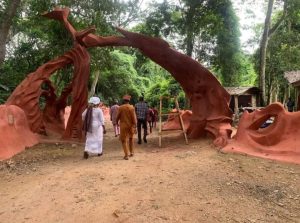
Myths of origin
The Yorùbá people are one of the largest cultural groups in Africa. Their ancestral language originated from the Niger-Benue confluence area around 2500 BC. From 300 BCE to 300 CE, the language and its speakers spread to diverse ecological zones between the River Niger and the Atlantic coast. By 1000 CE, the divine kingship and city-state had become their model of governance. Over the next 500 years, their religious institution evolved into a pantheon that mirrors their sociopolitical system. Ọ̀ṣun is one of the deities. Today, the Yorùbá identify south-west Nigeria and parts of Benin and Togo as their ancestral homeland. The Yorùbá Òrìṣà religion is the largest African Indigenous religion in the world.
The Ọ̀ṣun goddess features in many Yorùbá myths. One version claims that Ọ̀ṣun was one of the 17 deities (Òrìṣà) that Olódùmarè (the supreme being in Yorùbá cosmology) sent to create the world. She was the only woman among them. Initially, the 16 male deities ignored her. As a result, they failed to carry out Olódùmarè’s mandate. Olódùmarè commanded them to bring Ọ̀sun into their fold and be attentive to her advice. The 16 male deities complied and apologised to Ọ̀ṣun. She agreed to cooperate with them, but only after they taught her Ifá divination. These Òrìṣà then created the world, and fertility, peace, abundance and wellness prevailed.
Another myth associates the origin of Òṣogbo with Ọ̀ṣun, and this is relevant to the origin of the Ọ̀ṣun Festival as we know it today. In this version, there was a prolonged drought in the 16th century. Many rivers, streams, and ponds dried up. The community of Ìpolé Ọ̀mu, about 10km from the present town of Òṣogbo, was severely affected. Two hunters from Ìpolé Ọ̀mu, Láròóyè and Tìmẹ́hìn, were charged to scout for water. They convinced their community to settle on the banks of the river and began clearing the vegetation to make way for houses and farmland.
Unknown to the hunters and the settlers, the area they chose for settlement belonged to all-female ghommids specialising in dyestuff manufacture. Ghommids is an umbrella term for creatures in Yoruba folklore, something like ogres, goblins, and elves. While clearing the land, the settlers destroyed many of the ghommids’ dye pots. The ghommids were furious, and their leader and goddess of the river, Ọ̀ṣun, had had enough. She appeared to the settlers, who were enthralled by her beauty and trembled at her fury. Láròóyè, who had become the leader of the settlers, pleaded with the goddess for forgiveness.
The settlers’ humility impressed Ọ̀ṣun, and she forgave them. She then made a pact with them: if they treated her abode—the river and surrounding areas—with respect, she would protect them from all troubles. The settlers moved away to Ohùntótó, about 400 metres from the riverside, which became the first Òṣogbo settlement. It is now part of the Ọ̀ṣun Òṣogbo Grove complex. My archaeological excavations in Ohùntótó confirmed that this was where the first Òṣogbo settlement was indeed established during the late 16th and early 17th centuries.
Festival’s origin

To seal the pact, the founding community reportedly built a temple on the spot where Ọ̀ṣun had appeared to them. Since then, their descendants have been visiting the riverside temple every year to renew the pact and pay homage to the river goddess whose water and land resources sustained them in times of drought. The goddess is also credited for the community’s growth from a handful of families to one of the most successful frontier market towns in the 17th and 18th centuries, and today, a city of nearly a million and the capital of one of 36 Nigerian states.
Significance and observance
The Ọ̀ṣun festival is a week-long event that usually takes place from the end of July to early August. The festival renews the covenant between Ọ̀ṣun and the people of Òṣogbo. The Ọ̀ṣun river, especially near the temple and shrines of the grove, is believed to possess healing powers for social, spiritual, and physical ailments. People gather in the grove to receive the blessings of the king and the chief priestess and tender their requests to the deity.
As a civic festival, it brings the people of Òṣogbo together for community renewal. The festival has also become a time for many members of the Yorùbá religion worldwide to come together and celebrate their faith in Òrìṣà religion (also known as Ìṣẹ̀ṣe).
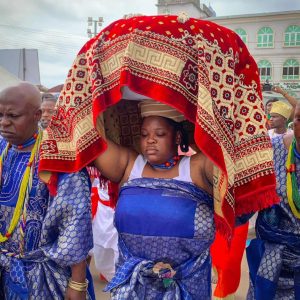
The grand finale of the festival involves several ritual spectacles in which the Arugbá, a young female virgin from the royal house, leads the procession of thousands of people from the palace to the grove and back. On her head is a calabash covered with colourful fabrics. The calabash contains the sacrifices of the entire community. This entourage of thousands of people includes the priestesses and priests of Ọ̀ṣun, the king and the chieftains of Òṣogbo, political dignitaries, worshippers and tourists. The annual ritual journey is festive and colourful. It involves supplications, songs, drumming and dance in praise of the deity. However, it is a solemn moment for most priests and priestesses. Throughout the journey, the Arugbá must not utter a word.
It is also a major driver of the local economy though there’s no reliable data to estimate the amount of money it attracts to Òṣogbo and environs.
What does it mean to the Yorùbá people?
The festival is an acknowledgement and reaffirmation of female power as the source of life, creativity and community building, an idea central to Yorùbá cosmology and theory of knowledge.
It is also a platform for celebrating the pan-Yorùbá cultural identity because it was in Òṣogbo in 1840 that the Yorùbá defeated the Ilorin army’s efforts to achieve the Sokoto Caliphate’s master plan to convert the region to Islam. That victory saved the Yorùbá kingdoms from being turned into emirates. The goddess, Ọ̀ṣun, is credited for that victory.
Festival’s future
The Yorùbá Òrìṣà religion is undergoing rejuvenation at home and enjoying expansion globally, especially in the Americas. Ọ̀ṣun is one of the most popular deities in that expansion. The designation of Ọ̀ṣun-Òṣogbo Grove as a world heritage site in 2005 is proudly celebrated in Nigeria.
The efforts made to safeguard Ọ̀ṣun heritage, and the message of gender equity, sustainable environment, abundance and wellness, suggest that the deity will continue to be relevant.
Ọ̀ṣun has a deep history, but she is very much a deity of the present and the future. Ore Yèèyé ò (“Praises to the Mother”).




















Leave a Comment
Your email address will not be published. Required fields are marked with *