
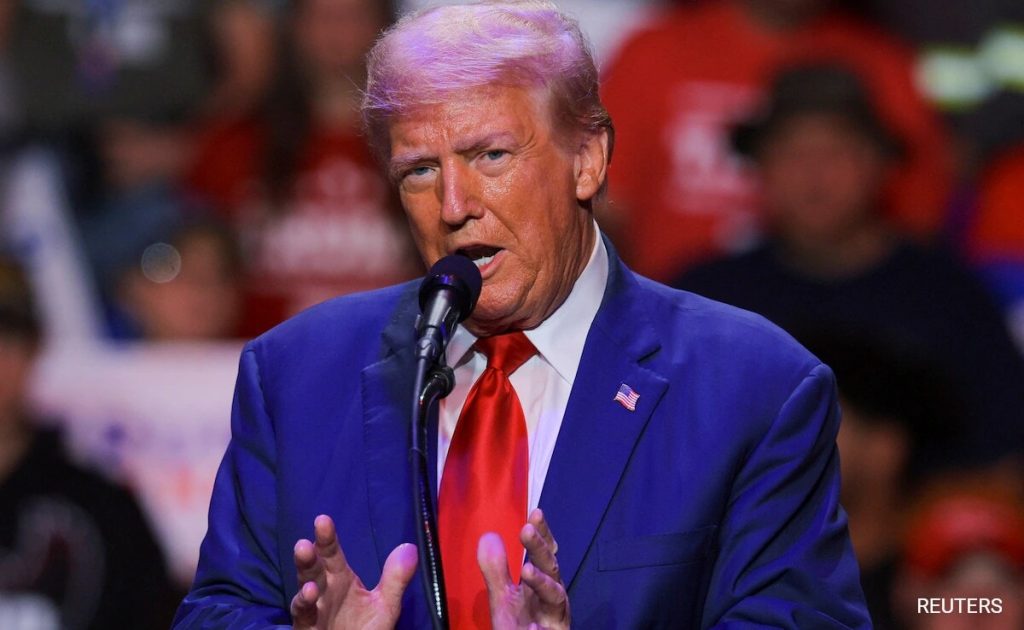
United States President Donald Trump has declared that he must be involved in determining who becomes the next leader of Iran following the death of the country’s Supreme Leader, Ali Khamenei. Trump made the statement during an interview with Axios on Thursday, where he rejected the possibility of Mojtaba Khamenei, the late leader’s
United States President Donald Trump has declared that he must be involved in determining who becomes the next leader of Iran following the death of the country’s Supreme Leader, Ali Khamenei.
 blob:https://www.image2url.com/6b1201f1-93ee-44f9-bbeb-45816585e575
Trump made the statement during an interview with Axios on Thursday, where he rejected the possibility of Mojtaba Khamenei, the late leader’s son, succeeding his father. He described Mojtaba as unfit for the role and insisted that the United States should have influence over the succession process. (Rediff)
According to Trump, Iran’s future leadership should prioritize stability and peace, rather than continue the policies of the previous administration.
“They are wasting their time. Khamenei’s son is a lightweight,” Trump said. “I have to be involved in the appointment, like with Delcy [Rodriguez] in Venezuela.” (The Telegraph Nigeria)
He added that Mojtaba Khamenei would not be acceptable to him as the next Iranian leader.
“Khamenei’s son is unacceptable to me. We want someone that will bring harmony and peace to Iran,” the U.S. president stated. (ایران اینترنشنال | Iran International)
Hundeyin Set To Step Down As Nigeria Police Spokesman After Five Months
Uncertainty Over Iran’s Leadership
The remarks come amid growing uncertainty in Iran after the death of Supreme Leader Ali Khamenei. Iranian authorities have yet to officially announce a successor, though political signals suggest a decision may be made soon.
Mojtaba Khamenei has been widely viewed as one of the leading candidates to replace his father, but other clerics and political figures are also considered possible contenders. (Yahoo)
Under Iran’s political system, the country’s Supreme Leader is chosen by an 88-member clerical body known as the Assembly of Experts, which holds the authority to appoint the nation’s highest religious and political authority.
Trump’s comments highlight Washington’s strong interest in Iran’s future leadership, particularly amid ongoing tensions in the Middle East.
Regional Fears of Instability
Meanwhile, concerns are growing across the Middle East that the leadership transition in Iran could trigger internal instability.
European Union foreign policy chief Kaja Kallas said several Middle Eastern countries have expressed fears that Iran could face internal conflict or even civil war as tensions escalate between Tehran, the United States, and Israel.
According to Kallas, regional leaders are worried about the political vacuum that could emerge during the leadership transition.
“They are also worried about civil wars inside Iran because of the regime’s leadership and what is going on there,” she said while speaking ahead of a meeting with EU foreign ministers and representatives of the Gulf Cooperation Council.
The European Union has called for diplomacy to resolve the crisis, warning that continued escalation could further destabilize the region.
Kallas emphasized that diplomacy remains the most effective path to ending the conflict.
“Wars really end in diplomacy, and there has to be room for diplomacy here to get out of this cycle of escalation,” she told reporters.
As global attention remains focused on Tehran, analysts say the choice of Iran’s next Supreme Leader could significantly shape the country’s political direction and its relations with Western powers in the coming years. (Reuters)













Leave a Comment
Your email address will not be published. Required fields are marked with *