
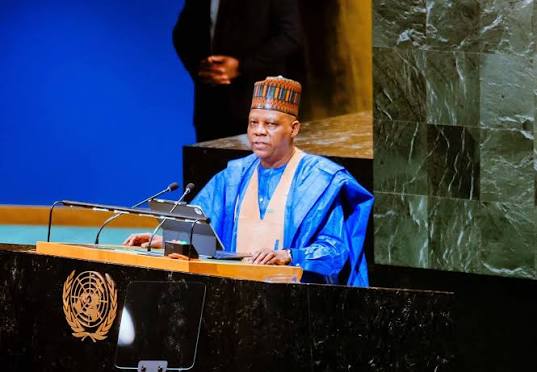
President Bola Tinubu has renewed Nigeria’s call for the reform of the United Nations Security Council, arguing that the global institution must reflect the political, economic and demographic realities of the 21st century. Tinubu made the call on Thursday while addressing delegates at the 81st United Nations General Assembly (UNGA) in New York. He
President Bola Tinubu has renewed Nigeria’s call for the reform of the United Nations Security Council, arguing that the global institution must reflect the political, economic and demographic realities of the 21st century.
Tinubu made the call on Thursday while addressing delegates at the 81st United Nations General Assembly (UNGA) in New York. He was represented at the session by Vice President Kashim Shettima.
 blob:https://www.image2url.com/6b1201f1-93ee-44f9-bbeb-45816585e575
Naira Strengthens Against Pound As GBP/NGN Falls To About ₦1,762
The President said Nigeria remained committed to the UN Charter and multilateralism but argued that the structure of the international system needed to change to reflect contemporary global realities.
“The reform of this institution must begin with the reconstitution of the Security Council, for the world of 2026 cannot remain captive to the distribution of power in 1945,” Tinubu said.
Nigeria has consistently advocated greater African representation on the Security Council, including permanent representation for the continent as part of broader UN reform discussions.
Tinubu also linked sustainable development to peace and security, saying development could not take root where violence continues to destroy livelihoods. He called for stronger international cooperation to tackle terrorism, organised crime, cyberattacks, illicit financial flows and the movement of illegal weapons across borders.
According to the President, Nigeria’s experience in confronting Boko Haram, ISWAP and other armed groups demonstrates that military action alone cannot provide lasting solutions to violent extremism. He identified education, economic opportunities, accountable governance and protection of citizens’ rights as important components of long-term efforts to address insecurity.
He also raised concerns over insecurity in the Sahel, warning that instability in one country can affect neighbouring states through displacement, cross-border insecurity and threats to regional integration.
Tinubu reaffirmed Nigeria’s commitment to regional cooperation through the Economic Community of West African States (ECOWAS) and the African Union (AU), while calling for greater attention to the underlying causes of violent extremism.
On international conflicts, the President called for urgent diplomatic efforts to address the crisis in Sudan and other conflict situations, including the protection of civilians, humanitarian access, dialogue, reconciliation and inclusive political processes.
Tinubu also urged Africa to move beyond its traditional role as an exporter of raw materials by expanding manufacturing, value addition, technological innovation and knowledge-driven economic growth.
Meanwhile, Nigeria has continued bilateral engagements on the sidelines of the UNGA. The Federal Government signed a memorandum of understanding with the United States to strengthen cooperation in the development of Nigeria’s solid minerals sector.
The agreement was signed by the Minister of Solid Minerals Development, Dele Alake, and US Deputy Secretary of State Christopher Landau at the Nigerian Mission House in New York. It covers areas including geological data, mineral exploration and development, processing, infrastructure and technical capacity.
Nigeria has also strengthened cooperation with Italy on the proposed Global Partnership for Education financing campaign, which seeks to mobilise funding for education development globally.












Leave a Comment
Your email address will not be published. Required fields are marked with *