
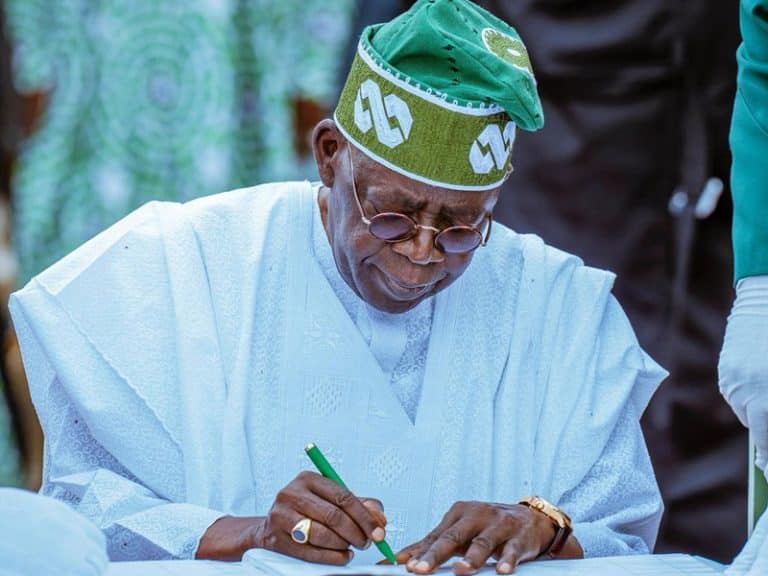
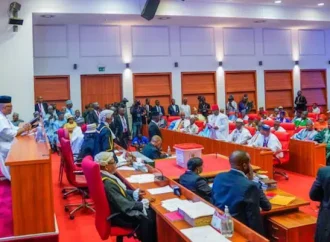
Nigeria’s infrastructure ambitions took center stage on Thursday as President Bola Ahmed Tinubu formally requested Senate approval for a $516.3 million external loan aimed at advancing the Sokoto–Badagry Superhighway project. The request, communicated in a letter addressed to Senate President Godswill Akpabio, was read during plenary, signaling a major step toward financing one of
Nigeria’s infrastructure ambitions took center stage on Thursday as President Bola Ahmed Tinubu formally requested Senate approval for a $516.3 million external loan aimed at advancing the Sokoto–Badagry Superhighway project.
The request, communicated in a letter addressed to Senate President Godswill Akpabio, was read during plenary, signaling a major step toward financing one of the country’s most ambitious road networks.
 blob:https://www.image2url.com/6b1201f1-93ee-44f9-bbeb-45816585e575
The proposed highway, spanning approximately 1,000 kilometers, is designed as a flagship corridor connecting Nigeria’s North-West to the South-West. According to the Presidency, the route will originate from Illela in Sokoto State, pass through Kebbi, Niger, Kwara, Oyo, and Ogun states, and terminate in Badagry, Lagos State.
2027: Hayatu-Deen Declares For ADC Presidential Ticket
The loan request specifically targets Sections 1, Phase 1a and 1b, covering 120 kilometers of the expansive corridor. President Tinubu emphasized that the funding arrangement involves a syndicated loan from Deutsche Bank AG, supported by a partial risk guarantee from the Islamic Corporation for the Insurance of Investment and Export Credit.
In addition to external financing, the federal government has committed over ₦265.5 billion in counterpart funding. This allocation will cover land acquisition, compensation for affected communities, and associated infrastructure needs.
The loan itself carries a tenure of nine years, including a grace period of up to three years. Interest is set at the Chicago Mercantile Exchange SOFR plus 5.3 percent annually—terms that reflect global financing benchmarks.
President Tinubu noted that the Federal Executive Council had already approved the arrangement, underscoring the administration’s urgency in pushing forward with the project. He further requested that the loan be incorporated into Nigeria’s national borrowing plan.
Beyond financing, the President highlighted the broader economic and social impact of the superhighway. He stated that the project is expected to significantly enhance connectivity across regions, improve road safety, and reduce transportation and logistics costs.
The highway is also projected to strengthen trade, boost food security, and foster national unity by linking agricultural production zones with major markets and ports. Plans for future rail lines and utility corridors along the route further position the project as a multi-purpose infrastructure backbone.
Senate President Akpabio subsequently referred the request to the Senate Committee on Foreign and Local Debts, instructing the panel to report back within one week.
Meanwhile, Senator Mohammed Adamu Aliero voiced strong support for the initiative, describing it as long overdue. He revealed that the project has been in discussion for over five decades and expressed satisfaction with the progress observed during inspections.
Aliero also pointed out that construction incorporates both concrete and asphalt road technologies, alongside solar-powered street lighting—features aimed at ensuring durability and sustainability.
Perhaps most notably, he highlighted the potential reduction in travel time between Sokoto and Lagos. Once completed, the journey could shrink from approximately 13 hours to just six, marking a transformative shift in mobility across the country.
As deliberations continue in the Senate, the Sokoto–Badagry Superhighway stands as a defining test of Nigeria’s commitment to large-scale infrastructure development and economic integration.
1 comment













1 Comment
ASIMI
April 23, 2026, 7:05 pmHi my name is AFOLABI
REPLY