
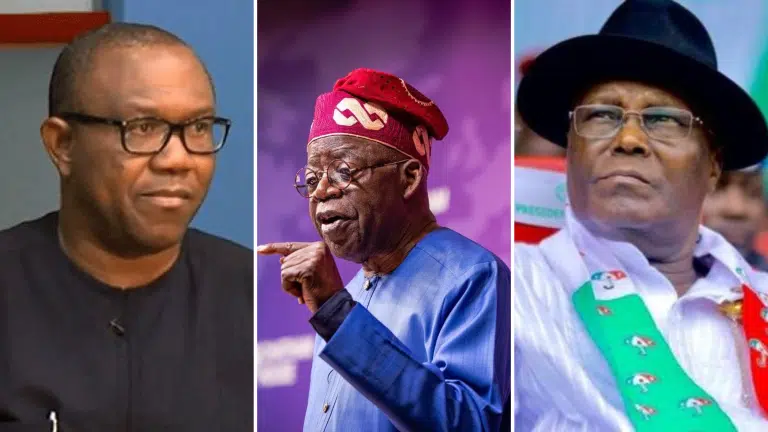
The opposition’s plan to unite behind a single presidential candidate to challenge President Bola Tinubu in the 2027 general election is facing serious setbacks, with major political parties and blocs adopting divergent positions despite earlier talks on forming a common front. While the Tanimu Turaki-led faction of the Peoples Democratic Party (PDP) insists discussions on
The opposition’s plan to unite behind a single presidential candidate to challenge President Bola Tinubu in the 2027 general election is facing serious setbacks, with major political parties and blocs adopting divergent positions despite earlier talks on forming a common front.
While the Tanimu Turaki-led faction of the Peoples Democratic Party (PDP) insists discussions on opposition collaboration remain ongoing, the Nyesom Wike-backed PDP faction has categorically ruled out any alliance, declaring it will contest the election independently. The camp of former Vice President Atiku Abubakar also acknowledged that political parties have already produced their presidential candidates but maintained that consultations on possible cooperation would continue before the polls.
How DSS Helped FBI Arrest Notorious Plane Hijacker In Lagos
 blob:https://www.image2url.com/6b1201f1-93ee-44f9-bbeb-45816585e575
The proposal for opposition unity gained traction following a summit held in Ibadan, Oyo State, on April 25, where opposition leaders explored the possibility of presenting a consensus presidential candidate capable of mounting a stronger challenge against Tinubu. Prominent attendees included Atiku Abubakar, Peter Obi, Rabiu Kwankwaso, Seyi Makinde, Rotimi Amaechi, Rauf Aregbesola, Aminu Tambuwal and other political leaders.
However, the political landscape has since changed significantly. Atiku and Amaechi have emerged as the presidential and vice-presidential candidates of the African Democratic Congress (ADC), while Peter Obi and Rabiu Kwankwaso secured the presidential and vice-presidential tickets of the Nigeria Democratic Congress (NDC). Oyo State Governor Seyi Makinde also emerged as the presidential candidate of the Allied Peoples Movement (APM), making the prospect of a single opposition flag bearer increasingly difficult.
Adding to the challenge is the fact that the Independent National Electoral Commission (INEC) has already closed the window for party primaries, with political parties submitting their candidates before the May 30 deadline.
Despite this, the Turaki-led PDP faction insists the idea of a united opposition has not been abandoned. The faction’s National Publicity Secretary, Ini Ememobong, said the overriding objective remains defeating the incumbent president, adding that every lawful strategy capable of achieving that goal remains under consideration.
“The simple answer is that the end justifies the means. The ultimate objective is to defeat the incumbent, and every strategy that can help achieve that objective remains under consideration,” Ememobong said.
He explained that opposition parties were still engaging one another to explore areas of cooperation, stressing that no single opposition party could effectively challenge the ruling APC alone.
In sharp contrast, the Wike-backed PDP faction dismissed any suggestion of working with other parties. Its National Publicity Secretary, Jungudo Mohammed, said the faction had no alliance with any political party and would field its own candidates at all levels.
“We are not fielding any candidate with anybody. We have our own presidential candidate, governorship candidates, and other candidates. So, we are not in any alliance with anybody,” Mohammed stated.
The NDC also appeared reluctant to embrace the idea of sacrificing its Obi-Kwankwaso ticket for a consensus arrangement. The party’s National Leader, Seriake Dickson, said discussions on a single opposition candidate were not on the table for now.
Similarly, the Peoples Redemption Party (PRP) expressed willingness to collaborate with other opposition groups but maintained that any arrangement must strengthen the chances of removing the APC from power.
The Labour Party equally distanced itself from the Ibadan summit. National Publicity Secretary Ken Asogwa said the party was not part of the arrangement, while Abia State Governor Alex Otti stated that the Labour Party was not bound by resolutions reached at the meeting.
A faction of the ADC led by Nafiu Bala Gombe also rejected the outcome of the Ibadan summit. The faction’s Chief of Staff, Bala Kumo, insisted the ADC was not represented at the meeting and would field its own candidates in the elections.
Reacting to the growing divisions within the opposition, the ruling APC dismissed the entire coalition effort as ineffective.
APC Director of Publicity Bala Ibrahim described the proposed alliance as “dead on arrival,” expressing confidence that President Tinubu would secure re-election regardless of whether the opposition contested separately or united behind a single candidate.
“We are not worried about the possibility of the opposition presenting a single candidate against our candidate. We know it is an issue that is dead on arrival. Since we were able to defeat them individually, defeating them collectively will not be a problem,” Ibrahim said.
He also argued that the Tinubu administration’s economic reforms were beginning to produce results and that Nigerians were gradually appreciating the necessity of the government’s policies.
With presidential candidates already confirmed across major opposition parties and conflicting positions emerging over coalition talks, the prospect of presenting a unified challenger against President Tinubu appears increasingly uncertain as the countdown to the 2027 general election continues.















Leave a Comment
Your email address will not be published. Required fields are marked with *