
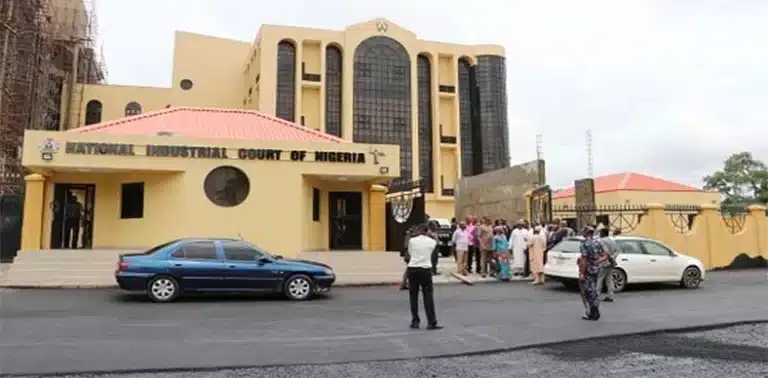
The National Industrial Court of Nigeria (NICN) in Abuja is set to deliver a crucial ruling today in the legal battle between the Federal Capital Territory Administration (FCTA) and the Joint Union Action Committee (JUAC), a case that has drawn national attention due to its impact on governance in the nation’s capital. The suit,
The National Industrial Court of Nigeria (NICN) in Abuja is set to deliver a crucial ruling today in the legal battle between the Federal Capital Territory Administration (FCTA) and the Joint Union Action Committee (JUAC), a case that has drawn national attention due to its impact on governance in the nation’s capital.
The suit, filed by the Minister of the Federal Capital Territory, Nyesom Wike, alongside the FCTA, seeks to restrain JUAC from continuing a strike that has brought activities in key government offices to a standstill. The prolonged industrial action followed the expiration of a seven-day ultimatum issued by the union and has disrupted operations at major FCTA departments, including the FCTA Secretariat, where security personnel were deployed to control access.
 blob:https://www.image2url.com/6b1201f1-93ee-44f9-bbeb-45816585e575
Military Finally Admits Coup Plot Against Tinubu
At the heart of the matter is suit number NICN/ABJ/17/2026, in which the FCTA named JUAC Chairman Rifkatu Iortyer and Secretary Abdullahi Umar Saleh as defendants. The claimants are asking the court to grant an interlocutory injunction barring the defendants from further strikes, picketing, or any form of industrial disruption pending the determination of the substantive suit.
Court Arguments Highlight Core C Issues
During proceedings on Monday before Justice E.D. Subilim, legal representatives for both parties presented arguments that underscored the complexity of the dispute. Counsel to the workers’ union, Maxwell Opara, urged the court to dismiss the FCTA’s application, arguing that granting the injunction would effectively determine the substantive matter at an interlocutory stage.
Opara relied on the Supreme Court decision in Opara Agwu & Anor v. Julius Berger Plc, warning that compelling workers to return to work while salary-related grievances remained unresolved could worsen tensions. He also asked the court to consider directing the FCT minister to participate in arbitration, emphasizing alternative dispute resolution as a more constructive approach.
The FCTA, however, maintained that it had addressed most of the workers’ demands and accused the union of acting outside the law. Counsel to the claimants, James Onoja (SAN), told journalists after the hearing that JUAC lacked juristic personality, arguing that the body was not registered under either the Companies and Allied Matters Act (CAMA) or the Trade Union Act.
According to Onoja, JUAC’s alleged lack of legal recognition rendered the strike illegal. He stressed that established procedures must be followed before industrial action is declared, adding that the government had been open to dialogue and mediation before the union resorted to a strike.
Opara countered this position, revealing that the union had written no fewer than 11 letters to the minister outlining unresolved grievances and requesting mediation. He argued that the FCTA chose litigation over dialogue and described the court action as an attempt to intimidate workers.
The defence also explained why it sought to join the Nigeria Labour Congress (NLC) and the Trade Union Congress (TUC) in the suit. Opara noted that the defendants were sued in their personal capacities rather than as union officers, meaning any court order would bind only two individuals. He added that NLC and TUC had issued directives for affiliated bodies to join a solidarity strike, making them necessary parties to the case.
Justice Subilim, after hearing submissions from both sides, adjourned the matter to today for ruling on the injunction application. The decision is expected to have far-reaching implications for industrial relations within the FCT and may determine whether normal operations resume in Abuja’s government offices or the strike continues.






















Leave a Comment
Your email address will not be published. Required fields are marked with *