
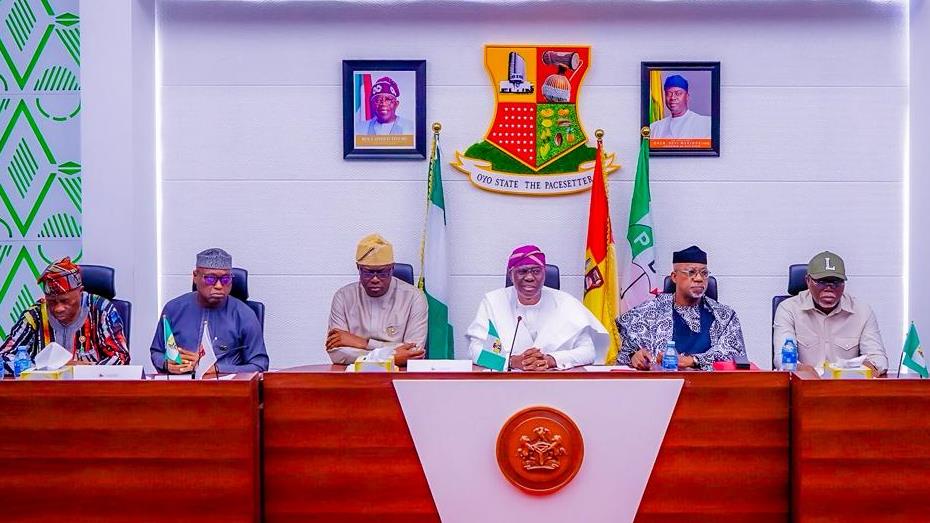
The Development Agenda for Western Nigeria (DAWN) Commission has disclosed that South-West states have proposed a combined budget of approximately ₦8.7 trillion for the 2026 fiscal year, with capital expenditure accounting for more than half of total projected spending. The disclosure highlights a growing emphasis on infrastructure and productivity-driven investments, even as concerns persist
The Development Agenda for Western Nigeria (DAWN) Commission has disclosed that South-West states have proposed a combined budget of approximately ₦8.7 trillion for the 2026 fiscal year, with capital expenditure accounting for more than half of total projected spending. The disclosure highlights a growing emphasis on infrastructure and productivity-driven investments, even as concerns persist over rising debt levels and fiscal fragility across the region.
The figure was announced on Tuesday during the Commission’s 2026 Outlook event, a virtual forum that brought together policymakers, economists and civil society leaders to examine how the South-West can convert Nigeria’s fragile macroeconomic stability into sustained growth, competitiveness and improved welfare outcomes. The event was themed “2026 South-West Nigeria Outlook: Advancing Subnational Economic Competitiveness.”
 blob:https://www.image2url.com/6b1201f1-93ee-44f9-bbeb-45816585e575
Opening the discussion, DAWN Commission Director-General, Dr Seye Oyeleye, said recent macroeconomic and structural reforms at the national level, though painful, are beginning to stabilise key economic indicators. According to him, this has created a narrow but critical window for subnational governments to pursue reforms that can unlock productivity and resilience.
Supreme Council For Shari’ah Calls For Removal Of INEC Chairman Over Trust Concerns
He described Nigeria’s current economic condition as one of “fragile stability,” noting that while risks remain high, the moment presents opportunities for states, particularly in the South-West, to assert economic leadership. Oyeleye stressed that the region, historically known for innovation and enterprise, must now translate stability into concrete gains for citizens through domesticated reforms and stronger regional collaboration.
DAWN Commission Highlights Debt, Capital Spending and Global Risks
Presenting the economic and budget outlook, the Head of Economic Development and Research at the DAWN Commission, Mr Adesoji Farayibi, said the ₦8.7 trillion aggregate budget reflects a deliberate shift toward capital spending, estimated at about ₦4.54 trillion. He noted, however, that Lagos State alone accounts for roughly 51 per cent of the total regional budget, underscoring both its economic dominance and the need to assess fiscal trends beyond the outlier.
Farayibi explained that when Lagos is excluded, the remaining South-West states still show improvement in internally generated revenue and increased capital expenditure. Despite this progress, he warned that steadily rising debt levels pose sustainability concerns that must be carefully managed.
He also pointed to global developments likely to shape the region’s economic outlook in 2026. These include renewed protectionism under a second Donald Trump administration, prolonged geopolitical tensions, tighter global monetary conditions and rapid investment in artificial intelligence. According to him, these factors will influence capital flows, trade dynamics and financing conditions.
Farayibi advised South-West states to position themselves to attract both foreign direct and portfolio investments, while ensuring funds are channelled into critical sectors such as energy, power, transportation, infrastructure and water. He also recommended greater reliance on multilateral financing rather than Eurobonds, given rising borrowing costs, while preparing to tap into opportunities linked to AI-driven investments.
From a state-level perspective, Osun State Commissioner for Budget and Economic Planning, Professor Moruf Adeleke, cautioned against framing capital and recurrent expenditure as a zero-sum choice. He argued that the quality and efficiency of spending matter more than headline ratios, noting that recurrent expenditure remains necessary for institutions to function and for capital projects to succeed.
Adeleke also stressed the importance of public–private partnerships, saying states cannot rely solely on budgetary resources to meet development needs. Collaboration with development partners, he said, is essential to deliver infrastructure and long-term investments.
Providing an academic viewpoint, Professor Abiodun Folawewo of the University of Ibadan emphasised that budgets are ultimately statements of intention whose success depends on implementation. He warned that many state budgets remain ambitious on paper but fall short in execution, with some achieving less than 70 per cent performance.
Similarly, Global Director of BudgIT, Mr Seun Onigbinde, criticised the tendency for budgets to be driven by short-term political considerations rather than evidence-based, long-term planning. He called for stronger outcome evaluation mechanisms to ensure spending translates into tangible improvements in education, healthcare, agriculture and industrial development.
Overall, the DAWN Commission’s 2026 outlook underscores both the promise and the pressure facing South-West states as they seek to balance ambitious capital spending with fiscal sustainability in a complex global and domestic environment.





















Leave a Comment
Your email address will not be published. Required fields are marked with *