
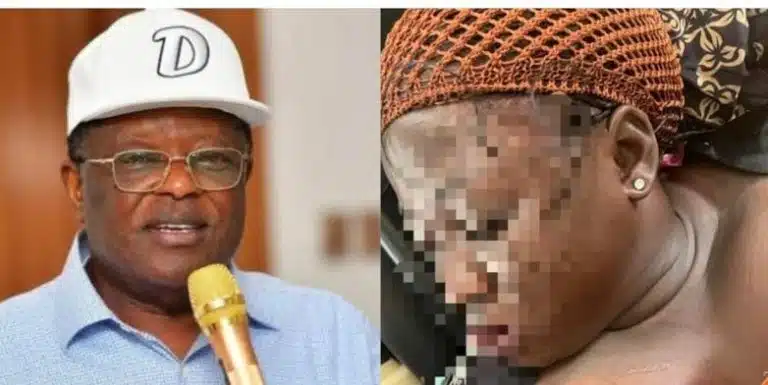
The Ebonyi State Ministry of Justice has recommended that a post-mortem examination be conducted to determine the cause of the death of 26-year-old Mary Habila, who was found dead at the Uburu residence of the Minister of Works, David Umahi. The recommendation was contained in a legal advice dated July 15, 2026, and addressed to
The Ebonyi State Ministry of Justice has recommended that a post-mortem examination be conducted to determine the cause of the death of 26-year-old Mary Habila, who was found dead at the Uburu residence of the Minister of Works, David Umahi.
The recommendation was contained in a legal advice dated July 15, 2026, and addressed to the Deputy Commissioner of Police in charge of the Criminal Investigation Department (CID) of the Ebonyi State Police Command.
The advice followed a police investigation into Habila’s death on June 27 and concluded that the available evidence did not sufficiently establish the cause of her death.
 blob:https://www.image2url.com/6b1201f1-93ee-44f9-bbeb-45816585e575
According to the Director of Public Prosecutions (DPP), investigators found Habila alone and unresponsive in her apartment, but the circumstances surrounding the incident remained unclear.
The legal advice noted that there was no evidence suggesting Habila had been ill or suffered from any known medical condition before her sudden death.
“There was no evidence that the deceased was indisposed, sick or unstable health-wise prior to her sudden death, as she was full of life at the time she returned to Uburu in company of her team,” the document stated.
The Ministry of Justice said the absence of any known health complications made it necessary to establish the exact cause of death through scientific means.
Questioning the circumstances surrounding the incident, the DPP stated:
“From the foregoing, therefore, the question that would readily come to mind is what exactly caused the deceased’s sudden death?”
Nigeria’s Headline Inflation Drops To 15.91 Per Cent
The ministry maintained that a post-mortem examination would provide investigators with crucial medical evidence to guide the ongoing investigation.
According to the legal advice, an autopsy remains the most reliable method of determining the cause of death.
“This curiosity under the law can only be resolved through a post-mortem examination, so as to provide a clue to the police as to the direction of their investigation,” the DPP stated.
The Ministry of Justice further advised the police to either respect the wishes of Habila’s family regarding burial arrangements or invoke their statutory powers to order an autopsy if deemed necessary.
“It is therefore the view of this office that the police invoke their discretionary power to either respect the request of the deceased’s family or proceed with the post-mortem examination,” the advice added.
The recommendation comes amid public interest over the circumstances of Habila’s death and reports that her body has not yet been released to her family.
Her father, Baba Habila, reportedly visited a morgue in Ebonyi State to collect her remains for burial in Nok, Kaduna State, but declined to comment to journalists.
Although the family is said to prefer burial without an autopsy, the body has reportedly remained in custody while investigators consider the legal advice.
Habila reportedly arrived at Umahi’s residence on June 26 alongside another woman identified as Anita Baski before she was found unresponsive the following morning.
The matter was initially reported at the Ohaozara Divisional Police Headquarters before being transferred to the State Criminal Investigation Department for further investigation.
Minister of Works David Umahi has since confirmed that Habila died at his residence, describing her as a physiotherapist seconded from the David Umahi Federal University of Health Sciences to the Federal Ministry of Works.
The minister also disclosed that he had encouraged the deceased’s family to consent to an autopsy to establish the exact cause of death.
Meanwhile, reports citing unnamed security sources indicate that investigators are also examining aspects of Habila’s employment history and her relationship with both the university and the Federal Ministry of Works as part of the ongoing investigation.




















Leave a Comment
Your email address will not be published. Required fields are marked with *