
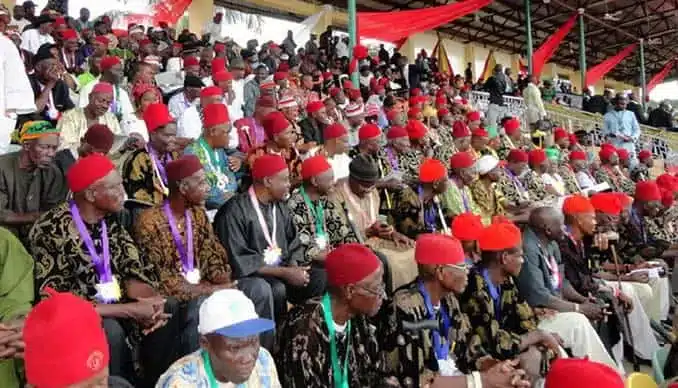
Ohanaeze Warns Tinubu: Dialogue, Not Defections, Key to 2027 Victory in Southeast The apex Igbo sociocultural organization, Ohanaeze Ndigbo, has cautioned President Bola Ahmed Tinubu against relying solely on political endorsements or defections from Southeast governors as a strategy for securing votes in the 2027 general elections. Instead, the group has strongly advised the president
Ohanaeze Warns Tinubu: Dialogue, Not Defections, Key to 2027 Victory in Southeast
The apex Igbo sociocultural organization, Ohanaeze Ndigbo, has cautioned President Bola Ahmed Tinubu against relying solely on political endorsements or defections from Southeast governors as a strategy for securing votes in the 2027 general elections. Instead, the group has strongly advised the president to engage in critical dialogue with nonviolent pro-Biafra leaders to address decades-long grievances and truly win the hearts of the Southeast electorate.
In a statement jointly signed by the Deputy President General, Mazi Okechukwu Isiguzoro, and the National Spokesman, Chief Thompson Ohia, Ohanaeze emphasized that the Southeast remains marginalized and that only sincere political engagement—not calculated alliances—can bridge the historical rift between the region and the federal government.
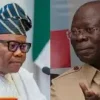
 blob:https://www.image2url.com/6b1201f1-93ee-44f9-bbeb-45816585e575
“As President Bola Ahmed Tinubu commemorates his second year in office, Ohanaeze Ndigbo issues a forthright appeal to the Federal Government to embark upon a critical dialogue with Nonviolent Pro Biafra leaders,” the statement read. “This moment represents perhaps the singular opportunity in 55 years to definitively resolve the protracted Biafra conflict—a goal that has eluded generations.”
The group pointed out that the federal government’s reluctance to engage with nonviolent pro-Biafra leaders constitutes a significant miscalculation, one that has contributed to national instability and mistrust. Ohanaeze believes that such dialogue could provide a pathway toward healing wounds that have lingered since the Nigeria-Biafra civil war ended more than half a century ago.
“For clarity, it must be noted that the Nonviolent Pro Biafra activists are neither banned nor proscribed,” the statement clarified. “Their unwavering commitment to peaceful agitation has remained unmarred by accusations of violence or conflict against governmental authorities.”
According to Ohanaeze, over the past 23 years, these groups have emerged as the moral compass in the Southeast, calling out systemic injustice and socio-economic neglect without resorting to violence. It insists that these groups should be seen not as a threat but as a legitimate voice for peace and reform in the region.
The organization also criticized the perceived silence and political hesitation of Southeast politicians who, it says, have failed to push for a resolution of the Biafra question. “Southeast politicians appear reticent to voice the truth regarding the resolution of the Biafra conflict,” the statement lamented. However, it assured that the nonviolent leaders remain ready and willing to work with the federal government for peace and national reconciliation.
Looking ahead to the 2027 elections, Ohanaeze issued a strong warning that political missteps—like ignoring legitimate regional concerns—could cost the president dearly. The group reminded Tinubu of the political downfall of former President Goodluck Jonathan in 2015, a cautionary tale of overreliance on political structures without engaging the wider populace.
“This upcoming election will serve as a referendum on the pervasive issues of hunger and poverty that plague our nation,” the statement declared. “President Tinubu must not place undue trust in ephemeral political endorsements or defections from state governors; such strategies are often reflections of self-preservation rather than genuine loyalty.”
It added that the influence of state governors in the region has significantly diminished, making their endorsements “effectively meaningless.” Ohanaeze emphasized that real political engagement must happen at the grassroots level with those who now command the attention and respect of the people—namely, the nonviolent Biafra agitators.
“The predominant voice in the region now rests with the Nonviolent Pro Biafra Agitators, who possess the capacity to galvanize and mobilize the populace across the 774 Local Government Areas,” the group asserted.
According to Ohanaeze, a failure to seize this rare opportunity for dialogue could not only weaken Tinubu’s support in the region but also fuel deeper political disenchantment. “President Tinubu’s political survival hinges upon the willingness to engage sincerely with the Igbo people,” the statement continued. “The Nonviolent Pro Biafra leaders have graciously offered a handshake of reconciliation—a historic opportunity for dialogue that must not be squandered.”
The group concluded its appeal with a message of unity and urgency: “Let us collectively advance towards a future founded on dialogue, understanding, and reconciliation. The time for action is now.”
As Nigeria approaches another pivotal election season, Ohanaeze’s message underscores a critical truth: that sustainable national unity requires listening to all voices—especially those long unheard—and building bridges through sincere dialogue, not political tokenism.



















Leave a Comment
Your email address will not be published. Required fields are marked with *