
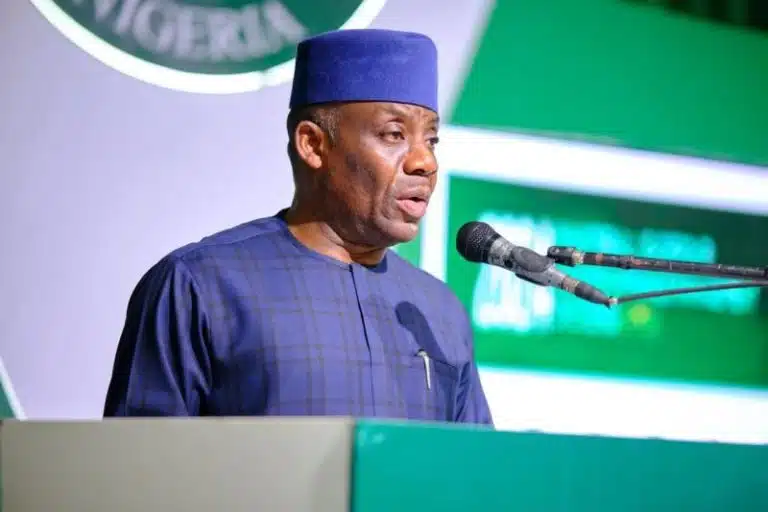
The Federal Government has adopted Kaduna State's household mapping model as the national framework for identifying out-of-school children, marking a shift from broad statistical estimates to verified, household-based data in efforts to improve access to education across Nigeria. Minister of Education, Dr. Tunji Alausa, announced the decision on Thursday after a meeting with Kaduna State
The Federal Government has adopted Kaduna State’s household mapping model as the national framework for identifying out-of-school children, marking a shift from broad statistical estimates to verified, household-based data in efforts to improve access to education across Nigeria.
Minister of Education, Dr. Tunji Alausa, announced the decision on Thursday after a meeting with Kaduna State Governor, Uba Sani, stating that the Federal Ministry of Education, in collaboration with the National Bureau of Statistics (NBS), will conduct a nationwide household mapping exercise across the 36 states and the Federal Capital Territory. According to the minister, the initiative will enable government authorities to identify the exact number of out-of-school children, their locations and households, thereby supporting targeted interventions and more efficient allocation of education resources.
IG Redeploys Embattled Osun Police Commissioner To Force HQ
 blob:https://www.image2url.com/6b1201f1-93ee-44f9-bbeb-45816585e575
Alausa said the approach had already demonstrated its effectiveness in Kaduna, where an earlier estimate of about 585,000 out-of-school children was revised to fewer than 200,000 following the household mapping exercise. He noted that the model would strengthen education planning, improve policy implementation and support the Tinubu administration’s Renewed Hope Agenda.
Governor Uba Sani welcomed the Federal Government’s adoption of Kaduna’s model, describing it as a significant step towards addressing Nigeria’s education challenges through accurate data. He reaffirmed the state’s commitment to working closely with the Federal Ministry of Education to increase school enrolment and expand access to quality education. Alausa added that the nationwide exercise would provide a reliable database to guide government policies, enhance collaboration with state governments and development partners, and ensure that more out-of-school children are identified, enrolled and retained in school.




















Leave a Comment
Your email address will not be published. Required fields are marked with *