
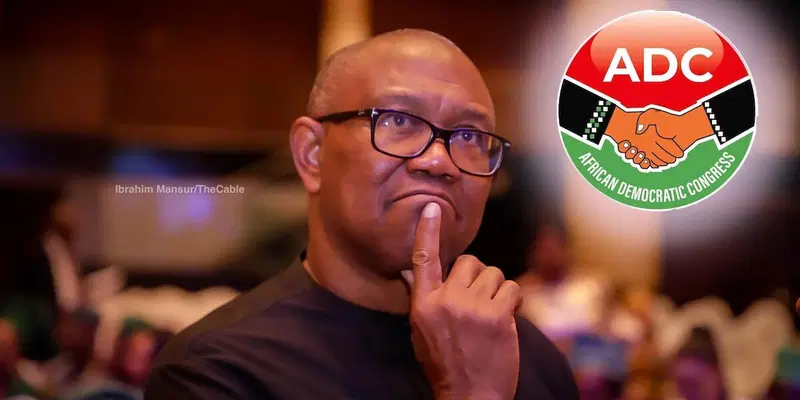
The growing conversation around Peter Obi’s possible alignment with the African Democratic Congress (ADC) has triggered renewed debate within Nigeria’s political space. While still largely speculative, the implications of such a move are far-reaching and could redefine opposition politics ahead of the 2027 general elections. A Strategic Boost for ADC The ADC, though nationally
The growing conversation around Peter Obi’s possible alignment with the African Democratic Congress (ADC) has triggered renewed debate within Nigeria’s political space. While still largely speculative, the implications of such a move are far-reaching and could redefine opposition politics ahead of the 2027 general elections.
A Strategic Boost for ADC
The ADC, though nationally registered, has long struggled to escape the shadow of Nigeria’s dominant political parties. Peter Obi’s political brand—built on accountability, fiscal discipline, and youth engagement—could instantly reposition the party as a serious national contender.
Osun Local Governments Resume January 5 As Newsworld Media Calls For Peace
Obi brings with him not just popularity, but structure. His 2023 campaign demonstrated an unprecedented level of grassroots mobilization, particularly among urban youths, professionals, and the politically disengaged middle class. For ADC, this translates into instant visibility, volunteer networks, and renewed relevance.
Rewriting the Opposition Landscape
If Obi formally aligns with ADC, the biggest casualty may be the Peoples Democratic Party (PDP). Already weakened by internal crises, leadership disputes, and ideological confusion, the PDP risks losing its remaining appeal to reform-minded Nigerians.
The All Progressives Congress (APC), on the other hand, would face a more ideologically coherent opposition than it has in recent years. Unlike traditional opposition politics driven by elite power struggles, an Obi-led ADC could push issue-based politics, accountability, and governance reform to the forefront.
Potential Political Realignments
A move by Obi could trigger a wave of defections—quiet at first, but significant. Politicians seeking relevance, especially in the South and parts of the Middle Belt, may view ADC as a new political home. Civil society groups and youth movements could also institutionalize their activism through the party.
This would mark a shift from personality-driven politics to movement-driven participation, something largely absent from Nigeria’s democratic journey.
The Risks and Realities
However, expectations must be tempered with realism. Transforming enthusiasm into electoral victory requires strong grassroots structures, funding, and internal party discipline. Without these, ADC risks becoming another platform of political hope without institutional strength.
Moreover, entrenched political interests will resist disruption. The electoral environment remains challenging, and the system historically favors established power blocs.
Whether or not Peter Obi ultimately contests under ADC, the conversation itself reflects a deep hunger for political alternatives in Nigeria. His potential move symbolizes a rejection of recycled politics and a demand for credible leadership.
If properly managed, an Obi-ADC alignment could mark the beginning of a new political culture—one centered on accountability, civic participation, and national development rather than patronage.
In that sense, the real impact may not just be about winning elections, but about resetting Nigeria’s political expectations.











Leave a Comment
Your email address will not be published. Required fields are marked with *