
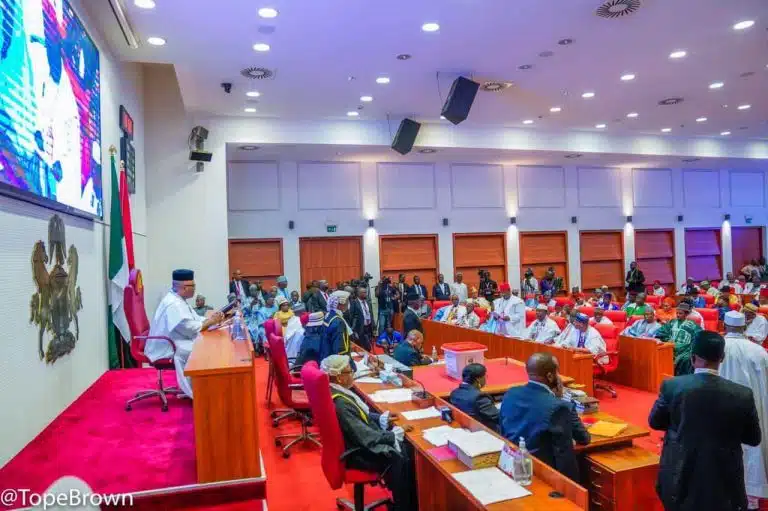
Nigeria moved a step closer to adopting decentralized policing on Wednesday as the Senate passed key constitutional amendments aimed at establishing state police across the federation. The proposed Constitution Alteration (State Police) Bill, 2026, received the support of more than two-thirds of senators after a clause-by-clause review and manual vote. However, the legislation must still
Nigeria moved a step closer to adopting decentralized policing on Wednesday as the Senate passed key constitutional amendments aimed at establishing state police across the federation.
The proposed Constitution Alteration (State Police) Bill, 2026, received the support of more than two-thirds of senators after a clause-by-clause review and manual vote. However, the legislation must still be approved by the House of Representatives, endorsed by state Houses of Assembly, and signed into law by President Bola Ahmed Tinubu before it can take effect.
Leading the debate, Senate Leader Opeyemi Bamidele emphasized that the bill contains extensive protections to prevent governors from turning state police formations into political tools.
 blob:https://www.image2url.com/6b1201f1-93ee-44f9-bbeb-45816585e575
Bamidele explained that lawmakers were mindful of concerns that state governors could potentially use local police forces for partisan, ethnic, religious, sectional, or personal interests.
To address these fears, the bill outlines strict limits on the powers and responsibilities of state police organizations.
According to him, state police would primarily focus on enforcing state laws, maintaining public safety, preventing and detecting crimes within their territories, and protecting lives and property.
The legislation also preserves the authority of the federal police in matters that extend beyond state boundaries or affect national security.
Wike, Obasanjo In Attendance As PDP Holds NEC Meeting
Under the proposed framework, the federal police would retain exclusive jurisdiction over critical national issues, including terrorism, organized crime, cybercrime, border security, arms trafficking, and interstate criminal activities.
The bill further specifies circumstances under which federal authorities may intervene in a state’s policing affairs.
Such intervention would be permitted only in cases involving a breakdown of public order, serious violations of constitutional rights, electoral intimidation, failure of state police operations, or threats to national security.
Bamidele noted that any federal intervention must be authorized in writing by the President, restricted in duration and scope, subjected to Senate oversight, and remain open to judicial review.
“The bill provides robust safeguards against abuse, preserves federal authority where necessary, protects constitutional rights, and creates a modern policing framework capable of addressing contemporary security challenges,” he stated.
The proposal received backing from several senators who argued that Nigeria’s worsening security situation requires new approaches.
Enyinnaya Abaribe revealed that although he previously opposed state police, the current security realities had convinced him of its necessity.
Similarly, Aminu Tambuwal and Senate Chief Whip Tahir Monguno expressed support for the measure, maintaining that it would strengthen security management at the state level and improve responses to local threats.
If eventually enacted, the legislation would represent one of the most significant reforms to Nigeria’s security architecture since the return to democratic rule in 1999.
Supporters believe decentralized policing could improve intelligence gathering, community engagement, and rapid response capabilities, particularly in areas affected by banditry, kidnapping, terrorism, and other violent crimes.
Critics, however, continue to caution that strong oversight mechanisms will be essential to ensure that state police forces remain professional, accountable, and insulated from political interference.
The next phase of the process will see the bill transmitted to the House of Representatives for consideration before moving to the states for constitutional ratification.






















Leave a Comment
Your email address will not be published. Required fields are marked with *