
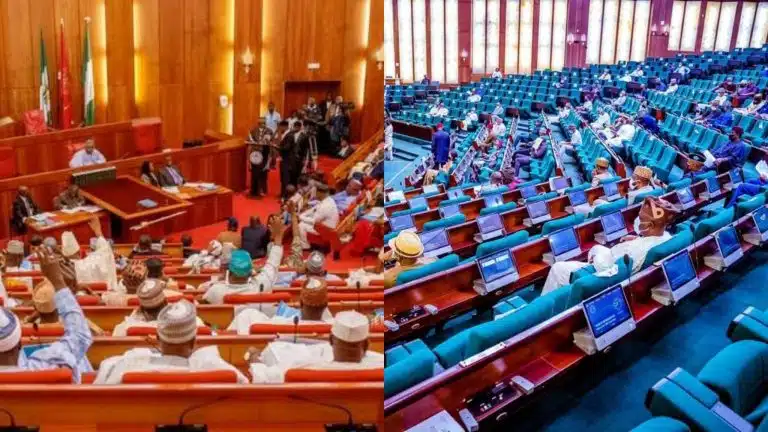
ABUJA — Plans are underway for a conference committee to harmonise two differing versions of the Constitution Alteration Bill seeking to establish state police, after the Senate and House of Representatives passed separate drafts of the legislation. Newsworld Media Network understands that the House passed its version on June 10, while the Senate adopted the
ABUJA — Plans are underway for a conference committee to harmonise two differing versions of the Constitution Alteration Bill seeking to establish state police, after the Senate and House of Representatives passed separate drafts of the legislation.
Newsworld Media Network understands that the House passed its version on June 10, while the Senate adopted the Executive Bill — earlier forwarded by President Bola Tinubu — on June 24. Before the bill can proceed to the President for assent, it must first secure the backing of at least two-thirds of the 36 state Houses of Assembly, following the harmonisation of both chamber’s drafts into a single document.
Court Sets Aside NDC Registration, INEC Awaits Certified Judgment Before Next Move
 blob:https://www.image2url.com/6b1201f1-93ee-44f9-bbeb-45816585e575
An examination of the two versions reveals notable differences in scope and structure. The Senate’s draft spans 26 clauses, compared to 18 in the House’s, with each chamber targeting different sections of the constitution for amendment. The House limited its changes to Sections 34, 35, 39, 42, 89, 129, 153 and 197, whereas the Senate cast a wider net, amending Sections 84, 89, 121, 124, 129, 157, 158, 160, 197, 201 and 202.
On the core issue of policing structure, both chambers agreed on inserting a new Section 214 to replace the constitutional provision that currently establishes the Nigeria Police Force, though the Senate’s version contains 15 new sub-clauses against seven in the House’s. The two chambers parted ways, however, on Section 215, which governs the appointment and control of police authorities. The Senate frames the section as “Appointment, Command, Direction and Tenure,” with state-level command heads styled “Commander,” while the House preserved the existing terminology, “Appointment of Inspector-General of Police and Commissioner of Police of a State,” keeping the title “Commissioner of Police” for state command heads.
A comparable split emerged over Section 216. Both chambers rewrote the provision entirely, but assigned it different functions — the Senate calling it “National Police Standards, Oversight and Accountability,” while the House framed it around the “Removal of Inspector-General of Police and Commissioner of Police of a State.” The Senate’s draft goes further still, incorporating seven transitional provisions to guide the rollout of state police structures and expanding amendments to the Second, Third and Fourth Schedules of the constitution, whereas the House restricted its changes to only the Second and Third Schedules.
Addressing the path forward, Deputy Speaker of the House of Representatives and Chairman of the House Committee on Constitution Review, Benjamin Kalu, disclosed that a conference committee would be constituted once the House resumes from recess on July 7 to resolve the outstanding differences. He described the legislation as a product of broad consultation involving the Executive and other key stakeholders, maintaining that despite the variations, both versions remain “fundamentally the same” at their core, separated mainly by drafting nuances rather than substantive disagreement.
This was corroborated by House spokesman, Akin Rotimi, who confirmed that the forthcoming conference committee would be charged with reconciling the two drafts ahead of their transmission to the state assemblies.
Kalu voiced confidence that the harmonisation exercise would be concluded swiftly once lawmakers return from recess, adding that the finalised bill would be formally handed over to the Speakers of the state Houses of Assembly in a ceremonial presentation the same day the process wraps up. He noted that state governors had already done preparatory work on their end, predicting the bill could return from the states within a week — clearing the way for presidential assent.
He further disclosed that the proposal has attracted broad national support, including endorsements from state governors and the Conference of Speakers, both of which have committed to ensuring swift passage once the bill reaches the state legislatures. Kalu also pointed to built-in safeguards meant to prevent governors from abusing control over state police, explaining that the National Police Council would establish minimum operating standards that any state must satisfy before its police service can be certified — while leaving room for states to exceed those baseline requirements if they choose.
Separately, Lagos State Governor, Babajide Sanwo-Olu, confirmed his state’s readiness to roll out its own police service as soon as the bill becomes law, revealing plans to tap into the expertise of retired security chiefs to bolster the state’s policing framework.
*Newsworld Media Network — bringing you happenings around the world, 24/7.*


















Leave a Comment
Your email address will not be published. Required fields are marked with *