
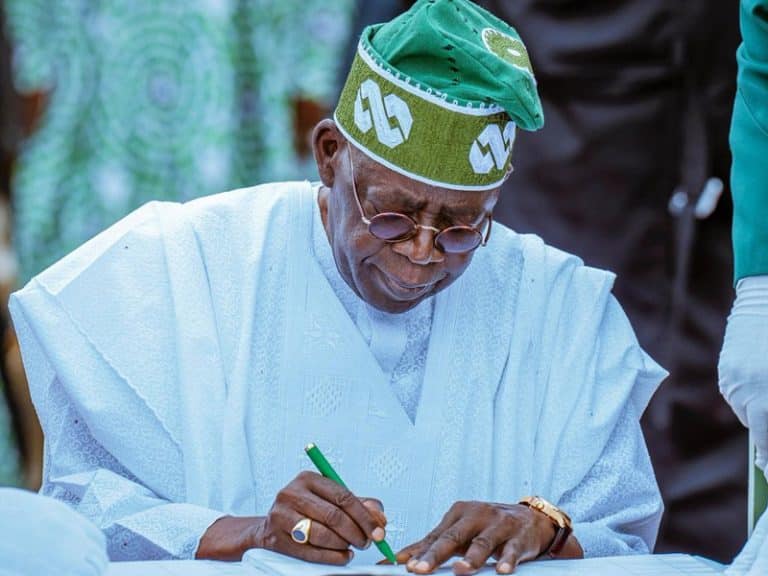
President Bola Ahmed Tinubu has formally requested approval from the Nigerian Senate to secure a total of $6 billion in external loans aimed at funding critical national projects and addressing budgetary shortfalls. The request, detailed in two separate letters, was presented during plenary and directed to Senate President Godswill Akpabio. The move signals the
President Bola Ahmed Tinubu has formally requested approval from the Nigerian Senate to secure a total of $6 billion in external loans aimed at funding critical national projects and addressing budgetary shortfalls.
The request, detailed in two separate letters, was presented during plenary and directed to Senate President Godswill Akpabio. The move signals the administration’s continued efforts to stabilise the nation’s finances while sustaining development initiatives.
 blob:https://www.image2url.com/6b1201f1-93ee-44f9-bbeb-45816585e575
In the first communication, Tinubu sought approval to obtain a $5 billion loan from Abu Dhabi Bank. According to the President, the facility will be used to cover Nigeria’s budget deficit and support debt financing obligations.
The government explained that this borrowing forms part of a broader fiscal strategy to maintain economic stability and ensure the uninterrupted execution of key government programmes. Officials argue that such financial support is necessary amid growing economic demands and limited revenue streams.
‘Heartless Coward’ – Tinubu Finally Speaks On Killings In Plateau, Kaduna
In a separate request, the President asked for approval to secure an additional $1 billion loan facility from UK Export Finance, arranged through Citi Bank in London.
This funding is specifically earmarked for the rehabilitation of major port infrastructure, including the Lagos Port Complex and Tin Can Island Port. These facilities are central to Nigeria’s maritime operations and play a vital role in international trade.
Tinubu noted that the planned upgrades are designed to address long-standing infrastructure deficiencies within the port system. He emphasized that improving these facilities would boost efficiency, enhance safety standards, and reduce congestion that has historically slowed trade activities.
The President further highlighted that revitalising port infrastructure aligns with the government’s broader objective of diversifying the economy beyond oil dependence. By strengthening the maritime sector, Nigeria aims to position itself as a competitive regional trade hub capable of attracting investment and increasing export capacity.
Following the reading of the letters, Akpabio referred the requests to the Senate Committee on Local and Foreign Debts for detailed consideration. The committee is chaired by Aliyu Wamakko, who will lead the review of the loan terms and their potential economic implications.
The proposal has already sparked discussions among policymakers and economic analysts, with opinions divided over the necessity of additional borrowing. While some view the loans as essential for infrastructure development and fiscal support, others have raised concerns about rising debt levels and long-term repayment sustainability.
As the Senate begins its evaluation, the outcome of this request will be crucial in shaping Nigeria’s financial strategy and determining how the country balances immediate funding needs with long-term economic growth.











Leave a Comment
Your email address will not be published. Required fields are marked with *