
The United States military has carried out a seventh consecutive night of airstrikes on Iran, marking a further escalation in hostilities after President Donald Trump declared the temporary ceasefire agreement between both countries had ended. According to the US Central Command (CENTCOM), American forces targeted surveillance sites, military logistics infrastructure, underground weapons storage facilities and
The United States military has carried out a seventh consecutive night of airstrikes on Iran, marking a further escalation in hostilities after President Donald Trump declared the temporary ceasefire agreement between both countries had ended.
According to the US Central Command (CENTCOM), American forces targeted surveillance sites, military logistics infrastructure, underground weapons storage facilities and maritime assets during the latest operation.
CENTCOM said the strikes involved fighter jets, aerial drones, warships and other military assets, with the operation concluding at about 9:30 p.m. Eastern Time (2:30 a.m. BST).
 blob:https://www.image2url.com/6b1201f1-93ee-44f9-bbeb-45816585e575
BUA To Commission 200,000-Barrel-Per-Day Oil Refinery In First Quarter of 2027
Iran responded by launching attacks against US allies across the Middle East, including Kuwait, Jordan and Bahrain.
Kuwaiti authorities confirmed that another electricity and water desalination plant was struck, triggering a fire that damaged parts of the facility and forced the shutdown of some power generation units. The incident followed a similar attack reported a day earlier.
Jordan’s military said it intercepted 10 Iranian missiles that entered its airspace overnight, preventing damage or casualties. Bahrain also announced that its air defence systems successfully repelled Iranian attacks targeting the kingdom.
Iranian state media reported explosions in the central city of Yazd, on Qeshm Island and around the strategic port of Bandar Abbas near the Strait of Hormuz, although the extent of the damage remains unclear.
The renewed fighting follows the collapse of a ceasefire agreed in June to create room for negotiations aimed at ending the conflict. Although the truce was largely observed initially, tensions resurfaced after Iran targeted oil tankers in the Strait of Hormuz in an attempt to enforce its shipping restrictions, prompting retaliatory US military action.
Last week, President Trump declared the ceasefire over, paving the way for a fresh round of military operations. Since then, the United States has intensified strikes against Iranian targets and reimposed a naval blockade on Iranian ports.
Iran has also declared the Strait of Hormuz closed to commercial shipping, significantly disrupting one of the world’s busiest energy transit routes. Roughly one-fifth of global oil and liquefied natural gas supplies normally pass through the waterway, raising concerns over international energy markets.
International Energy Agency Executive Director Fatih Birol has warned that continued disruption in the region could threaten global energy security.
Meanwhile, the US military dismissed reports by Iran’s Fars News Agency claiming that two oil tankers exploded after travelling through a mined section south of the Strait of Hormuz.
CENTCOM rejected the allegation, describing it as false and accusing Iran’s Islamic Revolutionary Guard Corps (IRGC) of spreading misinformation.
Iran’s armed forces also claimed responsibility for attacks on multiple US military facilities across Kuwait, Bahrain, Jordan and, for the first time, Syria. The United States denied the claims, although media reports indicated that several American service members were injured during recent Iranian attacks on military bases in Jordan.
The US also rejected Tehran’s accusations that it deliberately targeted civilian infrastructure, insisting that its operations focused solely on military objectives.
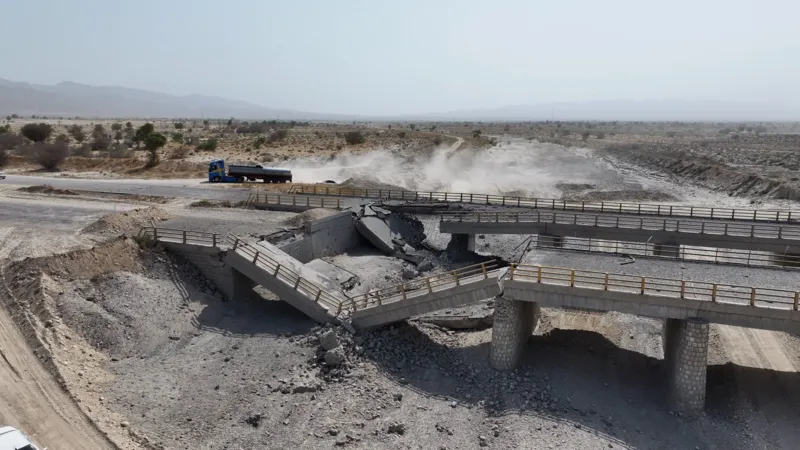
However, independently verified footage showed significant damage to Gariveh Bridge in Hormozgan Province, where local authorities reported that at least seven people were killed during the strikes.
The White House maintained that American forces had targeted only military logistics infrastructure, while Defence Secretary Pete Hegseth said US strikes also destroyed a control tower at Iran’s Chabahar Port, describing it as part of the IRGC’s maritime surveillance network.



















Leave a Comment
Your email address will not be published. Required fields are marked with *