
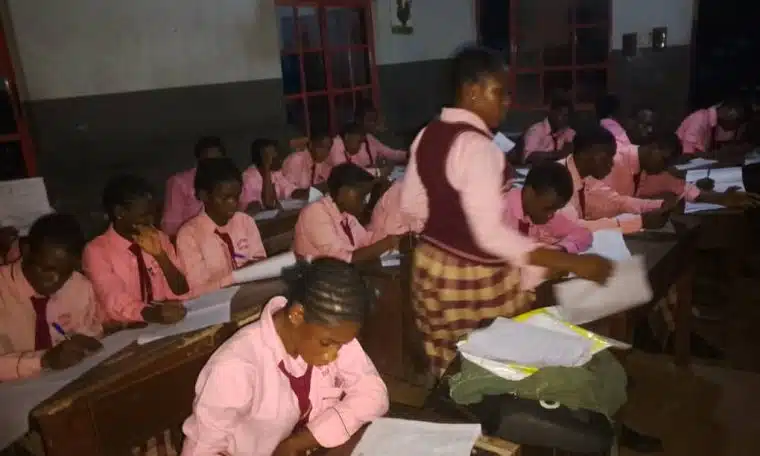
The Federal Government has come under heavy criticism following its approval of a new ₦50,000 registration fee for candidates sitting the West African Examinations Council (WAEC) and National Examinations Council (NECO) Senior School Certificate Examinations beginning in 2027. The new fee, which represents an increase of about 82 per cent from the current ₦27,500, has
The Federal Government has come under heavy criticism following its approval of a new ₦50,000 registration fee for candidates sitting the West African Examinations Council (WAEC) and National Examinations Council (NECO) Senior School Certificate Examinations beginning in 2027.
The new fee, which represents an increase of about 82 per cent from the current ₦27,500, has sparked widespread concern among education stakeholders, who warn that it could worsen Nigeria’s out-of-school crisis and further limit access to secondary education.
The approval was conveyed in a letter dated June 18, 2026, signed by the Director of Senior Secondary Education at the Federal Ministry of Education, Adeniji Ibrahim, following a request by WAEC for a review of examination charges.
 blob:https://www.image2url.com/6b1201f1-93ee-44f9-bbeb-45816585e575
According to the ministry, the decision followed a meeting held on March 31, 2026, between the Minister of Education and examination bodies, where the rising cost of administering public examinations was discussed.
The ministry explained that both WAEC and NECO would adopt a uniform registration fee of ₦50,000 for the Senior School Certificate Examination from the 2027 academic session.
“You may recall that at a meeting of examination bodies held with the Honourable Minister of Education on March 31, 2026, where the need for upward review of examination fees was discussed, the Honourable Minister directed that WAEC and NECO should adopt a uniform fee for the conduct of WAEC and NECO SSCE,” the letter stated.
The ministry also instructed NECO to notify relevant stakeholders ahead of the implementation of the new fee structure.
Confirming the development, the Director of Press and Public Relations at the Federal Ministry of Education, Folasade Boriowo, said the approval had been officially granted.
Although the ministry did not provide a detailed justification for the increase, examination bodies have consistently cited rising operational costs—including printing, logistics, security, supervision, transportation, technology deployment and administration—as reasons for periodic reviews of examination charges.
The decision has, however, drawn strong opposition from education experts and school proprietors, who argue that the increase comes at a time when many Nigerian families are already grappling with severe economic hardship.
National Mobilisation Officer of the Education Rights Campaign, Adaramoye Michael Lenin, described the policy as counterproductive, warning that it would increase the number of children unable to complete their secondary education.
“This increase is not going to help curb the out-of-school crisis the government is trying to stop; rather, it will increase it,” Lenin said.
He argued that education was gradually becoming commercialised and warned that parents struggling with inflation and declining purchasing power might withdraw their children from school because of the additional financial burden.
Lenin called on the Federal Government to reverse the decision, insisting that the new fee would discourage school enrolment and undermine efforts to improve educational outcomes.
Similarly, the President of the National Association of Proprietors of Private Schools (NAPPS), FCT Chapter, Dorothy Okwuenu, described the increase as unfortunate.
According to her, many parents are already struggling to meet basic educational expenses, and the higher registration fee could derail efforts to reduce school dropout rates.
“It is a terrible move from the government. The increase will discourage students from going to school and worsen the out-of-school children crisis,” she said.
Education consultant and Executive Director of Chalcedony Prime School, Dr. Mary Chinwuba, said the increase could deepen inequality within the education sector.
She noted that children from wealthier families would continue their education with little difficulty, while those from low-income households might be unable to register for the examinations.
“Many Nigerian families are already struggling with inflation and the rising cost of living. A sharp increase in examination fees could prevent thousands of qualified students from sitting for WAEC or NECO examinations,” Chinwuba said.
The Proprietress of The Winners Joy International Academy, Rosemary Onyenagubo, expressed similar concerns, warning that quality education was gradually becoming unaffordable for ordinary Nigerians.
“Education is gradually becoming only for the rich. Many students may drop out because their parents simply cannot afford the new charges,” she said.
Stakeholders also warned that state governments operating free WAEC and NECO registration programmes could face significant financial pressure as the new fee would require much larger budgetary allocations.
The presidential candidate of the African Democratic Congress (ADC), Atiku Abubakar, also criticised the government’s decision, describing it as economically insensitive.
In a statement issued by his media aide, Phrank Shaibu, the former Vice President argued that increasing examination fees at a time of soaring inflation, rising transportation costs and stagnant incomes would further deny many Nigerian children access to education.
According to Atiku, education remains one of the most effective pathways out of poverty and should be made more accessible rather than more expensive.
He maintained that imposing additional financial burdens on struggling families contradicts the government’s constitutional responsibility to promote access to education.
Amid the growing backlash, an old video of President Bola Tinubu from his tenure as Governor of Lagos State resurfaced on social media.
In the clip, recorded in 2001, Tinubu explained why his administration decided to pay WAEC examination fees for students after discovering that many parents could not afford the charges.
Speaking in Yoruba, the President recalled that examination fees then ranged between ₦1,000 and ₦2,000, yet many families still struggled to pay.
“Before we came into office, students were asked to pay WAEC fees of between ₦1,000 and ₦2,000. During the campaign, people told me they could not afford the fees and had asked their children to stay at home,” Tinubu said.
He explained that the experience prompted his administration to fund examination fees for students, arguing that financial hardship should never prevent children from becoming doctors, engineers or other professionals.
The resurfaced video has since reignited debate over the Federal Government’s latest decision, with many Nigerians questioning the sharp increase in examination fees amid worsening economic conditions and growing concerns over access to quality education.
















Leave a Comment
Your email address will not be published. Required fields are marked with *