

Nigeria’s Minister of Defence, Christopher Musa, has said the country's battle against terrorism, banditry, and insurgency remains challenging because criminal groups continue to receive support from sponsors and collaborators within local communities. Musa made the remarks during the 2026 edition of The Platform Nigeria, a public policy forum organised to commemorate Democracy Day and hosted
Nigeria’s Minister of Defence, Christopher Musa, has said the country’s battle against terrorism, banditry, and insurgency remains challenging because criminal groups continue to receive support from sponsors and collaborators within local communities.
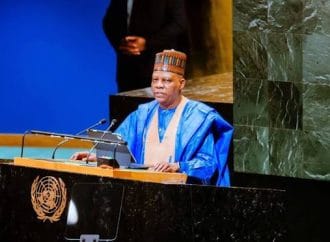
Musa made the remarks during the 2026 edition of The Platform Nigeria, a public policy forum organised to commemorate Democracy Day and hosted by Poju Oyemade.
Speaking on the theme, “Governance, Democracy and National Security,” the Defence Minister argued that security agencies cannot effectively defeat criminal networks without the active cooperation of citizens.
 blob:https://www.image2url.com/6b1201f1-93ee-44f9-bbeb-45816585e575
According to him, terrorists and bandits rely heavily on local support systems for survival, including access to food, water, intelligence, logistics, and financial assistance.
“Everything revolves around the people. If the people are ready and willing to make changes, changes will occur. If the people are not willing, nothing will happen,” Musa stated.
He explained that while security forces continue to intensify operations against armed groups, the existence of collaborators within communities significantly undermines those efforts.
Osun Accord Lawmakers Allege APC Plot To Incite Violence Ahead Of Governorship Election
The minister stressed that criminal groups do not operate in isolation but depend on networks of individuals who knowingly or unknowingly assist them.
He described such assistance as the “oxygen” that sustains terrorism and banditry across affected regions.
According to Musa, critical questions must be asked about those who provide financial support, intelligence, shelter, transportation, and supplies to criminal elements.
“There are several stories of how people have aided them by giving them food, water and information, and these are the things that keep them going,” he said.
The Defence Minister urged Nigerians to reject any form of cooperation with criminal groups and instead provide useful information to security agencies.
Musa noted that contemporary security challenges differ significantly from conventional warfare, where enemies are clearly identifiable.
He explained that today’s threats often come from individuals embedded within communities, making detection and response more difficult.
“Conventional warfare in the past used to be state-to-state, country-to-country, so you know who your enemy is. The most dangerous aspect of battles or campaigns is when the enemy is within,” he said.
The minister warned that individuals benefiting from security protection could sometimes be the same people aiding criminal activities behind the scenes.
He maintained that military and law enforcement agencies alone cannot overcome insecurity without sustained public support.
Musa also appealed for greater unity among Nigerians, warning that terrorists and criminal groups often exploit social, ethnic, religious, and political divisions to advance their objectives.
He urged citizens to close ranks and resist efforts by criminal elements to create mistrust and instability within communities.
“We must continue to work in unity because it is these gaps that exist between us that these individuals see and try to widen in order to separate and divide us,” he said.
Also speaking at the event, former Senate President Bukola Saraki emphasized the importance of an independent legislature in sustaining democratic governance.
Saraki argued that the National Assembly must maintain its constitutional role of scrutinizing executive actions rather than merely endorsing government proposals.
“A legislature that cannot say no is not a legislature at all,” he said.
According to him, legislative independence should not be viewed as opposition to the executive branch but as a necessary mechanism for ensuring accountability, transparency, and public trust in government.
He added that democratic mandates gain legitimacy when subjected to proper institutional checks and balances, stressing that a robust legislature remains essential for the health of Nigeria’s democracy.




















Leave a Comment
Your email address will not be published. Required fields are marked with *