
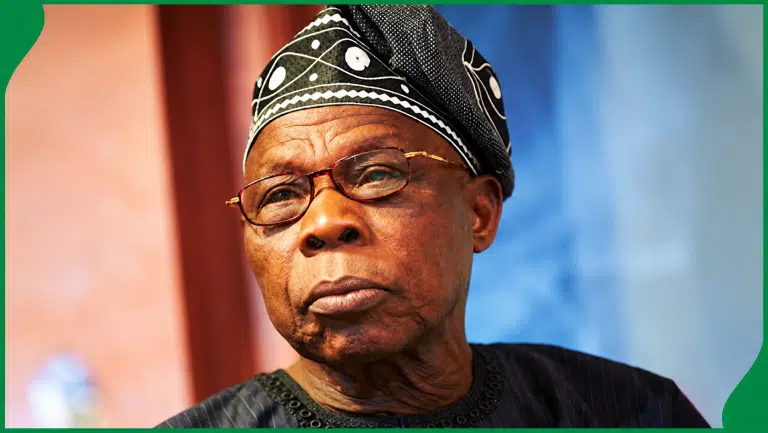
Former President Olusegun Obasanjo has said Nigeria played a crucial role in the struggle that eventually brought apartheid to an end in South Africa in 1994. Obasanjo made the remarks during an interview on C-Suite Cafe, hosted by Ikem Okuhu, while reflecting on Nigeria’s historical involvement in the anti-apartheid campaign and liberation struggles across Southern
Former President Olusegun Obasanjo has said Nigeria played a crucial role in the struggle that eventually brought apartheid to an end in South Africa in 1994.
Obasanjo made the remarks during an interview on C-Suite Cafe, hosted by Ikem Okuhu, while reflecting on Nigeria’s historical involvement in the anti-apartheid campaign and liberation struggles across Southern Africa.
South Africa held its first democratic, non-racial elections in 1994, marking the formal end of decades of institutionalised apartheid and the beginning of democratic rule under Nelson Mandela.
 blob:https://www.image2url.com/6b1201f1-93ee-44f9-bbeb-45816585e575
According to Obasanjo, Nigeria’s support for the anti-apartheid movement was not motivated by the expectation of financial benefits, political influence or other rewards.
The former military Head of State said Nigeria’s actions were driven by the principle that people should not be treated as inferior because of their race or skin colour.
He explained that Nigeria supported liberation movements across Southern Africa because of a broader commitment to racial equality and the liberation of black people on the continent.
“We were not doing what we did in South Africa or in Southern Africa or decolonisation anywhere for our personal gain or for our country. We did it for our race,” Obasanjo said.
He added that he believed no black person anywhere should be regarded as an inferior human being because of their colour.
I Had My First Private Jet At 22 Years Old – Dangote
Obasanjo described Nigeria’s intervention in the anti-apartheid struggle as a form of “enlightened self-interest,” while stressing that the country did not provide its support with the expectation of receiving something in return.
He said Nigeria should be proud of its contribution to the struggle and maintained that South Africa might not have achieved the end of apartheid at the time it did without Nigeria’s sustained assistance.
“And for me, and I believe for Nigeria at that time and even now, we should be proud of what we did because without Nigeria, South Africa would not have got rid of apartheid when it got rid of it,” he said.
The former president also recalled Nigeria’s collaboration with African and international figures during the anti-apartheid campaign and broader decolonisation efforts.
Among the African leaders he mentioned were former Tanzanian President Julius Nyerere, former Zambian President Kenneth Kaunda and former Mozambican President Samora Machel.
He also cited former United States President Jimmy Carter, former British Prime Minister James Callaghan and former Swedish Prime Minister Olof Palme as personalities who were involved in the wider international struggle against apartheid and colonialism.
Beyond the historical discussion, Obasanjo used the interview to express concern about xenophobic attacks targeting African migrants in South Africa.
He criticised the violence directed at foreigners and their businesses, arguing that alleged immigration violations or criminal conduct should be addressed through established legal processes.
The former president acknowledged that some foreigners could be living in South Africa illegally or might become involved in criminal activities.
However, he maintained that such cases should be handled by the appropriate authorities rather than through mob action or violence.
Obasanjo condemned the practice of encouraging local groups to attack migrants or destroy their businesses.
“I do not believe that you use illegality to treat illegality,” he said, rejecting the use of violence as a response to alleged violations of the law.
He also challenged the argument that African migrants generally deprive South Africans of employment opportunities.
According to Obasanjo, some migrants contribute positively to the South African economy and can also establish businesses that create jobs.
His comments placed South Africa’s contemporary treatment of African migrants against the backdrop of Nigeria’s historic support for the country during its struggle against apartheid.
Obasanjo’s position was that the principles of racial equality and human dignity that guided Nigeria’s anti-apartheid involvement should also inform how African countries respond to migration and disputes involving foreign nationals.
He therefore called for the rule of law to prevail in dealing with immigration violations and criminal allegations, while rejecting violence against migrants and their businesses.













Leave a Comment
Your email address will not be published. Required fields are marked with *