
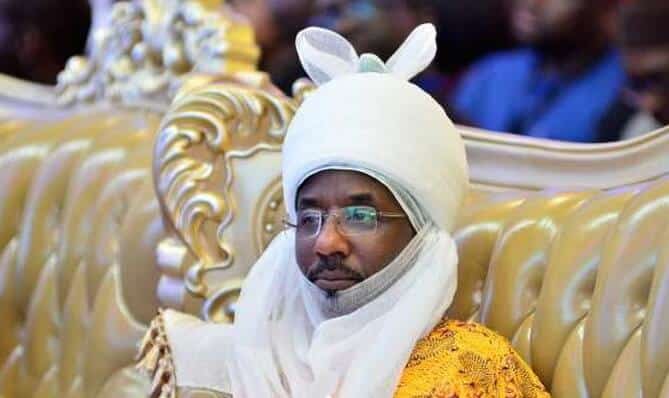
A strong message on leadership and knowledge has stirred fresh debate in Kano State after the 16th Emir of Kano, Muhammadu Sanusi II, declared that education outweighs traditional authority, boldly stating that a king without learning holds little value. Speaking during the culturally significant Hawan Nasarawa Durbar, part of the Eid al-Fitr celebrations, Sanusi
A strong message on leadership and knowledge has stirred fresh debate in Kano State after the 16th Emir of Kano, Muhammadu Sanusi II, declared that education outweighs traditional authority, boldly stating that a king without learning holds little value.
Speaking during the culturally significant Hawan Nasarawa Durbar, part of the Eid al-Fitr celebrations, Sanusi clarified that his recent return to academic pursuits was not influenced by legal battles, but by a desire to inspire others.
 blob:https://www.image2url.com/6b1201f1-93ee-44f9-bbeb-45816585e575
The former central banker turned monarch emphasized that education is a cornerstone of effective leadership, urging critics to reconsider their stance on his academic journey. According to him, knowledge not only strengthens leadership capacity but also elevates the dignity of traditional institutions.
Gunmen Storm ECWA Church, Kidnap Worshippers During Service
Sanusi’s remarks come at a time when discussions around the relevance of education within Nigeria’s traditional leadership structures are gaining momentum. His statement that “a king without education is worthless” has drawn both praise and criticism across political and cultural circles.
He argued that education should precede kingship, positioning it as a tool that enhances wisdom, decision-making, and respect in society. By returning to school, he said, he hopes to set a precedent for younger generations and fellow leaders.
The Emir also used the occasion to commend the Kano State government for the recognition accorded to the emirate, signaling a willingness to maintain cordial relations despite ongoing tensions within the traditional system.
However, the celebrations were overshadowed by an unusual development across Kano, as the city witnessed three separate Eid prayer gatherings—a stark departure from its long-standing tradition of unity.
Sanusi himself led prayers at the historic Kofar Mata Eid Ground, attended by top government officials including Governor Abba Yusuf. The sermon delivered during the prayer focused on unity and peaceful coexistence.
At the same time, the 15th Emir of Kano, Aminu Ado Bayero, held a parallel prayer session at the Nasarawa Palace, further highlighting the deepening divisions within the emirate system.
Adding to the complexity, political heavyweight Rabiu Kwankwaso also conducted a separate Eid prayer at his residence mosque, attended by loyalists and key allies.
The triple prayer gatherings underscore the lingering emirate crisis that began with Sanusi’s dethronement in 2020 and intensified following his reinstatement in 2024. The situation has since evolved into a delicate balance of parallel authorities and political alignments.
Observers note that political shifts, including Governor Yusuf’s controversial party movements, have further influenced the division, blurring the lines between traditional authority and political power.
Historically, Eid prayers in Kano symbolized unity, bringing together emirs, political leaders, and citizens in a single congregation. The recent fragmentation, however, signals a changing dynamic within one of Nigeria’s most influential traditional institutions.
As reactions continue to pour in, Sanusi’s statement on education has added a new dimension to the ongoing discourse—raising fundamental questions about what truly defines leadership in modern society.
His words may resonate beyond Kano, potentially shaping conversations on governance, tradition, and the evolving role of knowledge in leadership across Nigeria.


















Leave a Comment
Your email address will not be published. Required fields are marked with *