
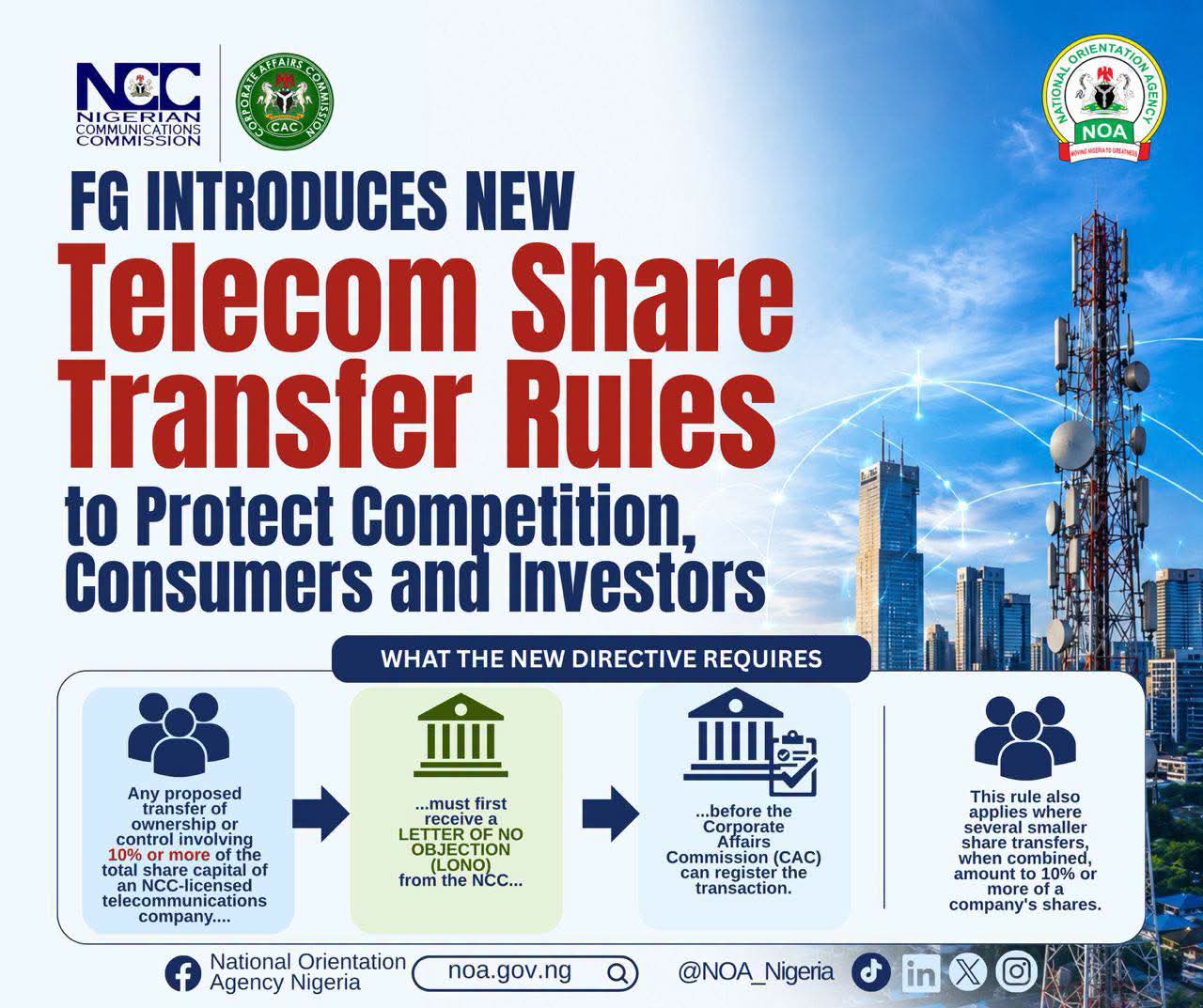
ABUJA — The Federal Government has introduced a new measure to strengthen oversight of ownership changes in Nigeria's telecommunications sector, requiring telecommunications companies to obtain regulatory approval before transferring significant portions of their shares. The new requirement, introduced jointly by the Nigerian Communications Commission (NCC) and the Corporate Affairs Commission (CAC), is aimed at
ABUJA — The Federal Government has introduced a new measure to strengthen oversight of ownership changes in Nigeria’s telecommunications sector, requiring telecommunications companies to obtain regulatory approval before transferring significant portions of their shares.
The new requirement, introduced jointly by the Nigerian Communications Commission (NCC) and the Corporate Affairs Commission (CAC), is aimed at promoting transparency, protecting competition, and ensuring long-term stability in one of Nigeria’s most critical sectors.
 blob:https://www.image2url.com/6b1201f1-93ee-44f9-bbeb-45816585e575
ALGON Osun Donates More Operational Vehicles To Security Agencies, Reaffirms Commitment To Safety
Under the new directive, any proposed transfer of ownership or control involving 10 per cent or more of the total share capital of an NCC-licensed telecommunications company must first receive a Letter of No Objection from the NCC before the CAC can register the transaction. The rule also applies where several smaller share transfers, when combined, amount to 10 per cent or more of a company’s shares.
Before this directive, changes in the shareholding structure of telecommunications companies could be registered by the CAC without an explicit requirement for prior sector-specific approval from the NCC in every case. Although the Nigerian Communications Act, Competition Practices Regulations and Licensing Regulations already empowered the NCC to oversee transactions affecting its licensees, the process was not expressly linked to the CAC’s registration procedure.
The new framework closes that gap by making the NCC’s approval a mandatory condition before the CAC can recognise and register significant ownership changes in telecommunications companies, creating a coordinated regulatory process between both agencies and ensuring that major ownership changes are scrutinised before they take effect.
**Why the Policy Matters**
The telecommunications industry plays a vital role in Nigeria’s economy, supporting mobile communication, internet access, digital banking, online education, e-commerce, healthcare services and many other activities millions of Nigerians rely on daily.
The Government says significant changes in the ownership of telecommunications companies can influence competition, service delivery, investment decisions and the overall stability of the industry. By reviewing such transactions before completion, regulators intend to ensure that ownership changes do not create unfair market dominance or undermine healthy competition.
The policy is also expected to improve transparency by ensuring major ownership changes are properly disclosed and reviewed, while giving investors greater confidence that the sector operates under clear and predictable regulatory rules.
In addition, the measure is designed to discourage direct or indirect anti-competitive practices that could reduce consumer choice or negatively affect the quality and affordability of telecommunications services.
The new requirement is backed by the Nigerian Communications Act 2003, the Competition Practices Regulations 2007 and the Licensing Regulations 2019, which empower the NCC to oversee transactions involving licensed telecommunications operators.
Officials say the new arrangement will strengthen regulatory certainty, encourage fair market practices, and support the orderly and sustainable development of Nigeria’s communications sector — ensuring that the industry remains competitive, transparent and stable, while protecting consumers and supporting continued investment and innovation in digital services.
Newsworld Media Network — bringing you happenings around the world, 24/7






















Leave a Comment
Your email address will not be published. Required fields are marked with *