
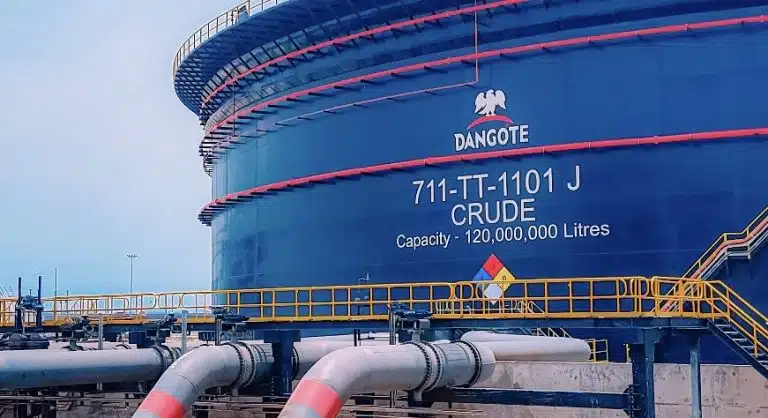
The cost of Premium Motor Spirit (PMS), commonly known as petrol or fuel, has reportedly risen by more than ₦100 per litre at some facilities following a recent decision at Dangote Refinery. Naija News reports that this is because petroleum marketers may require about $1.84 billion every month to purchase petrol, diesel and aviation fuel
The cost of Premium Motor Spirit (PMS), commonly known as petrol or fuel, has reportedly risen by more than ₦100 per litre at some facilities following a recent decision at Dangote Refinery.
Naija News reports that this is because petroleum marketers may require about $1.84 billion every month to purchase petrol, diesel and aviation fuel from the Dangote Petroleum Refinery following the company’s decision to begin pricing its refined products in United States dollars.
Energy analysts and downstream operators have warned that the new arrangement could increase demand for foreign exchange, test liquidity in Nigeria’s currency market and expose consumers to more frequent fluctuations in fuel prices.
 blob:https://www.image2url.com/6b1201f1-93ee-44f9-bbeb-45816585e575
The development has already coincided with sharp increases in the prices of petroleum products at depots, with the cost of Premium Motor Spirit, popularly called petrol, rising by more than ₦100 per litre at some facilities.
Industry stakeholders said the dollar-based sales policy would place additional pressure on marketers, whose revenues are earned in naira but who must now source foreign currency to buy products from the country’s largest refinery.
Although the dollars sourced by marketers would be paid to a domestic refinery rather than overseas suppliers, reducing the risk of significant foreign exchange leakage, experts said the fragmented nature of the downstream market could still put considerable pressure on available FX liquidity.
Marketers Face $60.7 Million Daily Demand
Calculations based on current national consumption and supply figures showed that marketers may need an estimated $60.7m daily to buy petrol, diesel and aviation fuel from the refinery.
Petrol accounts for the largest portion of the projected demand.
At Dangote refinery’s new gantry price of $0.779 per litre, marketers would require about $36.9m daily to purchase PMS. This translates to approximately $1.1bn every month.
For Automotive Gas Oil, commonly known as diesel, the refinery announced a price of $1.087 per litre. Based on existing supply volumes, marketers would need about $20.4m daily or approximately $633.5m monthly.
Aviation Turbine Kerosene was priced at $0.942 per litre. With the average daily supply estimated at 3.6 million litres, aviation fuel purchases could require an additional $3.4m daily or about $105.1m monthly.
The combined monthly requirement for the three products is estimated at $1.84bn.
Analysts said the arrangement would test how quickly the foreign exchange market and financial institutions could respond to substantial, short-notice dollar demands from numerous downstream operators.
Petrol Depot Price Rises By ₦113
Following the refinery’s announcement, the depot price of petrol reportedly climbed from about ₦1,137 to as high as ₦1,250 per litre at some facilities, representing an increase of ₦113.
Sahara, AIPEC and African Terminal were also reported to have adjusted their petrol loading prices from ₦1,090 to between ₦1,120 per litre.
Diesel prices also increased, with ex-depot rates rising to as high as ₦1,650 per litre at some facilities. This represented an increase of up to ₦150 per litre.
The price adjustments came only days after the Federal Government called for a reduction in the cost of petrol.
They also followed an increase in international crude oil prices to about $85 per barrel, representing a rise of roughly $10 within the first two days of the week.
With depot prices already increasing, marketers warned that the additional costs could eventually be transferred to motorists, transporters, manufacturers and other consumers.
Dangote Cancels Naira Invoices
Dangote Petroleum Refinery had informed marketers that all payments for products lifted from its gantry would be made in dollars from July 13.
Following the directive, previously issued transactions invoiced in naira were cancelled, while further payments under those invoices were discontinued.
The refinery announced new dollar prices for products sold through its gantry, with PMS fixed at $0.779 per litre, diesel at $1.087 per litre and aviation fuel at $0.942 per litre.
Coastal petrol was priced at $1,044.62 per metric tonne.
The refinery, however, clarified that the change would not apply to Liquefied Petroleum Gas transactions, which would continue under their existing payment arrangement.
Customers were advised to comply with the revised guidelines in their subsequent dealings with the refinery.
Policy Shifts FX Risk To Marketers
The development effectively transfers a substantial portion of the foreign exchange burden from the refinery to downstream operators.
Marketers, who sell products and generate revenue in naira, will now have to obtain dollars before purchasing petrol, diesel or aviation fuel from the refinery.
The decision represents a major departure from the naira-based sales framework introduced after the Federal Government began the naira-for-crude initiative in October 2024.
The policy was designed to reduce pressure on Nigeria’s foreign exchange market, support local refining and improve the country’s energy security by allowing domestic refineries to purchase crude oil in naira and sell refined products in the local currency.
However, this is not the first time Dangote refinery has reverted to dollar pricing.
The refinery took a similar decision in April last year after complaining about inadequate crude oil supply under the naira-for-crude arrangement.
The decision was later reversed following discussions with the Federal Government.
Industry sources said the latest change could be linked to persistent difficulties in sourcing sufficient crude oil locally, forcing the refinery to increase its reliance on imported feedstock purchased in dollars.
Consumers May Bear FX Cost – Economist
The founder of Energy Business Analytics, Dr Kaase Gbako, said the decision suggested that the naira-for-crude initiative was facing increasing pressure or that a larger proportion of the refinery’s feedstock was being imported.
According to The Guardian, Gbako stressed that the refinery had transferred foreign exchange risk from crude suppliers to downstream marketers and, ultimately, consumers.
Gbako said the requirement to pay in dollars would increase demand for foreign currency, potentially weakening the naira and raising domestic fuel prices.
He added that marketers were likely to include the cost of obtaining dollars and possible delays in accessing FX in their pricing calculations.
Such additional costs, he warned, could create further upward pressure on pump prices.
A professor emeritus of petroleum economics and Executive Director of the Emmanuel Egbogah Foundation, Prof. Wumi Iledare, said the decision reflected the realities of a deregulated petroleum industry in which crude oil, the major refining feedstock, is traded internationally.
Iledare said the policy provided greater commercial clarity and aligned domestic petroleum prices with global market fundamentals.
He, however, warned that it could create new operational and macroeconomic challenges.
According to him, marketers would now require more sophisticated foreign exchange procurement strategies in addition to their traditional product-sourcing arrangements.
He said companies with stronger banking relationships, better liquidity and more effective treasury management systems would have an advantage over smaller operators.
Iledare predicted that marketers might shorten their inventory cycles to reduce exposure to exchange-rate depreciation.
This, he said, could result in more frequent product purchases and faster adjustments to retail prices, thereby increasing volatility at filling stations.
The economist explained that pump prices would increasingly be influenced by three major factors: international crude oil prices, refining and logistics costs, and changes in the naira-dollar exchange rate.
He maintained that frequent price changes should not necessarily be regarded as evidence of policy failure.
According to him, volatility is an expected feature of a competitive and deregulated market in which prices respond to economic conditions rather than government controls.
To reduce the impact of sudden price movements, Iledare advised marketers to strengthen inventory management, diversify their supply sources, improve logistics and maintain adequate working capital.
He also urged them to adopt foreign exchange risk-management instruments where such facilities were available.
Iledare argued that the government should focus on ensuring macroeconomic stability, improving FX liquidity, maintaining exchange-rate stability and increasing crude oil supply to domestic refineries instead of attempting to fix fuel prices.
A former President of the Nigerian Economic Society, Prof. Adeola Adenikinju, said the refinery’s decision would fundamentally alter procurement practices in the downstream petroleum sector.
Adenikinju explained that marketers would now be required to obtain dollars through the banking system before purchasing products from a refinery located within Nigeria.
He said the arrangement effectively made domestic procurement resemble fuel importation.
Given the relatively inelastic demand for petrol, the economist warned that the additional foreign exchange requirement could place further pressure on the naira if it was not properly managed.
He said a weaker naira would have implications beyond petroleum products, as it could increase the cost of imported goods and worsen inflation across the economy.
According to Adenikinju, domestic fuel prices would also become more sensitive to exchange-rate movements, allowing naira depreciation to translate more quickly into higher pump prices.
Free Trade Zone Status Backs Dollar Deals
The Country Manager for Tradegrid, Jide Pratt, said Dangote refinery’s status as a Free Trade Zone enterprise provided a legal basis for it to conduct transactions in foreign currency.
Pratt, however, questioned why the refinery returned to dollar sales after previously operating under a naira-based framework.
He said inadequate crude oil supply under the naira-for-crude initiative appeared to be the most likely explanation.
Pratt warned that the new arrangement would significantly alter the way marketers financed their purchases.
Many downstream operators previously relied on bank guarantees for domestic transactions, but he said they might now need standby letters of credit and other trade-finance instruments.
This could make transactions more complicated and expensive, particularly for smaller marketers.
Pratt also identified currency mismatch as a major concern, explaining that marketers would buy products in dollars but sell them to consumers in naira.
Such an arrangement, he said, would expose operators to exchange-rate risks and tighter cash-flow conditions.
He called for greater transparency in the implementation of the naira-for-crude programme.
Pratt argued that products refined from crude oil supplied under the naira arrangement should ideally be sold in naira, while products produced from imported crude could reasonably be priced in dollars.
“There needs to be a transparent framework linking crude sourcing with product pricing. Without that, uncertainty will persist,” he said.
Exchange-rate Stability Crucial – CPPE
The Managing Director of the Centre for the Promotion of Private Enterprise, Dr Muda Yusuf, also identified currency mismatch as the central challenge facing marketers.
Yusuf said businesses generally face significant financial risks when most of their operating costs are denominated in dollars while their revenues are generated in naira.
According to him, the eventual impact on fuel prices would largely depend on the stability of the exchange rate and movements in international crude oil prices.
He argued that the transition to dollar pricing might not necessarily lead to a substantial increase in pump prices if the naira remained relatively stable.
Yusuf noted that converting the refinery’s published dollar prices at the prevailing exchange rate produced naira values broadly comparable with existing market prices.
He added that the refinery’s decision was commercially understandable because a substantial portion of its crude oil was imported and paid for in dollars.
The company, he said, would naturally require corresponding dollar inflows from the sale of refined products.
Marketers Fear Downstream Dollarisation
Petroleum marketers, however, expressed concerns that the policy could gradually lead to the dollarisation of Nigeria’s downstream petroleum market.
The National President of the Petroleum Products Retail Outlets Owners Association of Nigeria, Dr Billy Gillis-Harry, questioned whether marketers would now be expected to obtain dollars from the Central Bank of Nigeria (CBN) to purchase products produced and sold within the country.
He warned that allowing a dominant industry operator to alter its pricing structure without broader consultation could create uncertainty throughout the downstream sector.
The National President of the Independent Petroleum Marketers Association of Nigeria (IPMAN), Shettima Maigandi, also said independent marketers would encounter considerable difficulties converting their naira revenue into dollars before purchasing products.
Maigandi said it was too early to determine the full impact of the decision on retail prices.
He, however, maintained that marketers would prefer to continue buying petroleum products in naira because their sales to consumers were conducted in the local currency.
Stakeholders said that although the change reflected the commercial realities of a deregulated petroleum market linked to international crude oil trade, it had raised fresh questions about the effectiveness of the naira-for-crude policy.
They added that the decision would test the resilience of Nigeria’s foreign exchange market and could undermine efforts to deepen local value addition unless crude supply, pricing and currency arrangements were made more transparent.






















Leave a Comment
Your email address will not be published. Required fields are marked with *