
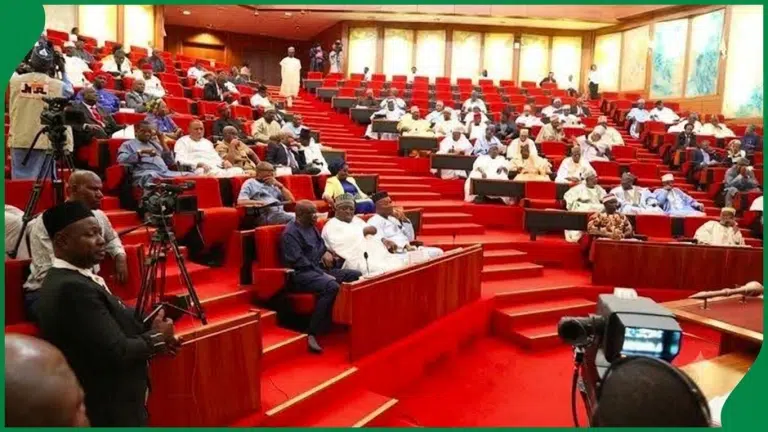
The Independent National Electoral Commission (INEC) has released a list containing 1,303 candidates who will contest the 109 senatorial seats across Nigeria and the Federal Capital Territory (FCT) senatorial seat in the 2027 general elections. The list features candidates sponsored by 21 political parties seeking representation in Nigeria’s upper legislative chamber. The publication provides an
The Independent National Electoral Commission (INEC) has released a list containing 1,303 candidates who will contest the 109 senatorial seats across Nigeria and the Federal Capital Territory (FCT) senatorial seat in the 2027 general elections.
The list features candidates sponsored by 21 political parties seeking representation in Nigeria’s upper legislative chamber.
The publication provides an early picture of the political battle for the Senate as parties position themselves ahead of the 2027 general elections.
 blob:https://www.image2url.com/6b1201f1-93ee-44f9-bbeb-45816585e575
2027: Sultan Urges Nigerians to Scrutinise Politicians’ Promises Before Voting
According to the list, the All Progressives Congress (APC) has the highest number of candidates with 109, followed closely by the African Democratic Congress (ADC), which has 108 candidates.
The Nigeria Democratic Congress (NDC) has 94 candidates, while the Allied Peoples Movement (APM) is fielding 104 candidates.
The Peoples Democratic Party (PDP) has 101 candidates, while the Social Democratic Party (SDP) has 95. The Action Democratic Party (ADP) has 92 candidates, with the Action Peoples Party (APP) presenting 69.
The Labour Party (LP) has 68 candidates, while Accord has 67. The National Rescue Movement (NRM) is fielding 65 candidates, followed by the Young Progressive Party (YPP) with 60.
The Zenith Labour Party (ZLP) has 51 candidates, while the Action Alliance (AA) has 39. The All Progressives Grand Alliance (APGA) has 33 candidates and the National Democratic Party (NDP) has 32.
Other parties on the list include the Democratic Labour Alliance (DLA) with 27 candidates, the Peoples Redemption Party (PRP) with 27, the African Action Congress (AAC) with 25, the New Nigeria Peoples Party (NNPP) with 21, the Boot Party (BP) with seven and the Young Progressives (YP) with four.
I — INEC List Features Several High-Profile Politicians
The published list includes several prominent political figures with previous experience in national and state-level politics.
Among them are incumbent Senate President Godswill Akpabio and Deputy Senate President Barau Jibrin.
Former Edo State Governor Adams Oshiomhole is also listed as a candidate, alongside former Zamfara State Governor Abdulaziz Yari, who previously served as director-general of President Bola Tinubu’s campaign council.
Former Senate President Ahmed Lawan is another notable name on the list.
Also featured is former Bayelsa State Governor Seriake Dickson, who is identified as a national leader of the Nigeria Democratic Congress.
Former Sokoto State Governor Aliyu Wamakko and former Abia State Governor Orji Kalu are also among the prominent politicians seeking Senate seats.
The list further includes Natasha Akpoti-Uduaghan, who represents Kogi Central in the Senate, as well as Stella Oduah, a former aviation minister and former senator representing Anambra North.
Imo State Governor Hope Uzodimma, a former senator representing Imo West, also appears on the list. He is listed under the APC and has been identified as secretary of President Tinubu’s campaign organisation.
Former Delta State Governor Ifeanyi Okowa and serving Gombe State Governor Inuwa Yahaya are among the other high-profile names contained in the list.
The release of the candidates is expected to intensify political discussions as parties and aspirants prepare for the 2027 elections.
The Senate remains a strategically important institution in Nigeria’s political system, with lawmakers playing a major role in legislation, oversight and national policy decisions.
The large number of candidates also demonstrates the level of competition expected across the various senatorial districts, with established politicians and other aspirants seeking to secure electoral support.
According to the electoral timetable cited in the report, the presidential and National Assembly elections are scheduled for January 16, 2027, while the governorship and State Houses of Assembly elections are scheduled for February 6, 2027.
With the publication of the candidate list, attention is expected to shift toward campaigns, voter engagement and the broader political contest ahead of the 2027 general elections.














Leave a Comment
Your email address will not be published. Required fields are marked with *