
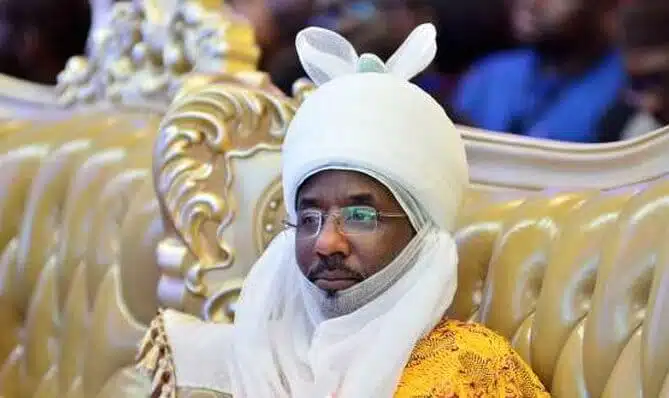
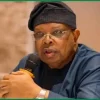
The Emir of Kano, Muhammadu Sanusi II, has attributed the growth of Boko Haram, banditry and other forms of insecurity in Nigeria partly to divisive language used in political and media discourse. Sanusi made the remarks in Abuja on Wednesday while speaking at the launch of a book documenting the tenure of retired Lieutenant General
The Emir of Kano, Muhammadu Sanusi II, has attributed the growth of Boko Haram, banditry and other forms of insecurity in Nigeria partly to divisive language used in political and media discourse.
Sanusi made the remarks in Abuja on Wednesday while speaking at the launch of a book documenting the tenure of retired Lieutenant General Tukur Yusuf Buratai as Chief of Army Staff.
The former Governor of the Central Bank of Nigeria said Nigeria’s security challenges should not be examined solely through the lens of violent attacks, terrorism and criminal activities.
 blob:https://www.image2url.com/6b1201f1-93ee-44f9-bbeb-45816585e575
According to him, the roots of insecurity also extend to years of ethnic, religious and regional divisions that have been reinforced through political speeches and media reports.
2027: PDP Replaces Kano Governorship Candidate With Abacha’s Son
Sanusi argued that repeatedly describing Nigerians according to their ethnic, religious or regional identities has contributed to an environment in which violent movements can emerge and gain support.
He said the country’s security crisis did not begin with Boko Haram, terrorism or banditry, but was preceded by what he described as violence embedded in public language and political discourse.
Sanusi Urges Nigerians to Put National Identity First
The Emir called on Nigerians to place their shared national identity above ethnic and religious classifications, warning that continued division could create conditions for further insecurity.
He urged citizens to see themselves first as Nigerians and to focus public attention on development, education, healthcare, economic growth and other issues that directly affect citizens.
Sanusi also challenged politicians to concentrate on delivering public services rather than making religion a central part of political engagement.
According to him, religious matters should remain primarily within the responsibility of religious leaders, while elected officials should focus on governance and development.
He also cautioned religious leaders against becoming overly involved in partisan politics, arguing that the increasing overlap between religious and political roles could make it harder for citizens to hold political leaders accountable.
The Emir said Nigerians risk creating interests that benefit from insecurity when political, ethnic and religious identities become deeply intertwined.
He further stressed the importance of allowing national institutions to develop long-term strategies that extend beyond the electoral cycle.
Sanusi noted that institutions such as the military, police and Central Bank cannot effectively plan their responsibilities around four-year election periods.
He argued that while elected officials may naturally focus on electoral cycles, institutions responsible for national development and security need to think in terms of decades.
“The army cannot think in four-year cycles. The police cannot think in four-year cycles. The central bank cannot think in four-year cycles,” he said, stressing the need for 20-year, 30-year and even 50-year planning.
The Emir’s comments came against the backdrop of Nigeria’s continuing security challenges and the broader debate over the factors contributing to terrorism, banditry and communal violence.
His remarks placed emphasis on the role of public discourse and political communication in shaping social relationships, alongside the direct security responses required to address violent crime.
Sanusi maintained that Nigerians must be able to scrutinise political leaders without allowing ethnic or religious loyalties to determine public debate.
He also called for stronger institutions capable of pursuing long-term national objectives regardless of changes in political leadership.
The message, delivered at an event focused on the tenure of a former army chief, therefore extended beyond military operations to the social and political environment in which Nigeria’s security challenges develop.














Leave a Comment
Your email address will not be published. Required fields are marked with *