
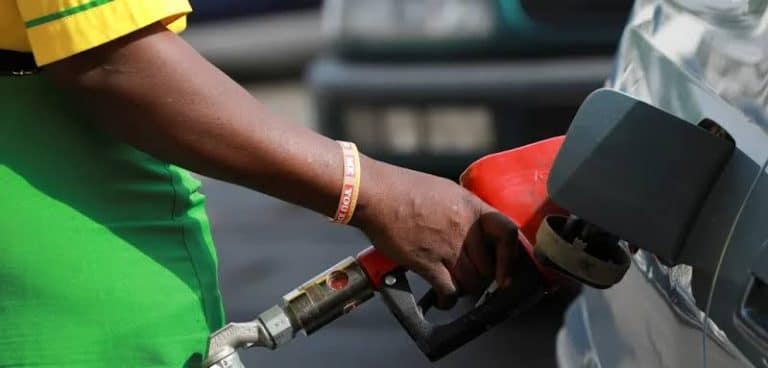
Petrol prices across parts of Nigeria’s Federal Capital Territory have recorded a noticeable decline, offering slight relief to consumers. In several areas of Abuja, filling stations have adjusted pump prices downward to ₦1,295 per litre, reflecting a ₦35 reduction from the previous ₦1,330 rate. The price drop, observed on Friday, has been implemented by
Petrol prices across parts of Nigeria’s Federal Capital Territory have recorded a noticeable decline, offering slight relief to consumers. In several areas of Abuja, filling stations have adjusted pump prices downward to ₦1,295 per litre, reflecting a ₦35 reduction from the previous ₦1,330 rate.
The price drop, observed on Friday, has been implemented by outlets such as AA Rano, Ranoil, and Mobil. Industry watchers say the adjustment is part of a broader strategy among marketers to stay competitive and attract more customers in a sensitive pricing environment.
 blob:https://www.image2url.com/6b1201f1-93ee-44f9-bbeb-45816585e575
The revised pricing aligns closely with rates offered by other major downstream operators, including Nigerian National Petroleum Company Limited, MRS Oil Nigeria, Ardova Plc, and NIPCO. These firms have been selling petrol within the ₦1,290 to ₦1,295 range in recent weeks, effectively setting a benchmark across the market.
Speaking on the development, Abubakar Maigandi, President of the Independent Petroleum Marketers Association of Nigeria (IPMAN), attributed the reduction to competitive market forces. He explained that marketers are compelled to adjust prices to maintain customer flow and remain relevant.
You Will Win Without Tinubu’s Support – Wike’s Ex-Aide Urges Fubara To Seek Re-Election
“It is required to boost patronage,” Maigandi stated, emphasizing that price flexibility is now a key survival strategy for fuel retailers.
Despite ongoing volatility in global oil markets, domestic petrol prices have remained relatively stable since early April. Analysts note that while international crude oil benchmarks continue to fluctuate, local pricing has shown resilience, largely influenced by internal distribution dynamics and policy adjustments.
On Friday, global market data indicated that West Texas Intermediate (WTI) crude traded at approximately $94 per barrel, while Brent crude hovered around $105 per barrel. The uncertainty surrounding the Strait of Hormuz—a critical global oil transit route—continues to cast a shadow over supply expectations and pricing trends.
Meanwhile, reports from Ilorin suggest even more favorable prices for consumers. Filling stations in the city are dispensing petrol at rates between ₦1,250 and ₦1,270 per litre, further highlighting regional variations in pricing.
The recent price drop, though modest, is seen as a welcome development for motorists and businesses grappling with high energy costs. However, stakeholders caution that the sustainability of this trend remains uncertain, given the influence of global oil prices and geopolitical tensions.
Energy experts argue that while competition among marketers can drive short-term relief, long-term stability will depend on broader economic policies, supply chain efficiency, and global market conditions.
For now, consumers in Abuja and beyond are taking advantage of the reduced rates, even as they remain watchful for future changes in the ever-sensitive fuel market.






















Leave a Comment
Your email address will not be published. Required fields are marked with *