

Rivers State Electorates Sue President Tinubu Over Emergency Rule Legal Battle Over Suspension of Elected Officials Sparks Constitutional Debate A lawsuit has been filed against President Bola Tinubu over his declaration of a state of emergency in Rivers State, a move that led to the suspension of Governor Siminalayi Fubara, the Deputy Governor, and the
Rivers State Electorates Sue President Tinubu Over Emergency Rule
Legal Battle Over Suspension of Elected Officials Sparks Constitutional Debate
A lawsuit has been filed against President Bola Tinubu over his declaration of a state of emergency in Rivers State, a move that led to the suspension of Governor Siminalayi Fubara, the Deputy Governor, and the entire State House of Assembly members. The suit, filed on behalf of Rivers State electorates by lawyer Daniel Wariboko, challenges the constitutionality of the President’s actions and calls for the restoration of democracy in the state.
The legal action, registered as FHC/CS/550/2025, was submitted at the Federal High Court in Abuja on March 20, 2025. The lawsuit not only targets President Tinubu but also lists Senate President, Speaker of the House of Representatives, the National Assembly, and the Attorney General of the Federation as co-defendants.
BOI Announces N10 Billion GLOW Fund To Support Female Entrepreneurs
 blob:https://www.image2url.com/6b1201f1-93ee-44f9-bbeb-45816585e575
This case has sparked a constitutional debate, questioning the limits of executive power and whether a dispute between a governor and the state legislature justifies the declaration of a state of emergency.
Key Constitutional Issues Raised in the Lawsuit
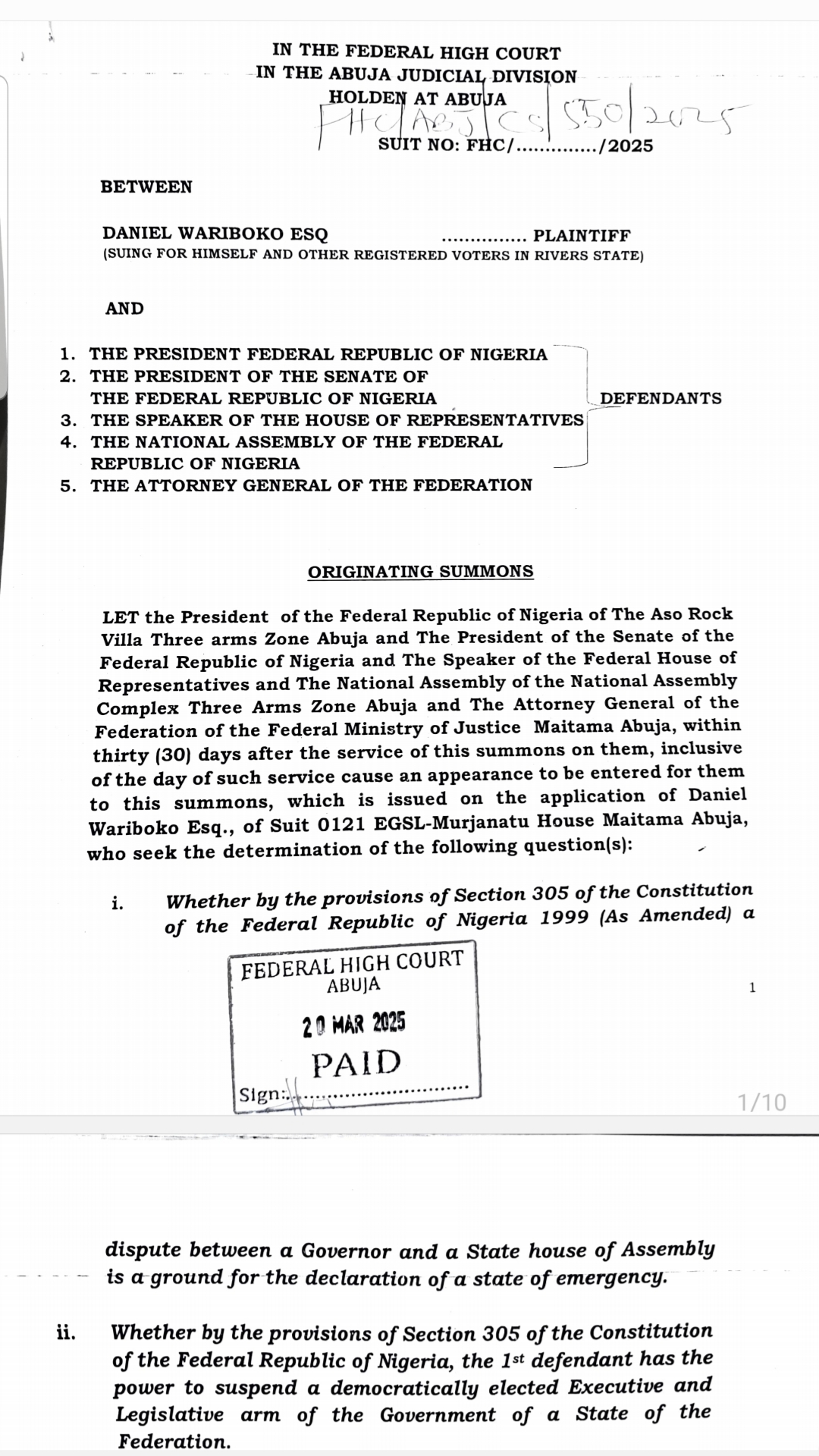 The suit is centered around the interpretation of Section 305 of the Nigerian Constitution (1999, as amended), which outlines the conditions under which a state of emergency can be declared. The plaintiff, Wariboko, argues that the crisis in Rivers State does not meet these conditions and that the suspension of elected officials violates democratic principles.
Among the key legal questions presented to the court for determination are:
- Does Section 305 of the Constitution allow a dispute between a governor and the state legislature as a basis for declaring a state of emergency?
- Can the President unilaterally suspend a democratically elected Executive and Legislative arm of a state government?
- Does the President have the power to appoint a sole administrator to govern a state when elected officials are in place?
- Is the emergency declaration made on March 18, 2025, unconstitutional, null, and void?
- Does the suspension of Rivers State’s executive and legislative bodies violate citizens’ rights to participate in governance, as provided in Article 13 of the African Charter on Human and Peoples’ Rights?
- Do the Senate President, Speaker of the House of Representatives, and National Assembly have the power to ratify the suspension of elected officials in Rivers State?
Plaintiff’s Demands and Legal Remedies Sought
The lawsuit seeks multiple declarations from the court, emphasizing the unconstitutionality of Tinubu’s actions and demanding an immediate reinstatement of elected officials. The reliefs sought by the plaintiff include:
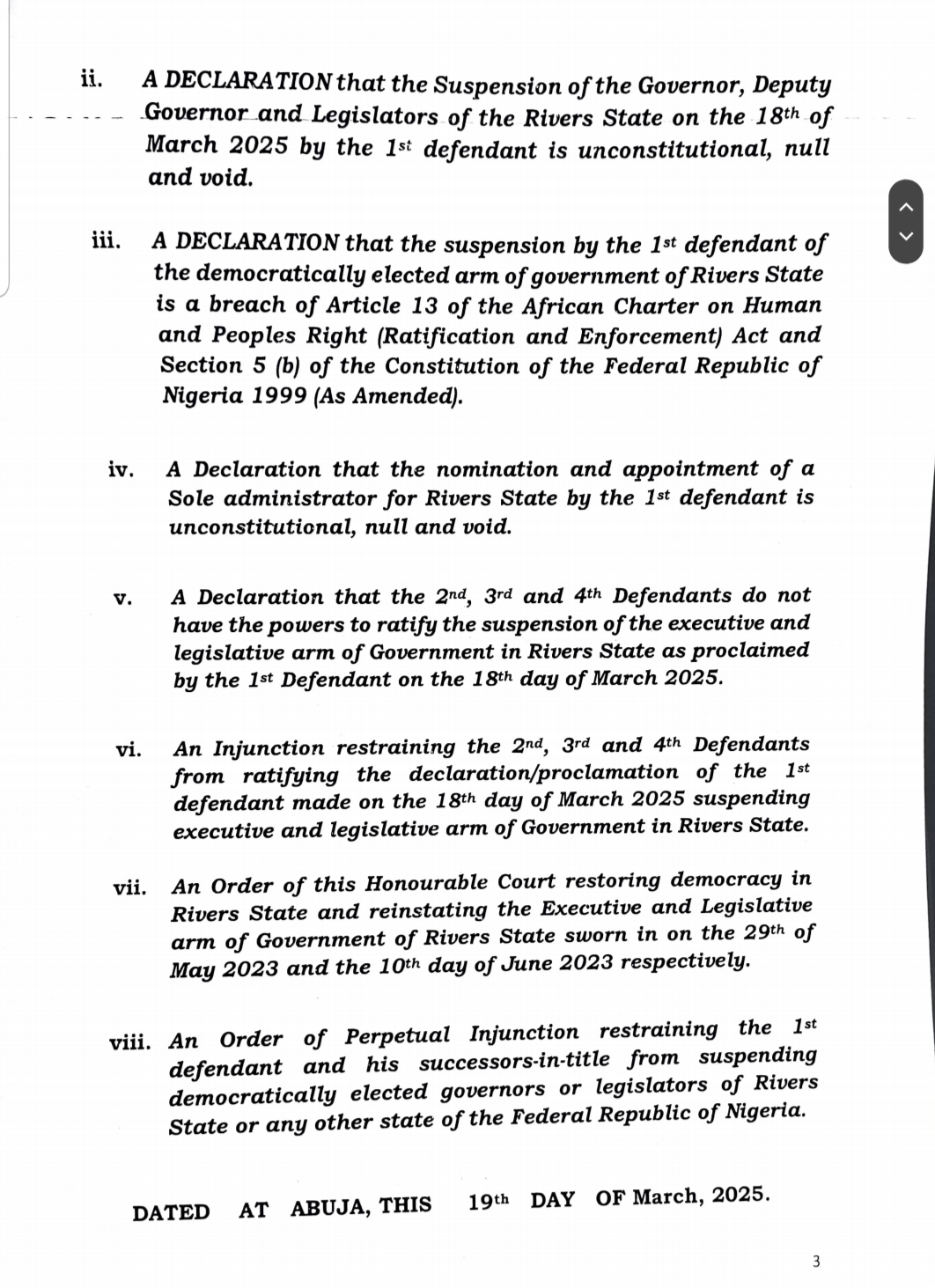
- A declaration that Tinubu’s emergency declaration and the suspension of the Rivers State government are unconstitutional, null, and void.
- A declaration that suspending a democratically elected governor, deputy governor, and legislators violates the Nigerian Constitution and the African Charter on Human and Peoples’ Rights.
- A declaration that the appointment of a sole administrator is illegal and lacks constitutional backing.
- A declaration that the National Assembly does not have the power to ratify the suspension of Rivers State’s executive and legislative arms.
- An injunction restraining the National Assembly from approving or endorsing the President’s emergency declaration and suspension of elected officials.
- An order restoring democracy in Rivers State, reinstating Governor Fubara, his deputy, and all suspended lawmakers.
- A perpetual injunction preventing the President and his successors from suspending elected governors or lawmakers in Rivers State or any other Nigerian state.
Legal and Political Implications
This lawsuit has significant legal and political ramifications, as it challenges the President’s authority to suspend elected officials and impose emergency rule. If the court rules in favor of the plaintiff, it could set a major legal precedent limiting executive overreach in Nigeria.
Legal experts believe that this case could force a re-evaluation of the powers of the Nigerian presidency, particularly regarding federal intervention in state governance. Additionally, it raises concerns over the protection of democratic institutions and citizens’ rights to elect their leaders without interference from the federal government.
Politically, the case intensifies the power struggle between President Tinubu and Governor Fubara, who has been in conflict with Minister of the Federal Capital Territory, Nyesom Wike—a key political figure in Rivers State. The legal battle also fuels speculation about the political motivations behind the emergency declaration and the federal government’s broader agenda in Rivers State.
A Defining Legal Battle for Nigerian Democracy
The lawsuit against President Tinubu is shaping up to be one of the most significant constitutional cases in recent Nigerian history. It will test the limits of presidential authority, the autonomy of state governments, and the fundamental democratic rights of Nigerian citizens.
If the court rules in favor of the Rivers State electorates, it will reinforce the constitutional protection of elected officials and prevent future executive overreach. However, if the ruling favors the federal government, it may expand presidential powers, allowing future administrations to suspend state governments under similar circumstances.
As the legal proceedings unfold, all eyes will be on the Federal High Court, which now holds the responsibility of determining whether the Rivers State emergency rule stands or falls under Nigeria’s constitutional framework.














Leave a Comment
Your email address will not be published. Required fields are marked with *