
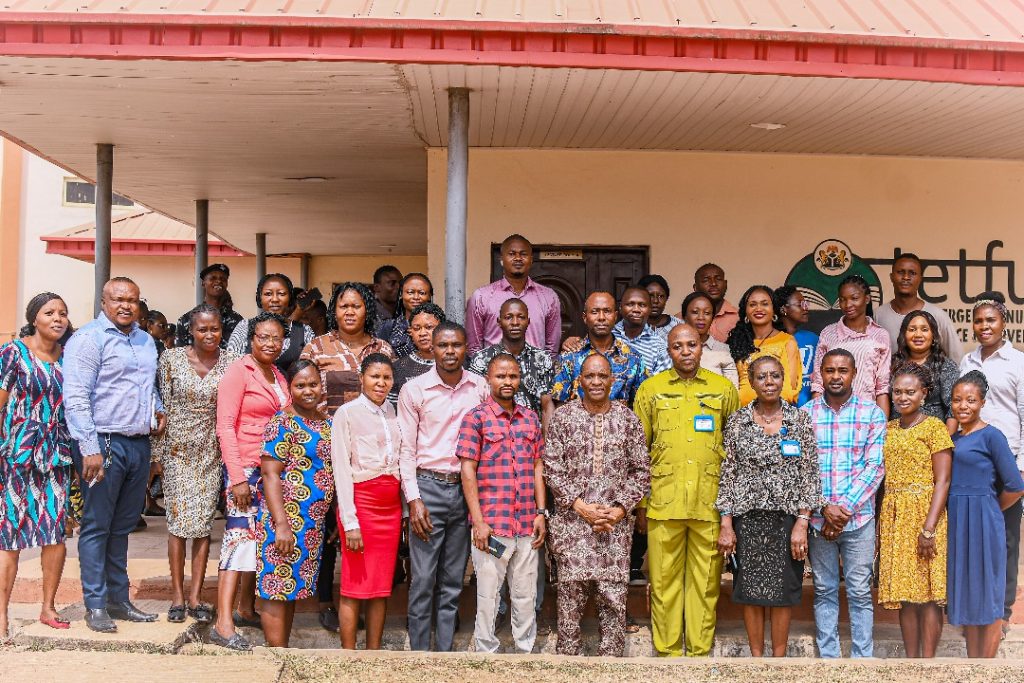
The University of Medical Sciences, Ondo, organized its maiden edition of the Registry’s In-house seminar on Wednesday, 15th January, 2025, at the Tetfund Building, Laje campus of the institution. The training, with the theme “Self-Leadership and Organisational Productivity in University Setting”, was facilitated by Associate Professor Tunde Oseni, an Associate Professor of Political Science and
The University of Medical Sciences, Ondo, organized its maiden edition of the Registry’s In-house seminar on Wednesday, 15th January, 2025, at the Tetfund Building, Laje campus of the institution.
The training, with the theme “Self-Leadership and Organisational Productivity in University Setting”, was facilitated by Associate Professor Tunde Oseni, an Associate Professor of Political Science and International Relations) and CEO, Upward BAO Consulting, UK. The facilitator established that self-leadership and productivity are inextricably linked and that self-development is crucial to self-leadership. In his words, “The organisation is the extension of the self. Self-development is the basis of self-leadership.”.
“The organization is the extension of the ego,” he said. The foundation of self-leadership is self-development. He listed a number of self-leadership skills, including communication, critical thinking, and emotional intelligence, but he also mentioned that self-leadership will be improved by tactics like responsiveness, responsibility, creativity, and adaptability, all of which eventually boost organizational productivity. “Self-leaders are collaborators and not competitors; and self-leaders are contributors and not free riders,” he said in closing.
 blob:https://www.image2url.com/6b1201f1-93ee-44f9-bbeb-45816585e575
In his welcome speech, Mr. Ezekiel Adeniran, the university’s registrar, gave an explanation of the purpose of the In-house Seminar Series, which will be a regular feature at UNIMED. “The Registry’s leadership is dedicated to establishing the Registry as an internationally recognized leading Registry that embodies excellence and innovation, cultivates a friendly and conducive academic atmosphere, and empowers students and staff to achieve success,” he said. Training and retraining employees is one method to accomplish this, he said.
Earlier in the training, Vice-Chancellor Professor Adesegun Fatusi praised the idea and gave an explanation of why his administration supports ongoing training for university employees. “This initiative is great. It is the best option, particularly for Registry employees who serve as the university’s backbone. Universities cannot afford to employ intellectually weak registry staff! Therefore, the Registry’s employees’ skills need to be continuously improved through current information.
The Vice-Chancellor emphasized the regrettable capacity situation in Nigerian university registries, where candidates were unable to define their own vision statements, using the experience from the university’s recent interview for the Registrar post.
Thus, the goals of UNIMED’s Registry In-House Seminar are to enhance knowledge and abilities, fortify the organization and its processes, expand infrastructure and resources, and promote an innovative and learning culture.





















Leave a Comment
Your email address will not be published. Required fields are marked with *