
EFCC Cracks Down on Former Refinery Bosses Over Missing $2.9 Billion Rehabilitation Funds In a sweeping anti-corruption operation, the Economic and Financial Crimes Commission (EFCC) has arrested former managing directors and senior executives of Nigeria’s three state-owned refineries—Port Harcourt Refining Company, Warri Refining and Petrochemical Company, and Kaduna Refining and Petrochemical Company. The arrests are
EFCC Cracks Down on Former Refinery Bosses Over Missing $2.9 Billion Rehabilitation Funds
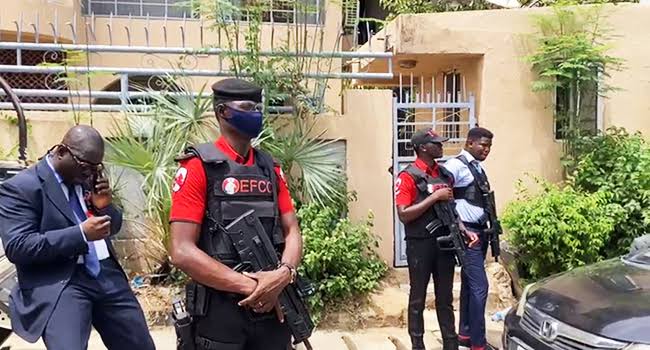
In a sweeping anti-corruption operation, the Economic and Financial Crimes Commission (EFCC) has arrested former managing directors and senior executives of Nigeria’s three state-owned refineries—Port Harcourt Refining Company, Warri Refining and Petrochemical Company, and Kaduna Refining and Petrochemical Company. The arrests are tied to a high-profile investigation into the alleged mismanagement of a staggering $2.96 billion allocated for the rehabilitation of these long-dormant facilities.
According to sources familiar with the probe, the EFCC is scrutinizing the financial operations surrounding the disbursement of $1,559,239,084.36 for the Port Harcourt refinery, $740,669,600 for the Kaduna refinery, and $656,963,938 for the Warri refinery. The investigation, which has already led to the arrest of key figures including Ibrahim Onoja, former MD of the Port Harcourt Refining Company, and Efifia Chu, ex-MD of the Warri Refining and Petrochemical Company, is said to be expanding rapidly.
 blob:https://www.image2url.com/6b1201f1-93ee-44f9-bbeb-45816585e575
Atiku Demands Accountability From Tinubu Over Alleged Abuse Involving Seyi Tinubu
Billions Allocated, But Refineries Still Idle
Despite the release of nearly $3 billion intended to revive the country’s ailing refining sector, Nigeria’s refineries remain largely inoperative, forcing the nation to rely heavily on imported fuel. This discrepancy has triggered public outrage and prompted the EFCC to dig deeper into how the funds were managed—or mismanaged.
A senior official at the EFCC, who spoke anonymously to Saturday Punch, confirmed the arrests and ongoing manhunt for other officials linked to the rehabilitation funds. “We are investigating the money that was released for the rehabilitation of all three refineries. All principal officers within that time frame are being invited. Some have been arrested already, and we are still on the lookout for others,” the source said.
The official added, “Nigerians are interested in seeing our refineries work. We are asking: where is the money, and what has happened to the refineries?”
The scale of the inquiry suggests that this could become one of the most significant anti-corruption investigations in recent Nigerian history, potentially surpassing even the infamous “Emefielegate” scandal involving the Central Bank.
₦80 Billion Found in Accounts of Former MD, EFCC Deepens Probe
New revelations have added a layer of urgency to the investigation. Sources within the Nigerian National Petroleum Company Limited (NNPCL) disclosed that a former managing director—whose name is currently withheld due to the sensitive nature of the case—had over ₦80 billion discovered in various bank accounts linked to him.
The staggering figure has raised eyebrows across Nigeria’s oil sector and among anti-graft crusaders. “Large amounts have been discovered in his accounts. About ₦80 billion has so far been found. The way things are going, it may be bigger than Emefielegate,” said one source.
Officials describe the situation as “incredibly sad,” noting that such vast sums were earmarked for national infrastructure renewal but have instead been diverted, leaving the refineries moribund and the public grappling with soaring fuel prices.
A separate insider added, “All three former MDs are under EFCC investigation. The volume of the alleged fraud is shocking.”
A Test Case for Tinubu’s Anti-Corruption Agenda
This development presents a major test for President Bola Ahmed Tinubu’s administration, which has promised transparency and accountability in governance. The success or failure of this probe may very well determine the credibility of his anti-corruption stance, particularly as Nigerians grow more frustrated over the lack of progress in reviving key state assets.
Public trust is at an all-time low due to years of broken promises regarding refinery repairs and billions spent with little to no visible results. The EFCC’s proactive measures, while commendable, will need to be backed by swift prosecutions and transparent judicial proceedings if the public is to regain faith in the system.
The case also raises critical questions about oversight mechanisms within the NNPCL and Nigeria’s broader oil sector. How such massive disbursements escaped scrutiny for years remains an open—and troubling—question.
As the EFCC continues its investigation, Nigerians are closely watching the fallout, with hopes that this time, accountability will not be sacrificed on the altar of political convenience or elite impunity.
















Leave a Comment
Your email address will not be published. Required fields are marked with *