
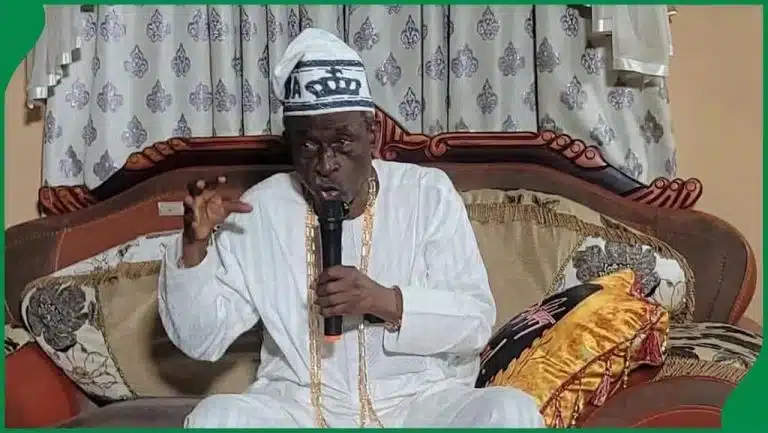
The Apena of Egbaland and Oluwo of Iporo-Ake, Alani Bankole, has stirred debate with his claim that Nigeria has abundant opportunities and that many people experiencing hunger are unwilling to work hard. The 85-year-old traditional chief made the remarks on Wednesday during a media interaction, where he discussed youth development, parenting, wealth creation and the
The Apena of Egbaland and Oluwo of Iporo-Ake, Alani Bankole, has stirred debate with his claim that Nigeria has abundant opportunities and that many people experiencing hunger are unwilling to work hard.
The 85-year-old traditional chief made the remarks on Wednesday during a media interaction, where he discussed youth development, parenting, wealth creation and the challenges facing Nigeria.
Bankole argued that the country has sufficient opportunities for people who are prepared to work and develop productive skills.
 blob:https://www.image2url.com/6b1201f1-93ee-44f9-bbeb-45816585e575
He expressed concern over what he described as a declining culture of hard work among younger Nigerians, while also acknowledging that parents and the wider system have contributed to the situation.
How Boko Haram, Other Terrorist Activities Started In Nigeria – Emir Sanusi
The Egba chief said many parents have failed to properly prepare their children for economic independence, arguing that excessive pampering could discourage young people from developing practical skills and a strong work ethic.
According to him, children should be introduced early to productive activities and taught the value of labour.
He recalled that people of his generation often combined formal education with practical work, saying such experiences helped young people understand the importance of creating value and becoming economically self-reliant.
Alani Bankole Calls for Early Work Training
Bankole said parents should focus on teaching children how to create wealth rather than simply providing money for them.
He argued that young people need to learn skills that can enable them to generate income independently instead of relying exclusively on salaried employment.
“Teach people how to make money, don’t give them money. Salary jobs are only meant to eat. When you learn how to create wealth, you become rich,” he said.
The traditional ruler’s comments also extended to Nigeria’s economic and political system, which he said has contributed to some of the country’s difficulties.
Bankole blamed aspects of the system inherited from the British colonial administration, arguing that Nigerians have continued to operate structures that, in his view, encourage oppression and suppression.
He maintained that individual responsibility and systemic problems should both be considered when discussing poverty and unemployment in Nigeria.
“The system has encouraged a lot of nonsense. The system is responsible for our everyday calamity,” he said.
He also questioned the expectation that political leaders should personally solve every individual’s economic challenges, asking rhetorically whether President Bola Tinubu could go farming on behalf of citizens.
His remarks come amid continuing public discussions about unemployment, living costs, poverty and the ability of Nigerians to earn sustainable incomes.
While Bankole placed considerable emphasis on personal effort and wealth creation, he also acknowledged that the system itself plays a role in the country’s economic difficulties.
The traditional chief further reflected on changes in Nigerian politics when he was asked whether he had advice for politicians preparing for the 2027 general elections.
Bankole declined to offer specific advice, saying the political environment of today differs significantly from the one he experienced during his active years in politics.
He recalled taking political campaigns to rural and border communities rather than concentrating only on urban areas.
According to him, contemporary politicians operate in ways he does not recognise from his own political experience, making him reluctant to offer guidance on current political practices.
“No, I can’t advise them because I’m not used to this type of politics,” he said.
Bankole’s comments therefore touched on several issues, from parental responsibility and youth development to wealth creation, institutional shortcomings and changing political practices.
His central argument was that Nigerians should place greater emphasis on productive work and economic self-reliance while also addressing systemic problems that affect opportunities and livelihoods.

















Leave a Comment
Your email address will not be published. Required fields are marked with *