
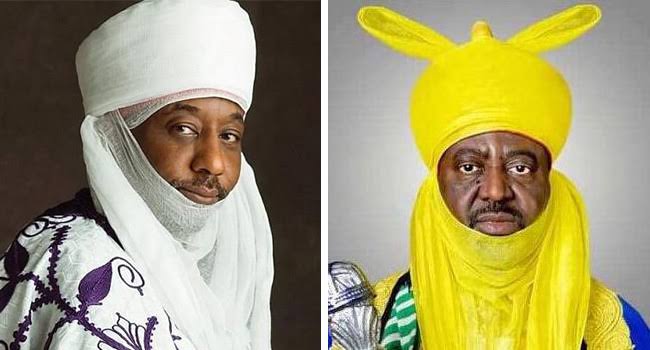
Appeal Court Suspends Actions Against Muhammadu Sanusi II’s Reinstatement as Emir of Kano Legal Battle Intensifies Over Kano Emirate Leadership The Appeal Court in Abuja has officially set aside previous actions against the reinstatement of Muhammadu Sanusi II as the 16th Emir of Kano, directing all concerned parties to exercise caution while awaiting the Supreme
Appeal Court Suspends Actions Against Muhammadu Sanusi II’s Reinstatement as Emir of Kano
Legal Battle Intensifies Over Kano Emirate Leadership
The Appeal Court in Abuja has officially set aside previous actions against the reinstatement of Muhammadu Sanusi II as the 16th Emir of Kano, directing all concerned parties to exercise caution while awaiting the Supreme Court’s ruling on the case. This latest development further deepens the legal dispute over the leadership of the Kano Emirate, following the Kano State Government’s decision to reinstate Sanusi II after repealing the law that had previously deposed him.
Kano Emirate Tussle: Political Rivalry And The Risk Of State Emergency
Appeal Court’s Ruling and Supreme Court Transmission
In a unanimous ruling, a three-member panel of justices, led by Justice Biobele Abraham Georgewill, accepted the withdrawal of an application filed by the Kano State Government regarding the dispute. The court acknowledged that the case record had been transmitted to the Supreme Court, meaning that further actions on the ruling delivered on March 14, 2025, would be halted.
 blob:https://www.image2url.com/6b1201f1-93ee-44f9-bbeb-45816585e575
During the resumed hearing on the enforcement of its previous orders, Ibrahim Wangida, counsel for the Kano State Government, informed the court that a notice of appeal had been filed against the stay of execution issued by the Court of Appeal on March 14, 2025. He further explained that all necessary legal processes, including the transmission of the case record, had been completed, meaning that the Supreme Court would now take over the matter.
Implications of the Supreme Court Appeal
According to legal precedent, the transmission of the case record to the Supreme Court automatically acts as a stay of any further action on the Court of Appeal’s earlier ruling. This means that neither party can take any drastic steps regarding the Emirate leadership until the Supreme Court delivers its verdict.
The Court of Appeal had initially ruled on March 14, 2025, ordering a stay of execution on a lower court’s judgment that had validated the reinstatement of Sanusi II as Emir. Justice Abang, who issued that ruling, also directed all parties to maintain the status quo ante bellum—effectively returning to the position before the trial court’s decision on June 13, 2024, in Suit No. FHC/KN/CS/182/2024.
 Kano Government’s Objection to the Court’s Ruling
Unhappy with the March 14 ruling, the Kano State Government’s legal team, led by Wangida, argued that the decision constituted a misinterpretation of constitutional provisions. The government insisted that an appeal had already been filed at the Supreme Court, making further proceedings at the lower courts unnecessary.
However, counsel for the appellant, Abdul Fagge (SAN), did not object to the Supreme Court appeal, acknowledging that the respondent had acted within constitutional provisions. This means that the battle for the Kano Emirate throne has now reached the highest court in Nigeria, where a final ruling is expected to determine the rightful Emir of Kano.
Background: The Emirate Law Repeal and Leadership Dispute
The Kano State Government reinstated Muhammadu Sanusi II as Emir of Kano following the repeal of the Kano State Emirate Council Law 2020. This law, which had been enacted under former Governor Abdullahi Ganduje, led to the dethronement of Sanusi II in March 2020 and the creation of five separate emirates, weakening the traditional power of the Kano Emirate.
However, the new Kano State Emirate Council (Repeal) Law 2024, enacted under Governor Abba Kabir Yusuf, dissolved the five emirates and restored the traditional Kano Emirate system, leading to the official reinstatement of Sanusi II. This move, however, sparked legal and political tensions, as Aminu Ado Bayero, who was appointed the 15th Emir of Kano, refused to accept his removal.
Bayero’s Resistance and Parallel Emirate Claims
Following his removal, Aminu Ado Bayero returned to Kano and took residence at the Nassarawa mini palace under heavy security protection. Supported by certain political and traditional factions, Bayero has continued to challenge the Kano State Government’s decision in court, arguing that his removal was unlawful.
This situation has created a dual power struggle, with both Sanusi II and Bayero laying claim to the Emirate throne while legal battles continue in court. The Supreme Court’s final ruling will be crucial in settling the disputed leadership of the Kano Emirate.
Legal and Political Implications
The ongoing legal battle over the Kano Emirate throne highlights deep divisions within the political and traditional structures of Kano State. Key issues at stake include:
- Judicial Precedent: The Supreme Court’s ruling will set a legal precedent on whether a state government can repeal laws to reinstate a traditional ruler previously removed by another administration.
- Political Influence: The Emirate dispute has political undertones, with Governor Yusuf’s administration reversing a decision made by his predecessor.
- Traditional Leadership Stability: The case raises concerns about the stability of traditional institutions in Nigeria, as repeated legal battles could weaken public confidence in the role of Emirs, Obas, and other monarchs.
Conclusion: Awaiting Supreme Court’s Verdict
With the Court of Appeal halting further actions and the case now at the Supreme Court, all parties involved—including Sanusi II, Bayero, and the Kano State Government—must exercise restraint until the final judgment is delivered.
As the battle for the Kano Emirate throne intensifies, Nigerians await a landmark Supreme Court ruling that will determine the fate of the 16th Emir of Kano and potentially reshape the legal framework governing traditional institutions in the country.



















Leave a Comment
Your email address will not be published. Required fields are marked with *